Objects
A crampon that puts the adjustment in the wire, not in the two parts it joins
A wire-adjustment patent enters a century-old effort to keep crampons on boots, where fit and upkeep matter as much as invention.

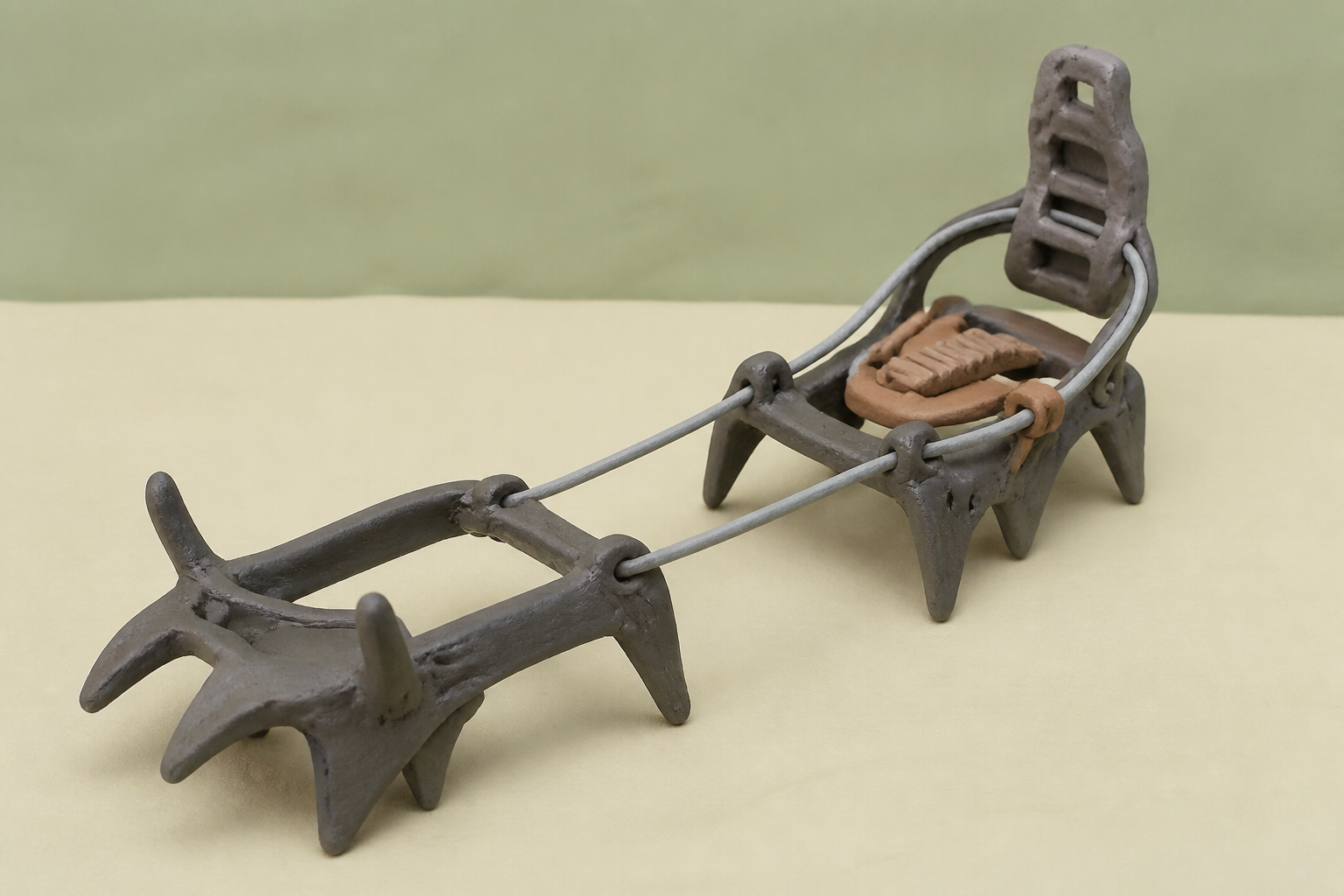
What changes in this design
A reader might assume that the length control would sit in the two main sections, because those are the pieces the wire joins.
Instead, the length control is in the wire. The wire passes through holes in the fixing and guide sections, is redirected by right-side and left-side obstacles plus a friction element, and has ends that can be removed independently from right and left attachments.
This is worth knowing because the wire is not only a link between the two sections. It is also where its effective length is changed, while other parts redirect it.
Fourteen Metres Up
At eight metres up low-angle ice at Frankenstein Cliff in New Hampshire, a climber's crampon came off. He refastened it and climbed on. At 14 metres, it came off again. His backup ice-axe anchor pulled after about a metre, and an ice screw stopped a fall of roughly 12 metres. The climber had already been having trouble with the fit.
The detail I can't shake is the repeat: the equipment had warned him once, then did it again when the stakes were higher. A long-running North American climbing accident archive has published annual reports since 1948 and now holds more than 5,000 accounts. For me, its lesson is not that every crampon is unreliable. It is that the line between a boot and its spikes has always been a place where small failures can become large ones.
A Wire with Two Ends
Into that old problem comes US20260256248A1, titled Crampon And Method Of Use. It describes fixing and guide sections linked by a wire passing through holes, with a device to adjust the wire's effective length. Right and left obstacles, plus a friction element, change the wire's direction. Its two ends can be independently removed from attachments on the right and left.
That is a specific piece of attachment engineering, not a proven answer to the accident at Frankenstein Cliff. The filing tells us how the wire is arranged; it does not establish, from the information available here, that a poorly fitted or poorly maintained crampon will stay on. That distinction matters to me because the word 'adjustment' can sound like a promise of safety when it may only describe a mechanism. The question I keep returning to is simpler: can a climber tell, before leaving the ground, that this system is truly secure?
Italian Connection Hardware
Crampons have been redesigned before, sometimes against resistance. One account dates Oscar Eckenstein's first modern 10-point crampon to 1908; a manufacturer's history puts the drawings with blacksmith Henri Grivel in 1909. That history says the roughly 1.5-kilogram prototype was dismissed as "cheating," prompting a public test on the Brenva glacier on June 30, 1912. Laurent Grivel added two forward points in 1932.
The work is still unsettled. A 2025 Italian publication describes an angled connecting rod intended to suit both straight-soled ski-touring boots and hiking boots with angled toes. Another, also published in 2025, covers adjustable multi-size crampon and spike connection hardware. I take those filings, alongside this American publication, as evidence of a live design problem rather than a forgotten bit of mountaineering gear.
The Heel Cup Screws
Hardware can fail in much plainer ways. In June 2024, Black Diamond recalled about 350 Neve Strap crampons and accessory kits sold in the United States, plus about 28 in Canada. The screws joining a plastic heel cup to an aluminum heel unit could loosen, allowing the cup to detach. There had been three incident reports and no reported injuries at the time of the recall.
Earlier notices show the category has a longer memory: two separate crampon recalls appeared in February 2015, including one involving a Nuptse series. That makes my skepticism specific, not abstract. A more ingenious wire path might solve a real fitting or adjustment problem, but it cannot substitute for secure fasteners, compatible boots, inspection, and care. The accident report makes the same point from the climber's side: fit and maintenance can decide the outcome before a new geometry gets any chance to help.
What would have to be true
For this design to deserve confidence, its adjustment would need to hold through real boot shapes, wear, movement, cold, and the snow or ice that accompanies a climb. The independently removable ends would need to remain secure when they should, and be removable when they must. What I would want before calling it safer is evidence that ordinary climbers can fit it correctly, notice a bad fit, and keep it working over time.
I don't think a patent needs to solve every old problem to be useful. This one may make adjustment easier for some boot-and-crampon pairings, but the filing alone cannot show that. The more honest reading is smaller and more interesting: the mechanism joins a long effort to improve a stubborn connection, while the oldest lesson remains close at hand. Steel, wire, and clever routing still have to meet a boot that fits and a person who checks it.
Sources
Reporting for this piece drew on the published filing and the references below.
- US20260256248A1 - Crampon And Method Of Use
- Crampons
- The Engineer, the Crampon, and the Beast
- EP4501163 - Connection System for Crampons
- EP4543252 - Multi-Purpose and Multi-Size Crampon and Spike
- Black Diamond Equipment Recalls Neve Strap Crampons and Accessory Kits Due to Fall Hazard
- About the Accidents Archive
- Climbing Equipment Recalls and Warnings
The record, briefly. US20260256248A1, “Crampon And Method Of Use” A crampon has fixing and guide sections joined by a wire through holes, an adjustment device for its effective length, right and left obstacles and a friction element that change its direction, and wire ends independently removably fixed to right and left attachments.
More angles on this
- CPC A43C: Fastenings or attachments of footwear; laces in generalThe official classification family this record was filed into, published in the USPTO Cooperative Patent Classification scheme.
- A Segment That Cools And A Segment That Carries FlavourAnother reading from the wider A24D classification family, cigars.
- Two sensors, one puff, and a controller that retunes when nothing arrivesAnother reading in the same Objects category on this site.
Read around this one:Public patent recordUSPTO published figure