Wearables
A Glove With a Portfolio
The examiner on this knitted-glove design patent cited an Amazon product page as prior art, which tells you who really runs this market.

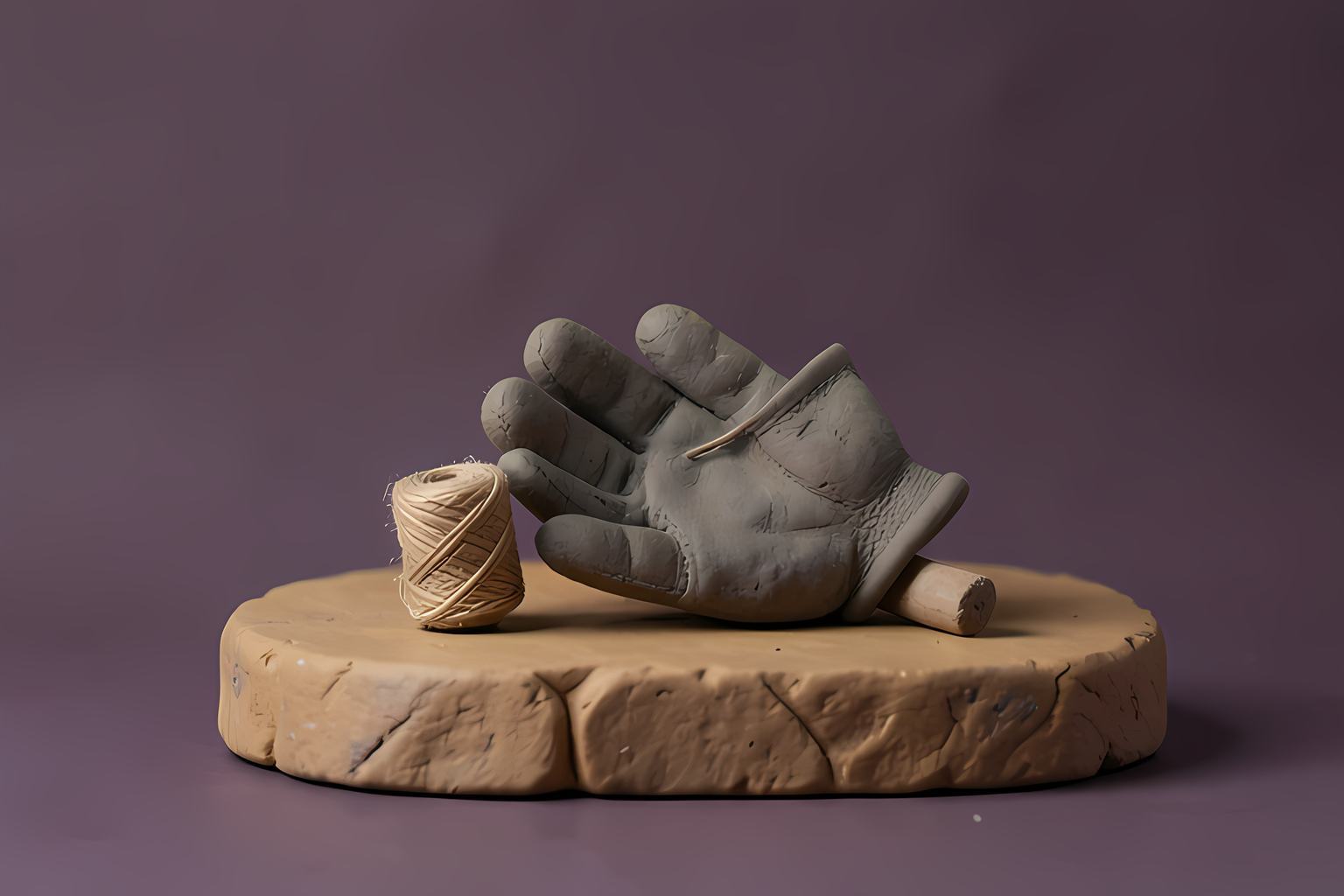
What changes in this design
When people hear "glove," they may expect details about material, protection, fit, or use. None of those details are established by this record, which asks the reader to look at appearance rather than assume how the item works.
Instead, this record focuses on the visible form: two similar five-fingered shapes with open oval top edges, wider middle areas, four long grouped digits, one shorter angled side digit, and a stippled surface with darker bands.
That matters because it keeps the reader from mistaking a visual record for an explanation of function. The image offers details of shape, finger spacing, and surface pattern while leaving materials, performance, and purpose unstated.
Thirty-three cents a pair
In August 2025, a glove manufacturer called HexArmor published results from its own lab. It had tested 144 gloves. One competitor's product, sold as ANSI A5, came back with a median score of A1 in the left hand and A4 in the right. Because the standard grades you on your worse hand, that glove rates A1. Around 30% of the sample had no cut protection in one hand at all, usually the left: no steel, no engineered fibre. The gloves came from a Vietnamese factory supplying one of North America's largest safety brands. Leaving the yarn out of one hand saved roughly $0.33 a pair, about $66,000 a year on one food company's volume.
Read that knowing HexArmor sells gloves, and that a rival's failures are useful to it. I still think the number matters, because of what it sits beside.
One claim, eight drawings, and a shopping page
On August 11, 2026, the patent office granted design patent D1,140,503 to Changzhou Ansir Safety Product Co., Ltd. of Changzhou, China, with Zhiya Zhu as sole inventor. The title is "Glove." There is one claim, the ornamental design for a glove as shown and described, and eight sheets of drawings: a knit glove with a ribbed cuff and darker patches on the thumb and three fingertips. It was filed in November 2023, took about 33 months, and runs to 2041.
Nothing in it says the glove stops a blade, and nothing could. A design patent covers appearance. What held me was the examiner's reference list. Seven patent documents going back to 1987, and exactly one other publication: an Amazon product page for a competitor's cut-resistant work gloves, retrieved in August 2025. The file dates that listing to November 2022 and then, in parentheses, to 2020, because retail pages have no stable publication date. A document helping bound a fifteen-year federal right is one its seller can edit, reprice or delete this afternoon.
A safety certificate hosted on a retailer's servers
The applicant's own safety paperwork arrives the same way. A European type-examination certificate issued in Lyon in June 2021 covers a grey stainless steel wire, glass fibre and HPPE cut-resistant glove, model 1707. The copy I read is a PDF on Amazon's media servers, attached to a listing. The label reproduced in it carries an EN 388 marking of 244XF and, beside it, ANSI/ISEA CUT LEVEL A9. Those are different scales. EN 388 tops out at F, roughly an ANSI A6. The bigger-sounding claim is not the one the notified body tested there. The certificate's validity ended on 4 June 2026, two months before the patent issued.
There is an order of operations here. A near-identically named company in the same district registered a US trademark in February 2023, then the design application followed that November. Amazon's Brand Registry wants a registered mark before you can enrol, and enrolment is what unlocks the reporting tools.
Fifty-two thousand designs and a rule change
This glove is one of roughly 52,000 design patents issued in 2025, the highest annual total on record and about 10% above the year before. Utility patents were flat at around 326,000. The growth comes from outside the country; on international design filings reaching the US office, China is the largest single origin, near a third. Filing runs $2,600 for a large entity and $520 for a micro entity.
For a $15 glove, what that buys is not really a lawsuit. Design patents carry an unusual damages rule: an infringer owes the owner total profit on the article of manufacture, and for a glove the article is the glove. But most enforcement happens on the marketplace. A takedown notice needs a patent number, a listing URL and seller details; supporting documents are helpful but not required. No judge.
Then the ground moved. In May 2024, six months after this application was filed, the full Federal Circuit threw out the rigid test that had governed design patent obviousness since the 1980s and put the flexible utility-patent standard in its place. Every design patent granted since, this one included, issued into a weaker position than its filing-era siblings expected.
The open question
So: a fifteen-year federal right polices how a glove looks, enforceable with a web form in an afternoon. Whether the glove stops a blade is policed by self-applied marks, a certificate that has lapsed, and two rating scales printed side by side that do not convert into each other. I don't think this applicant did anything unusual; that is the point. This is the ordinary shape of the thing.
The patent office switched on an image-based prior-art search tool for design examiners in October 2025, after this application was already in the queue. It will find lookalikes faster. Nothing I read checks the yarn. Who should?
Sources
Reporting for this piece drew on the published filing and the references below.
- US D1,140,503 S - "Glove" (USPTO full document)
- NoCry Cut Resistant Work Gloves (Amazon listing, ASIN B08L6RC7M1)
- EU-Type Examination Certificate 0075/2716/162/06/21/0957, CTC (Notified Body 0075)
- SCHWER - US Trademark Reg. No. 6972011 (USPTO TSDR)
- USPTO Hour: An overview and statistical update on design patents (July 2025)
- The Surprising Headline of 2025: USPTO Stability? (Patently-O)
- Full Federal Circuit Eliminates "Improperly Rigid" Tests for Design Patent Obviousness (Ballard Spahr)
- Design Patent Enforcement in Online Marketplaces (Sterne Kessler)
- Samsung Electronics Co. v. Apple Inc. (Cornell LII Supreme Court Bulletin)
- Exposing the truth: how faulty safety gloves put workers at risk (HexArmor)
- Understanding cut resistance in safety gloves (HexArmor)
The record, briefly. USD1140503S1, “Glove” The checked public record identifies a U.S. design patent titled 'Glove'. The reading treats the published title and figure as a visual starting point and does not infer a material, mechanism, or performance claim not established there.
More angles on this
- The Pants Have a Particular Part To PlayAnother reading from the same A41D classification family, outerwear; protective garments; accessories.
- The Jacket Is Not Just Passing ThroughAnother reading from the same A41D classification family, outerwear; protective garments; accessories.
- CPC A41D: Outerwear; protective garments; accessoriesThe official classification family this record was filed into, published in the USPTO Cooperative Patent Classification scheme.
- CPC A63B: Apparatus for physical training, gymnastics, swimming, climbing, or fencing; ball games; training equipmentThe official classification family this record was filed into, published in the USPTO Cooperative Patent Classification scheme.
- An Inflatable Costume Prepares for Lift-OffAnother reading from the neighbouring A63H classification family, toys, e.g. tops, dolls, hoops or building blocks.
Read around this one:Public patent recordUSPTO published figurePatent issue-date index