Machines
A reticle stage with a shield that travels with it, and what two positions make legible
ASML spent decades building a blade too careful to touch a reticle. Its newest patent bets that carefulness was optional.

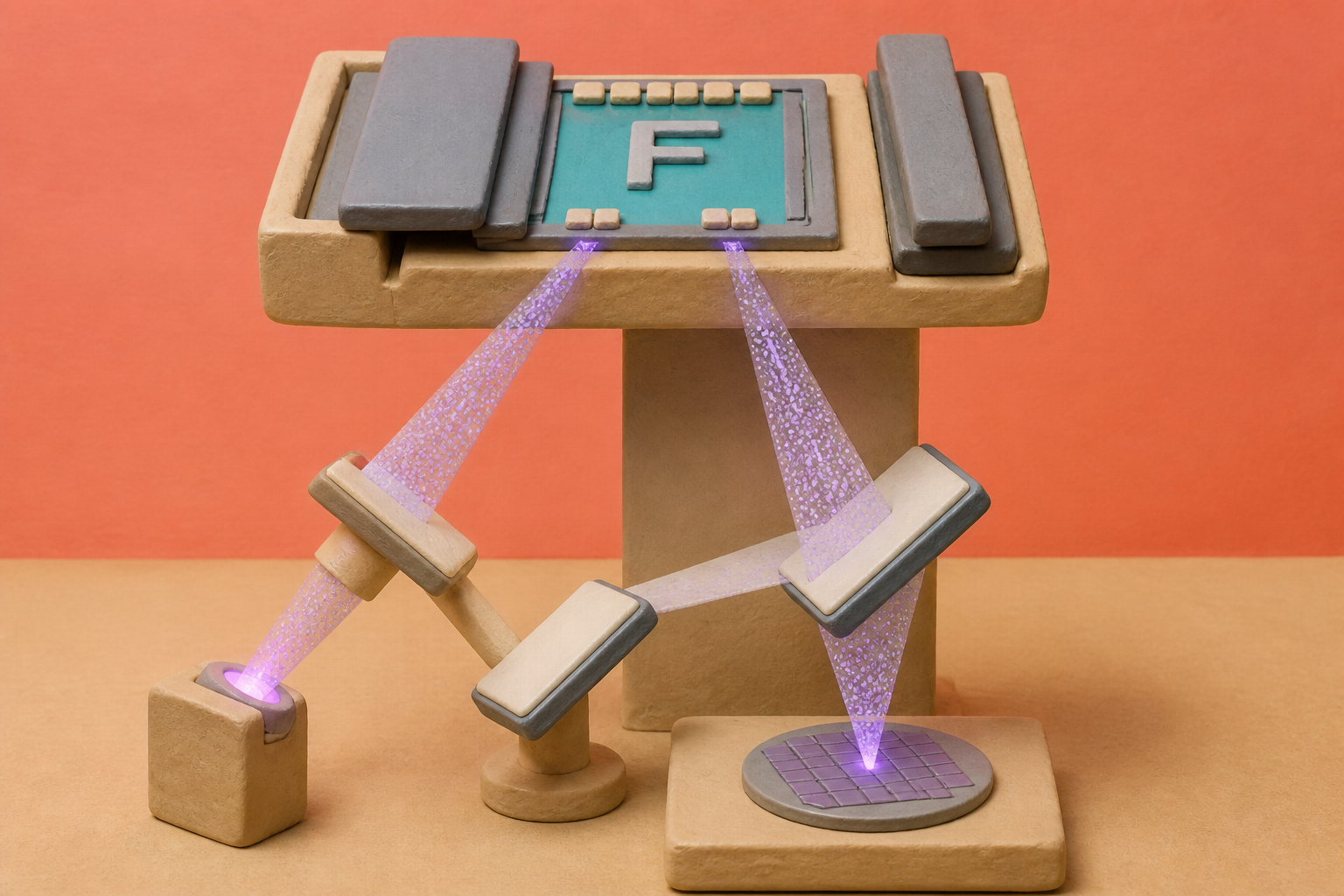
What changes in this design
You might expect the job of blocking light from part of a master plate to be handled somewhere else in the machine, by a separate mask or aperture mounted in the optical path, independent of whatever is holding the plate itself.
Here the shielding element is coupled to the support that holds the reflective plate, so it travels with the plate rather than sitting apart from it. It moves between two settings, one blocking a chosen portion of the patterned face and one leaving that portion open.
Where a blocking part lives changes what it can do. A shield fastened to the same carrier as the plate keeps a fixed relationship with the pattern as the carrier moves, rather than needing to track a moving target from a distance.
A Blade That Could Not Touch Anything
In 2005, ASML filed a patent for a reticle-masking blade that hovers instead of sliding. Its job was simple enough on paper: block a reticle's alignment marks, the guide markings that are never supposed to print, from reaching the wafer beneath it. What made the patent unusual was the reason ASML gave for the hovering. Ordinary bearings, the filing explained, need lubrication to move smoothly, and lubrication sheds particles, and a particle landing on the patterned side of a reticle inside an EUV chamber becomes a defect stamped onto every wafer exposed through it afterward. So the company built a blade that never touches anything at all: suspended by magnetic levitation, controlled in six degrees of freedom, floating over a moving reticle and timed to block exactly the right patch at exactly the right instant.
That system has a name in the industry, ReMa, short for Reticle Masking, and it has been doing this job in various forms for two decades. It is also the kind of engineering a company only builds when the alternative is worse. Contact meant contamination. Contamination meant ruined wafers. Six-axis levitation was the price of avoiding both.
Fifteen Claims Canceled, One Left Standing
ASML's newest reticle patent, published this month, describes that same ReMa hardware in its own background section as "large, complex, costly." Not somebody else's design - its own. The fix it proposes drops the levitation entirely. A shielding element mounts directly onto the support that holds the reticle, moving between two positions: one that covers part of the reticle's patterned side from the radiation beam, one that exposes it. No hovering, no six-axis control, no magnetic field holding a blade in place over a target that is itself in motion.
The filing's own history is worth pausing on. Fifteen of its original sixteen claims were canceled before publication. Only claim 16 survived, the one describing the simplified, support-mounted shield. I don't know what the other fifteen claimed or why they fell away; the filing doesn't say. But the shape of what's left is unambiguous: whatever ASML first asked for narrowed, under examination, down to the cheap version.
One Particle in Ten Thousand Wafers
The reason the old blade needed all that engineering has not gone away. Reticle contamination is still, by most industry accounts, one of EUV lithography's biggest operational headaches. ASML's own stated target is one contaminant particle per 10,000 wafers. One major memory maker has reported seeing one per day. Another chipmaker plans around one per 20,000. A pellicle tested by a Korean pellicle maker lost transmission from 92 percent to 90 percent after four hours under a 400-watt source, and ruptured at five. Mask cleaning on a roughly two-week cycle would force a reticle replacement about twice a year, against masks in older lithography lasting five times longer.
None of that is about alignment marks specifically. It is a separate reticle problem, contamination rather than pattern shielding, but it's the backdrop I kept returning to while reading the new filing. Researchers elsewhere are still trying to fix the old blade directly rather than replace it, testing ceramic in place of its steel to cut the cooling and thermal complexity that six-axis levitation carries with it. The old system isn't regarded as solved so much as expensive.
A Customer Patents Its Own Fix
ASML is not the only company rethinking reticle handling right now. TSMC, one of ASML's own customers, filed a patent in April 2023, granted in mid-2025, for a different approach entirely: gas openings built into the reticle's border that blow a pressurized wall of air, roughly half an atmosphere to one and a half, standing off the surface by five or six millimeters. No pellicle at all, and a reported yield improvement of about half a percent. Two companies tied together as supplier and customer, working the same underlying problem from opposite ends in the same few years - that is not something I would call a coincidence.
It reads instead like an industry that is not satisfied with how it currently protects a component that is both extraordinarily expensive and short-lived. ASML's second quarter this year posted 9.3 billion euros in net sales and 2.9 billion in net income, with full-year guidance raised - this is not a company simplifying its shield because it is short of money. A separate pressure, a proposed U.S. law that would restrict its exports to China, bears on ASML's business but has nothing to do with this particular piece of hardware. The reticle stage is getting cheaper because somebody decided it should be, not because anyone was forced into it.
Where this leaves things
What the new filing does not say, at least not in what is public so far, is how a support-mounted shield avoids reintroducing the particle risk that justified the levitating blade in the first place. It is possible the risk is smaller than it looks. A shield that only needs two fixed positions, rather than one tracking continuously over a moving reticle, may simply have less opportunity to shed anything into the chamber. That is my guess, not the filing's claim, and I would not treat it as settled without seeing more. What I can say is that this patent arrives at a moment when the case for caution around a reticle's surface is, if anything, stronger than it was in 2005, not weaker. Whether the cheaper shield holds up against that case, or turns into a lesson in why the complicated version existed, is not something a single filing can answer on its own.
Sources
Reporting for this piece drew on the published filing and the references below.
- US20260259509A1 - Reticle Stage patent filing
- Mask Contamination: The Big Operational Headache for EUV Lithography
- ASML reports Q2 2026 financial results
- ASML Just Got Hit by a New China Export Threat
- US7372548B2 - Levitated reticle-masking blade stage
- US12353143B2 - Reticle of protecting from particle attacks
- Improving Performance Of Blades In EUV Lithography Machines
The record, briefly. US20260259509A1, “Reticle Stage” A reticle stage for a lithographic apparatus comprising a support for a reflective reticle and at least one shielding element coupled to the support, selectively configurable between a first position shielding a portion of the reticle's patterned side from a radiation beam and a second position exposing that portion. An EUV lithographic apparatus and a corresponding method of operating one are also disclosed.
More angles on this
- CPC G03F: Photomechanical production of textured or patterned surfaces, e.g. for printing, for processing of semiconductor devicesThe official classification family this record was filed into, published in the USPTO Cooperative Patent Classification scheme.
- Camera Array With Reduced Cross-Talk Makes the Next Move Easier to SeeAnother reading from the neighbouring G03B classification family, apparatus or arrangements for taking photographs or for projecting or viewing them.
- Portable And Low-Cost Microscopic Imaging Device Makes a Small Case for Better TimingAnother reading from the wider G02B classification family, optical elements, systems or apparatus.
- When One Line of Light Becomes a DecisionAnother reading in the same Machines category on this site.
Read around this one:Public patent recordUSPTO published figure