Objects
Chocolate, With Shape as Its Main Argument
Confectioners can't trademark a chocolate rabbit, so one of the biggest turned to design patents - and patented a cartoon in bunny ears instead.

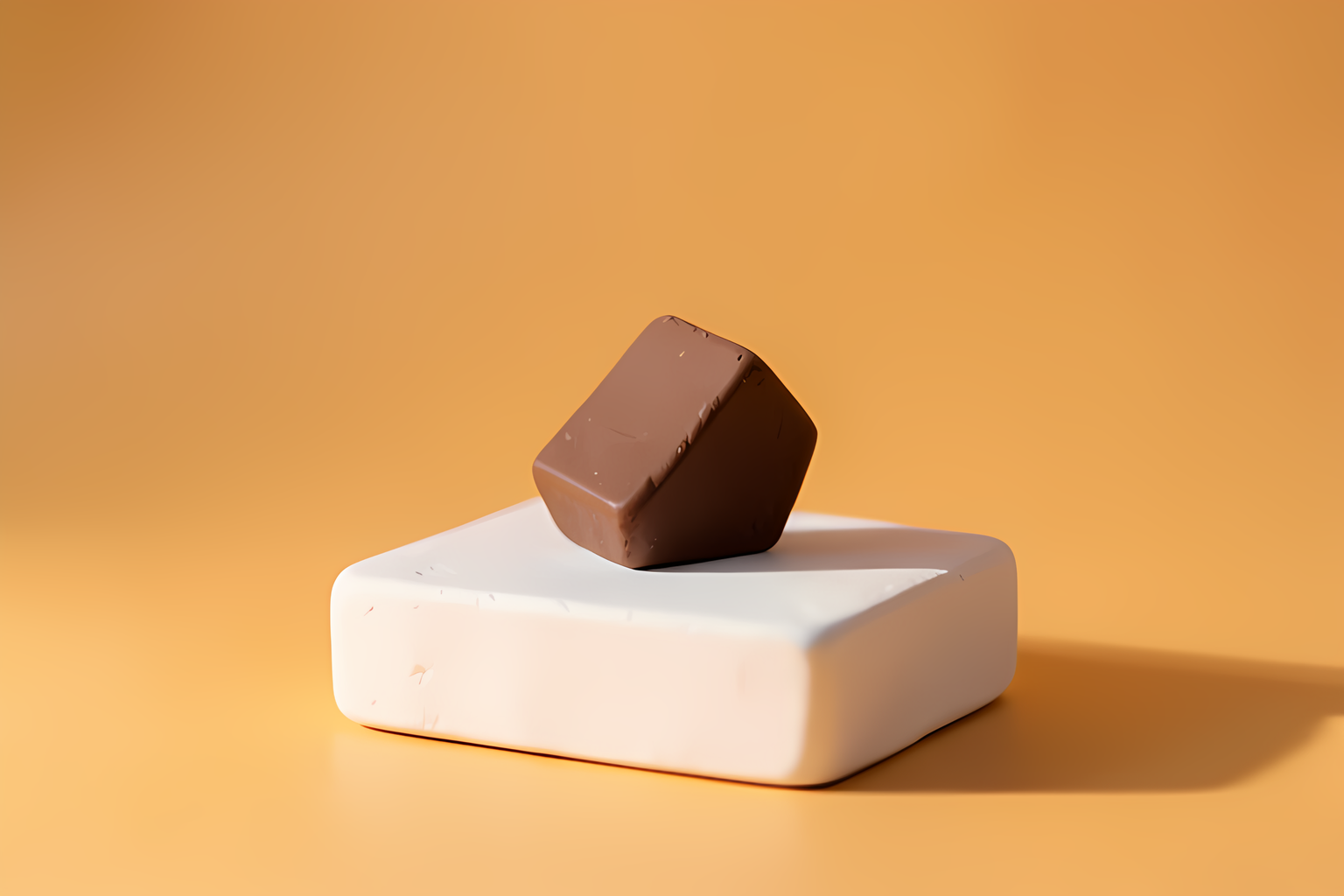
What changes in this design
Without a drawing-centered entry, someone may assume a patent will explain materials, moving parts, a practical use, or a result.
This record stays with what can be seen: two rounded upright figures, one forward and one partly turned, with rising lobes, oval eye-like outlines, a small central outline, a curved line, bow-shaped neck outlines, broad foot-like forms, and an oval base outline beneath them.
That distinction helps set expectations. The image offers a way to examine the pictured form, while leaving the object's material, workings, purpose, and performance unstated.
A rented warehouse in Sinking Spring, 1948
Richard Palmer started in 1948 with $25,000, used equipment, a rented warehouse in Sinking Spring, Pennsylvania, and four employees. To my mind, the important thing is that his idea was not the usual seated rabbit. He molded caricatures in chocolate, cartoon faces with exaggerated heads. One of the first was Baby Binks, and that mold was reportedly inspired by a dog toy. He patented his original four Easter items.
The economics were settled early and have not changed. An operations executive at the company Palmer founded told Smithsonian that a large solid bunny "would be like a brick; you'd be breaking teeth." Then the commercial half: "Hollow has a greater perceived value. It creates a much greater chocolate footprint than solid." You sell apparent size, not cocoa. That company still makes around 25 million hollow bunnies a year.
Why a gold foil rabbit could not be a trademark
In 2012 the Court of Justice of the European Union refused Lindt EU-wide trademark protection for its gold foil sitting bunny. Only a mark that departs significantly from the norm or customs of the industry, the court held, tells you where a product came from. A sitting rabbit is typical. Gold foil turns up on competitors. A red ribbon and a bell are ordinary decoration.
The lesson lawyers drew was one I share: a shape trademark in Europe now means proving acquired distinctiveness across the entire union, which is slow and document-heavy. One firm writing about the ruling suggested registered design rights might serve businesses better. That is the road a very large confectioner took on 18 July 2023, with four European design registrations filed the same day.
The drawings are not a rabbit
Those four became a family of American design patents. The one I read is US D1,137,985, titled simply "Chocolate," filed in April 2025 by an inventor based in London and granted on 4 August 2026. It is assigned to the Chicago chewing gum company Mars bought in 2008 and built its confectionery arm around. One claim, five sheets of drawings, a fifteen-year term.
The drawings show no rabbit, and I found that surprising. They show the lentil-shaped candy character: large eyes and eyebrows, a wide smile, stubby limbs, oversized shoes. It is wearing long rabbit ears. The "m" on its torso and the character's hands are drawn in broken lines, which means they are excluded from what is claimed. So the protected thing is a molded cartoon in ears with the brand mark cut out of the claim. It is distinctive because it isn't a bunny, which is Palmer's 1948 insight run again, 77 years later.
It is not one filing, either. The parent went in during January 2024 and issued in May 2025; a divisional issued that July. Three patents so far from one European design, each drawing a different line between claim and disclaimer.
Seven Palmers in the citation list
Twenty-one references are cited on the face of the patent. Seven carry the Palmer name: one from 1950, two from 1955, one from 1958, and three granted in 2006. To get this design allowed, the examiner had to clear it past the man who invented the caricature in chocolate and the company that kept patenting them.
That company has had a terrible few years. On 24 March 2023, at about 4:57 in the afternoon, its West Reading plant exploded. Seven people were killed and ten injured. Workers had smelled gas around 4:30 and the evacuation was delayed. Federal investigators concluded in April 2025 that a degraded retired service tee let natural gas migrate underground into the buildings, and that the ignition source could not be determined. Property damage came to $42 million. The European filings were made four months after the blast. I don't think the two are connected. They sit on the same timeline anyway.
Where the risk actually sits
On 21 May 2024 the full Federal Circuit threw out the test that had made design patents unusually hard to invalidate. Under the old rule a challenger had to first produce a single earlier design basically the same as the claimed one, or the obviousness inquiry stopped there. The court found that requirement imposed limits absent from the statute and replaced it with the ordinary obviousness analysis. The read at the time: design patents just got harder to keep. This continuation was filed eleven months later.
The substance is under pressure too. Cocoa passed $12,000 a ton in 2024, West Africa grows about 70 percent of the world's crop, and manufacturers have been swapping in palm and shea oils. Two large British makers had to drop the word chocolate from packaging after falling below the legal cocoa threshold. Owning the character rather than the rabbit was the smart call. What worries me, in my reading, is that the shape may end up better protected than whatever is inside it.
Sources
Reporting for this piece drew on the published filing and the references below.
- US D1,137,985 S - "Chocolate" (USPTO full-text patent)
- USD1074114S1 - Chocolate (the parent patent, Google Patents)
- Federal Circuit Overrules Rosen-Durling Test for Design Patent Obviousness (Patently-O)
- The Endless Bunny Hunt: CJEU Rules on Trademark Protection for the Shape of Chocolate Bunnies (Jones Day)
- Why Are Chocolate Easter Bunnies Hollow? (Smithsonian Magazine)
- NTSB issues final report on 2023 R.M. Palmer chocolate factory explosion that killed seven (WFMZ)
- Climate Change Is Reshaping How Much Chocolate Costs and What It's Made Of (Sierra)
The record, briefly. USD1137985S1, “Chocolate” The checked public record identifies a U.S. design patent titled 'Chocolate'. The reading treats the published title and figure as a visual starting point and does not infer a material, mechanism, or performance claim not established there.
More angles on this
- Confectionery, Seen Through the Eyes of a Tiny MuseumAnother reading from the same A23G classification family, cocoa.
- The Potato Product Makes Its Entrance in SlicesAnother reading from the same A23G classification family, cocoa.
- CPC A23G: CocoaThe official classification family this record was filed into, published in the USPTO Cooperative Patent Classification scheme.
- CPC A61K: Preparations for medical, dental or toiletry purposesThe official classification family this record was filed into, published in the USPTO Cooperative Patent Classification scheme.
- The Leveling Bar Has a Very Firm Opinion About LevelAnother reading from the wider A01B classification family, soil working in agriculture or forestry.
Read around this one:Public patent recordUSPTO published figurePatent issue-date index