Machines
A Baseplate's Signal: From Guess to Defined Response
A Vermont CBD seller's flat-iron rosin patent arrives as the federal definition of hemp tightens around the products it might touch.

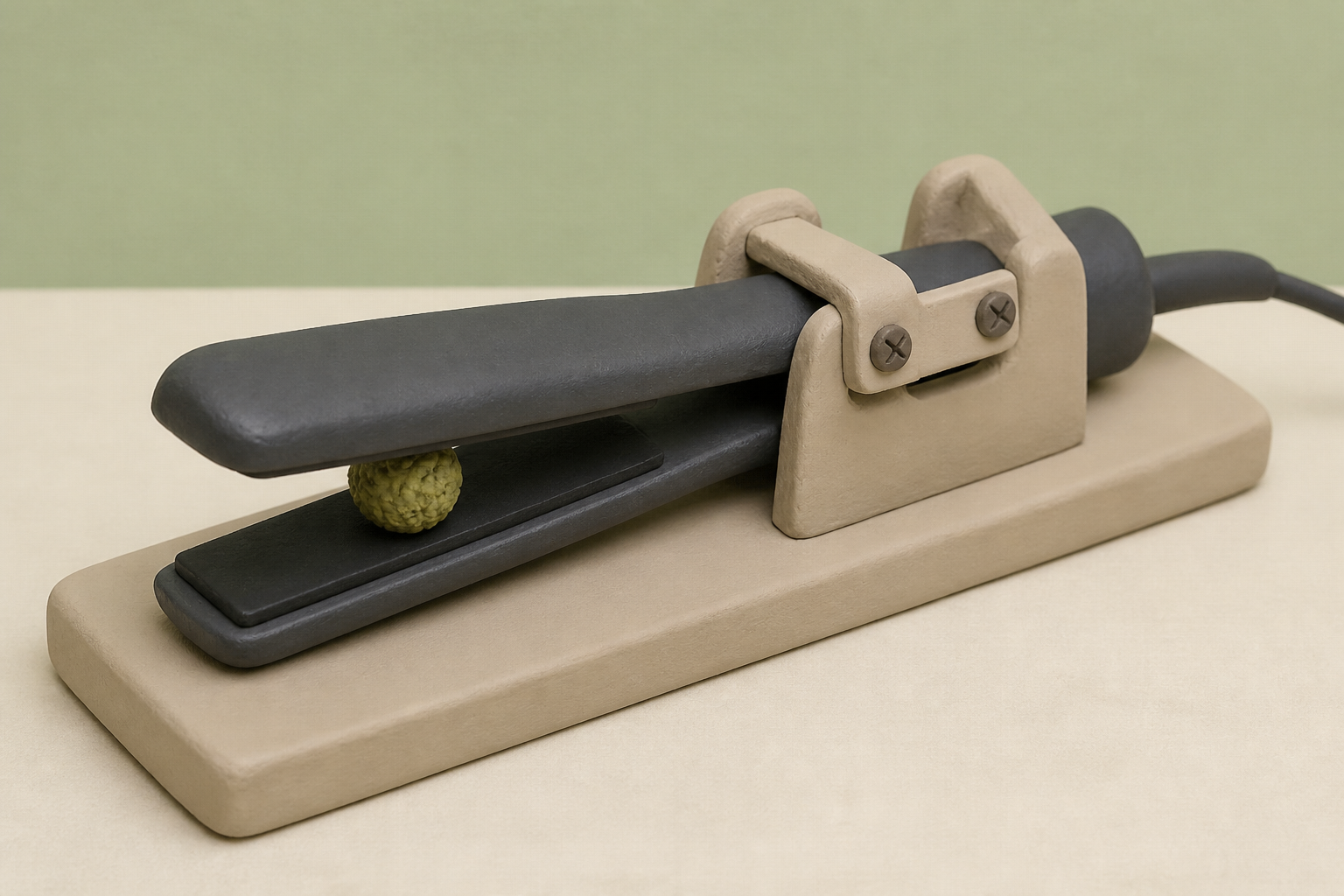
What changes in this design
Someone familiar only with a straightening iron might picture it on its own, rather than fitted into a base that is part of a heated foot press.
Here, the iron rests on a top seating surface. Side rails rise beside it, and a fastener pulls the rails inward so its handle is held in place.
These details show that the baseplate is meant to hold the iron's handle securely while making the iron part of a heated press.
A flat iron underfoot
At the low end of rosin making, a straightening iron can do double duty as a press. A cannabis bud meets hot plates; the operator clamps a tool made for hair, not extraction. The price of entry is low, but the grip, pressure, and temperature are uncertain.
That awkward little scene is what US 2026/0256184 A1, published September 3 and titled Cannabis Foot Press Baseplate, tries to formalize. It describes a baseplate that receives the iron: a top seating surface, upward side rails around the handle, and a fastener that pulls the rails inward to secure it. The result is a heated foot press intended for extracting rosin from cannabis bud.
The handle is the part I keep returning to. This is not a new press plate, heater, or chemical process. It turns the loose end of an improvised method into a fixture.
A storefront without a press
SunSoil PBC of Burlington, Vermont is the applicant, with Alejandro Bergad and Jacob Goldstein named as inventors. Its current store sells USDA Organic CBD gummies, drops, and softgels, along with vitamin gummies without CBD. It sells no rosin press, flower, or extraction hardware. That contrast is real, but it does not reveal why the company is pursuing this patent family.
Bergad and Goldstein began the business in 2015 by converting former dairy hayfields in Hardwick, Vermont, to hemp. An industry profile reported roughly 500 retail stores by 2019 and oil priced at five cents per milligram. The paper trail for the baseplate reaches back to a January 17, 2023 provisional: the new application, filed April 23, 2026, is a continuation-in-part of a 2024 application that became U.S. Patent 12,629,909.
That is more than three years spent protecting a device family that its own storefront does not sell. One market-report publisher estimates the dedicated rosin-press market at $120 million in 2025 and names ten established manufacturers, none of them SunSoil.
The flat-iron ceiling
A history of rosin places an early version in a 2006 forum post about pressing trichomes with heated spoons. In 2015, Phil 'Soil Grown Sal' Salazar found that applying heat and pressure to whole buds made flower rosin, then went on to found a commercial press company.
Flat irons remain an entry method because they are cheap and available, but the instructions are not standardized. A 2018 guide suggests one to seven buds, 280 to 330 degrees Fahrenheit, and three to eight seconds of clamping. Another puts three to four grams under a straightener at about 200 to 220 degrees for two to three minutes, puts equipment cost below $100, and reports just under one gram of output. A third calls 200 degrees ideal and says output is limited to one or two grams at a time.
The sources agree on the larger limitation: a straightener makes temperature and pressure hard to control or measure, and lacks hydraulic or pneumatic pressing. The baseplate's stated role is narrower. It secures the handle and makes the pressing foot-operated. I don't read that as a substitute for a purpose-built press; I read it as a way to squeeze more usefulness from the entry-level tool.
The November deadline
Ten weeks after this patent published, a federal deadline is set to change the frame around hemp. Section 781 of the FY2026 Agriculture Appropriations Act, enacted November 12, 2025, takes effect November 12, 2026. The change applies a total-THC test across cannabinoids rather than only delta-9 THC. Intermediate hemp products above 0.3 percent total THC and finished products above 0.4 milligrams total THC per container would fall outside the federal hemp definition.
That timing makes the small bracket more consequential. The patent is expressly for pressing cannabis bud, while the federally recognized hemp category is about to tighten. A report on an August 2026 multi-university study says 80 percent of delta-9 THC edibles marketed as compliant hemp products fail the legal math required to qualify. I would not treat that percentage as settled without the underlying study, but it is a warning that the label was already unstable.
The law does not decide whether this baseplate works. It does change the federal definition around the material named in the filing. Pressure and heat are only part of the story; the remaining question is what product can still be called hemp when the new threshold arrives.
The part worth watching
This filing matters less as a hardware story than as evidence of where cannabis patent activity can appear. A legal-sector review counted nearly 250 cannabis patents issued in 2017 and 2018, more than in the preceding seven years combined, plus about 550 applications in that same window. It found more than 780 entities with at least one filing, a field numerically led by small companies and individual filers.
The number I keep coming back to is not $120 million or 80 percent. It is the cheap flat iron. A low-yield entry method now sits behind a continuation-in-part, a granted family member, and a fresh publication. The record does not tell us whether the baseplate will reach a shelf. It does show a company holding a claim over an ordinary object while the material and label around it are becoming more contested.
That is why this is not chiefly a story about a foot press. It is a story about the distance between a household workaround and a product category whose federal definition is about to get smaller.
Sources
Reporting for this piece drew on the published filing and the references below.
- US 2026/0256184 A1 - Cannabis Foot Press Baseplate
- Cannabis Foot Press Baseplate - public patent record
- Sunsoil
- Hemp CBD Brand Sunsoil Sets Itself Apart With Low Price and Focus on Organic
- HIGH HISTORY: Hashing Out the Origins of Rosin Tech
- An Insider's Guide: How to Make Rosin with a Flat Iron
- Can You Really Press Quality Rosin with a Hair Straightener?
- Pressing Rosin with a Hair Straightener
- Rosin Press Machine Market
- Cannabis Patent Activity Surges Amid Industry Gold Rush
- Changes to 'Hemp' Definition Set to Close the Farm Bill Loophole
- 80% of Hemp-THC Products Are Illegal Marijuana
The record, briefly. US20260256184A1, “Cannabis Foot Press Baseplate” A baseplate receives a straightening iron to form a heated foot press for extracting rosin from a cannabis bud, with a top seating surface, upward side rails, and a fastener that urges the rails inward to secure the iron handle.
More angles on this
- CPC A24B: Manufacture or preparation of tobacco for smoking or chewing; tobacco; snuffThe official classification family this record was filed into, published in the USPTO Cooperative Patent Classification scheme.
- Degassing a bottle: a chamber, a pump, and the judgment left to whoever holds itAnother reading from the wider A23L classification family, foods, foodstuffs or non-alcoholic beverages, not otherwise provided for; preparation or treatment thereof.
- A cooling plate broader than it is deep, and the quiet difference between a setting and a promiseAnother reading in the same Machines category on this site.
Read around this one:Public patent recordUSPTO published figure