Objects
Degassing a bottle: a chamber, a pump, and the judgment left to whoever holds it
A vacuum chamber for baby bottles arrives as births fall and a basic question about colic remains unresolved.

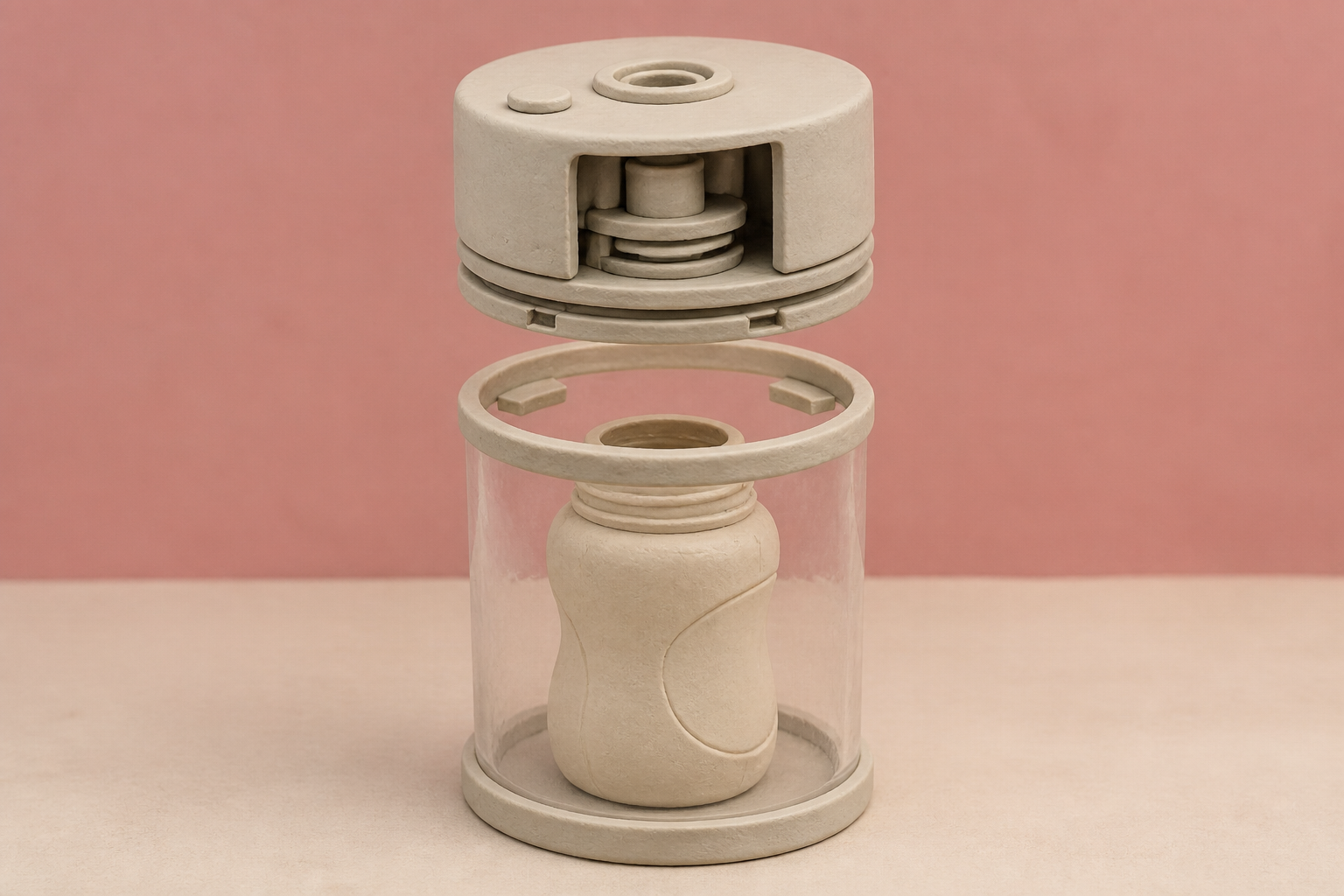
What changes in this design
A reader might otherwise picture just the bottle and its drink, rather than a separate chamber and pump that affect air pressure.
This device works with a beverage held in a receptacle, such as an infant feeding bottle. It includes a chamber, a part that can be closed, and a pump that extracts air to establish a preset vacuum pressure.
That is worth knowing because the focus is a pressure-based setup used with a beverage container. The exact pressure and how much gas is removed are not stated.
A £135 million bet
In May 2016, a Chinese cosmetics group paid £135 million for Mayborn, the owner of the Tommee Tippee baby-products brand. The buyer said China's newly relaxed two-child policy and the expected growth of baby products made the deal attractive. The deal puts this bottle in a larger story, which is why I started there. For a tired parent, it is a tool for getting through a feed. For the buyer, it was a bet on the future of baby products.
Now I see a very different number. China recorded 7.92 million births in 2025, down 17 percent from 9.54 million in 2024 and the lowest annual figure since records began in 1949. Meanwhile, Mayborn reported 2024 revenue down 14.7 percent to £155.4 million and an operating loss of £73.6 million, after a £15.5 million profit the year before. Its directors pointed to an innovation pipeline. The pipeline is not one I can tie to any one patent application. But those published figures make it hard for me to read this filing in isolation.
The chamber on the counter
On September 3, 2026, the United States published Mayborn's application, US20260256170A1, titled Beverage Degassing Assembly And Method Of Degassing A Beverage. Another bottle valve was what I expected. Instead, I found a separate sealed chamber: a caregiver puts a filled infant bottle inside, closes it, and a pump removes air before the feed begins.
The claims set a vacuum pressure of 40 to 60 kPa, reached after a pull-down of 10 to 120 seconds and held for one to five minutes. The preferred example is 50 kPa for two minutes. It does not rely on a passive vent during feeding. It turns a feed into a preparation step with a pump, a chamber, a lid, and a wait. That distinction struck me as more revealing than the word 'degassing.'
Six weeks of crying
This is where I slow down. Infantile colic often peaks at about six weeks and resolves by 12 to 16 weeks, yet the reasons for the apparent pain remain unsettled. One clinical reference estimates that 3 percent to 28 percent of infants worldwide are affected. Another says whether swallowed air or gas causes colic, rather than follows it, remains a matter of debate. That uncertainty matters when a product's value rests on taking gas away.
That same review found no evidence supporting simethicone for colic pain. The nursing reference says no gastrointestinal mechanism for the apparent pain has been identified and no medication is proven to relieve symptoms. None of that proves vacuum-degassing cannot help a particular family, and the filing is not evidence from a clinical trial. But it means I won't grant the device the causal story its category invites: remove air, remove distress. The published clinical literature I read doesn't get us there.
The 2024 bottle complaint
This patent, for me, also has to sit beside a separate safety question around the bottle line. A class action filed in 2024 alleges that Tommee Tippee bottles marketed as BPA-free contain undisclosed microplastics. An allegation is not a finding, and I keep it separate from the degassing application. Still, it affects how I read a new technical response to a parent's fear. The product has to earn trust on more than one question.
Philips sells an anti-colic bottle with a single-piece passive vent meant to keep the nipple full of milk during feeding. It cites its own placement test, in which 80 percent of mothers agreed their babies had fewer feeding issues. That doesn't count as clinical proof for me. Mayborn's claims describe a procedure rather than a clinical outcome. For me, the contrast shows two ways of turning a difficult, unsettled infant experience into an engineering feature and a claim a sleep-deprived adult can act on.
The part worth watching
The patent is not something I dismiss because it is elaborate. A chamber that removes air from a prepared bottle could be useful if it reliably changes the feed in a way that matters to babies. The filing gives us something concrete to test: a specified vacuum range, a timed hold, and a separate enclosure. Measuring what that process changes, we can then ask whether it changes the baby's experience.
What I will watch is the next kind of evidence. Does Mayborn publish controlled results that distinguish less gas in the bottle from less distress in the child? Are caregivers able to use the process without adding another stressful chore? And will the company describe the benefit with the caution the colic literature deserves? Until then, I see US20260256170A1 less as an answer to colic than as a precise machine built around a question medicine has not yet settled.
Sources
Reporting for this piece drew on the published filing and the references below.
- Beverage Degassing Assembly And Method Of Degassing A Beverage
- Beverage Degassing Assembly and Method of Degassing a Beverage - US 2026/0256170 A1
- Recent advances in understanding and managing infantile colic
- Infantile Colic (Nursing)
- Tommee Tippee Lawsuit Alleges 'BPA Free' Baby Bottles Contain Undisclosed Microplastics
- Tommee Tippee owner falls into the red after year of challenges
- Anti-colic Baby Bottles with AirFree Vent
- Cosmetics maker Shanghai Jahwa acquires Tommee Tippee owner
- Baby bust: China births plunge 17% in 2025 to historic low as population shrinks
The record, briefly. US20260256170A1, “Beverage Degassing Assembly And Method Of Degassing A Beverage” An assembly degasses a beverage held in a receptacle, such as an infant feeding bottle, using a chamber, a selectively closable second portion, and a pump that extracts air to establish a predetermined vacuum pressure; a beverage-degassing method is also disclosed.
Identity details. The saved title-page transcription needs review, so names are not repeated here. Check the official published title page.
More angles on this
- CPC A23L: Foods, foodstuffs or non-alcoholic beverages, not otherwise provided for; preparation or treatment thereofThe official classification family this record was filed into, published in the USPTO Cooperative Patent Classification scheme.
- CPC B01D: SeparationThe official classification family this record was filed into, published in the USPTO Cooperative Patent Classification scheme.
- A cooling plate broader than it is deep, and the quiet difference between a setting and a promiseAnother reading from the neighbouring A23G classification family, cocoa.
- The cheese ripening record that coats every face, then leaves two of them openAnother reading from the wider A01J classification family, manufacture of dairy products.
- Small Game Cleaning Device Makes the Next Move Easier to SeeAnother reading in the same Objects category on this site.
Read around this one:Public patent recordUSPTO published figure