Field Notes
The cheese ripening record that coats every face, then leaves two of them open
A quiet industrial contest lies behind the rind shaved from cheese blocks: a larger wax pattern versus no wax at all.

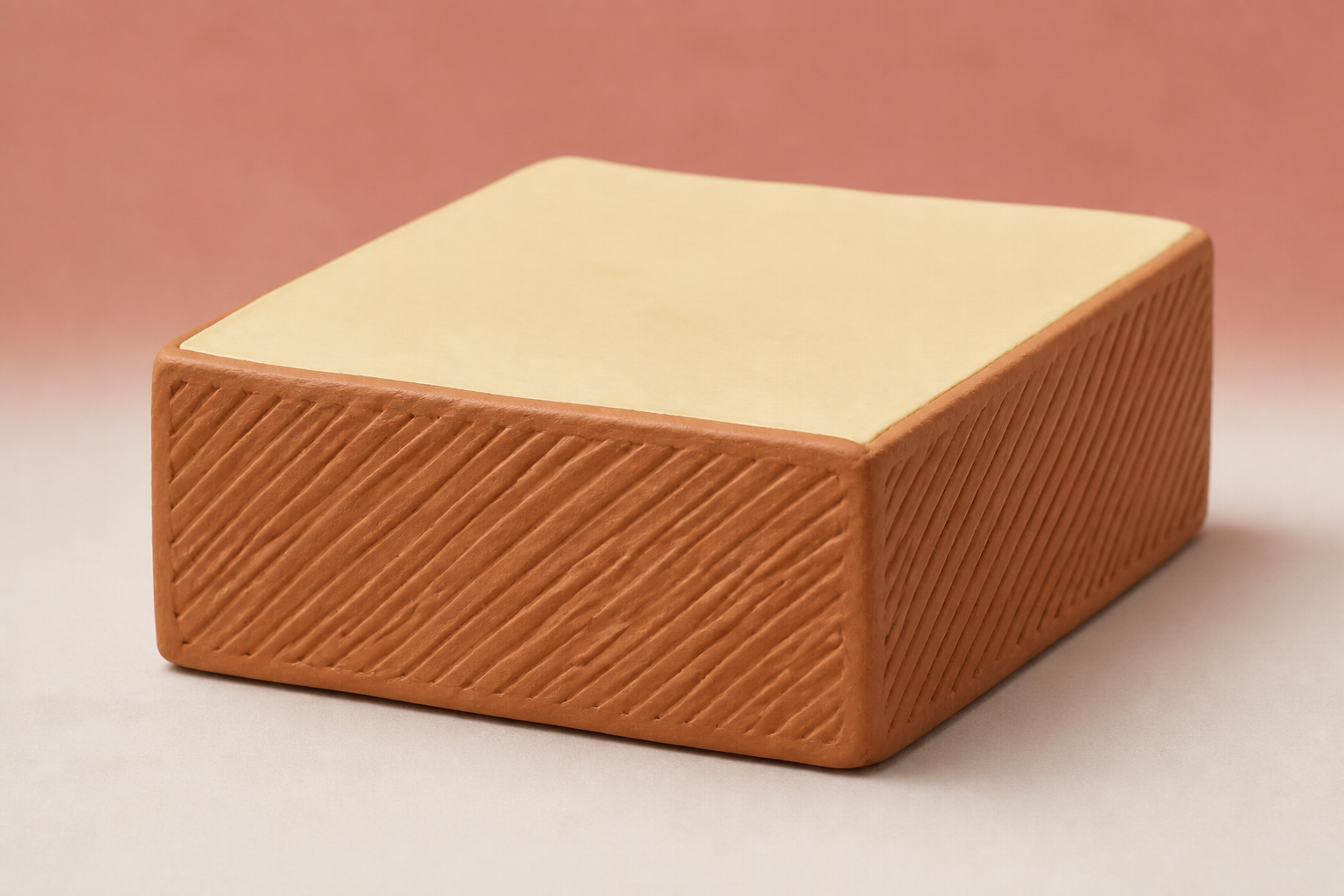
What changes in this design
The record does not say how hard or semi-hard cheese is ordinarily ripened. A reader might otherwise expect each face of the block to be treated the same way during ripening.
After cheese is formed from curd, its entire surface receives a protective coating that lets water through. Water-blocking material then covers only part of that coating, and the top and bottom faces remain completely uncovered as the cheese ripens.
The contrast between all-over coating and uncovered top and bottom faces is the detail to notice. It tells readers that the water-blocking material is not used on those faces; a measured result or particular benefit is not stated.
The rind on the floor
What gets swept away is where I began. In a cheese plant, an untreated mature block can develop a dry, dark outer band that has to be cut off before sale. One industry estimate puts annual Gouda and Parmesan cutting loss at 3 to 10 percent of production, roughly 220,000 tons. That is not a cosmetic defect. It is milk, labor and finished food leaving the line as trim.
Among food inventions I've seen, some begin with a dazzling consumer feature. This one begins in the quiet interval between pressing and sale, as water leaves cheese and a producer later removes the consequence. The patent family describes old cheeses with dry, dark zones 7-8 millimeters deep or more, sometimes 15-20 mm. The appeal is clear, I think, without pretending the arithmetic is simple: a few points of yield at industrial scale can mean a great deal of food.
Four vertical faces
US 2026/0256162 A1, published September 3, 2026, is where I stopped. Its title, Improved Cheese Ripening, conceals a very specific move. FrieslandCampina Nederland B.V. claims a method for a hard or semi-hard block: coat every surface with a protective water-permeable layer, then put water-impermeable material on part of it. The top and bottom faces stay completely uncovered by that second material. Each of the four side faces must have wax on it at least in part.
That geometry is, I think, the filing's real point. It does not call for water-impermeable coverage of every face. It is a limited effort to slow loss at the sides while leaving the broad faces exposed. In its worked examples, the applicant reports weight-loss reductions against reference cheeses of 34.5 percent after four weeks, 31.7 percent after nine, 30.3 percent after 16 and 27.7 percent after 26. Its stated six-week target is under 4 percent moisture loss.
Vertices and edges
This doesn't read to me as a sudden leap. An earlier FrieslandCampina patent, filed in 2020 and granted in 2025, addressed the same block-cheese problem by waxing the vertices and the edges joining them. It described wax loads of 50-70 mg per square centimeter and said dried rind could drive cutting losses as high as 15 percent. The new application is a continuation in the same research line, with a fuller side-face pattern rather than a new diagnosis.
That history changes how I see it. The technical shift may be small, but small is not meaningless. Food manufacturing often advances by finding a boundary where an intervention protects yield without harming the process it is meant to preserve. Here, the boundary is literally the perimeter of a block. The application offers worked examples, not proof that every recipe, aging schedule and cheese room will behave the same way.
A membrane without PVA
The sharper contrast was what I found next. dsm-firmenich markets Pack-Age, a ripening membrane intended to eliminate the PVA coating rather than redesign the wax pattern on top of it. The company says the system can reduce post-maturation cutting loss by up to 7 percent and yield up to 10 percent more cheese from the same milk. Those are marketing claims, not a matched trial against this method, so I won't treat them as a winner's scorecard.
But the contrast matters. One path tries to control where a coating lets water move. The other tries to remove a coating layer altogether. A third pressure may shape the choice: under EU Regulation 2023/2055, a sales restriction for synthetic polymer microparticles in waxes, polishes and similar products starts on October 17, 2028. Whether cheese wax in this method is covered, I cannot tell from that rule, so I won't use it to predict a legal obstacle. It does make me ask harder questions about the materials.
What would have to be true
For this patent to matter beyond its drawings, I think several things must hold at once. The side coverage would need to preserve the reported weight-loss advantage at factory scale, across the cheeses and aging periods customers actually buy. It would need to reduce trim rather than merely move the loss into coating, handling or quality checks. And it would need to compare well with membrane approaches on cost, food safety, labor and waste, not only grams of moisture.
That is why I wouldn't dismiss the patent as a tiny change, or celebrate it as a solution. A clear marker appears to me in a practical contest: how much of a cheese block can we save before ripening stops being the cheese people expect? The next useful evidence will not be another pattern on a diagram. It will be independent, plant-scale comparisons showing what reaches the customer and what still reaches the floor.
Sources
Reporting for this piece drew on the published filing and the references below.
The record, briefly. US20260256162A1, “Improved Cheese Ripening” Method for naturally ripening a hard or semi-hard block-shaped cheese: form cheese from curd, coat its entire surface with a protective water-permeable coating, partially cover that coating with water-impermeable material, and allow ripening while the top and bottom faces remain completely uncovered.
More angles on this
- Method For Producing Fermented Milk Makes the Next Move Easier to SeeAnother reading from the same A23C classification family, dairy products, e.g. milk, butter or cheese; milk or cheese substitutes; preparation thereof.
- CPC A23C: Dairy products, e.g. milk, butter or cheese; milk or cheese substitutes; preparation thereofThe official classification family this record was filed into, published in the USPTO Cooperative Patent Classification scheme.
- CPC A01J: Manufacture of dairy productsThe official classification family this record was filed into, published in the USPTO Cooperative Patent Classification scheme.
- Ferrate on Produce: A Quiet Change in Who Carries the Burden of FreshnessAnother reading from the neighbouring A23B classification family, preservation of foods, foodstuffs or non-alcoholic beverages; chemical ripening of fruit or vegetables.
- Small Game Cleaning Device Makes the Next Move Easier to SeeAnother reading from the wider A22B classification family, slaughtering.
Read around this one:Public patent recordUSPTO published figure