Machines
Method For Producing Fermented Milk Makes the Next Move Easier to See
Meiji's new yogurt patent treats movement as an ingredient in a worldwide attempt to make dairy feel rich without additives.

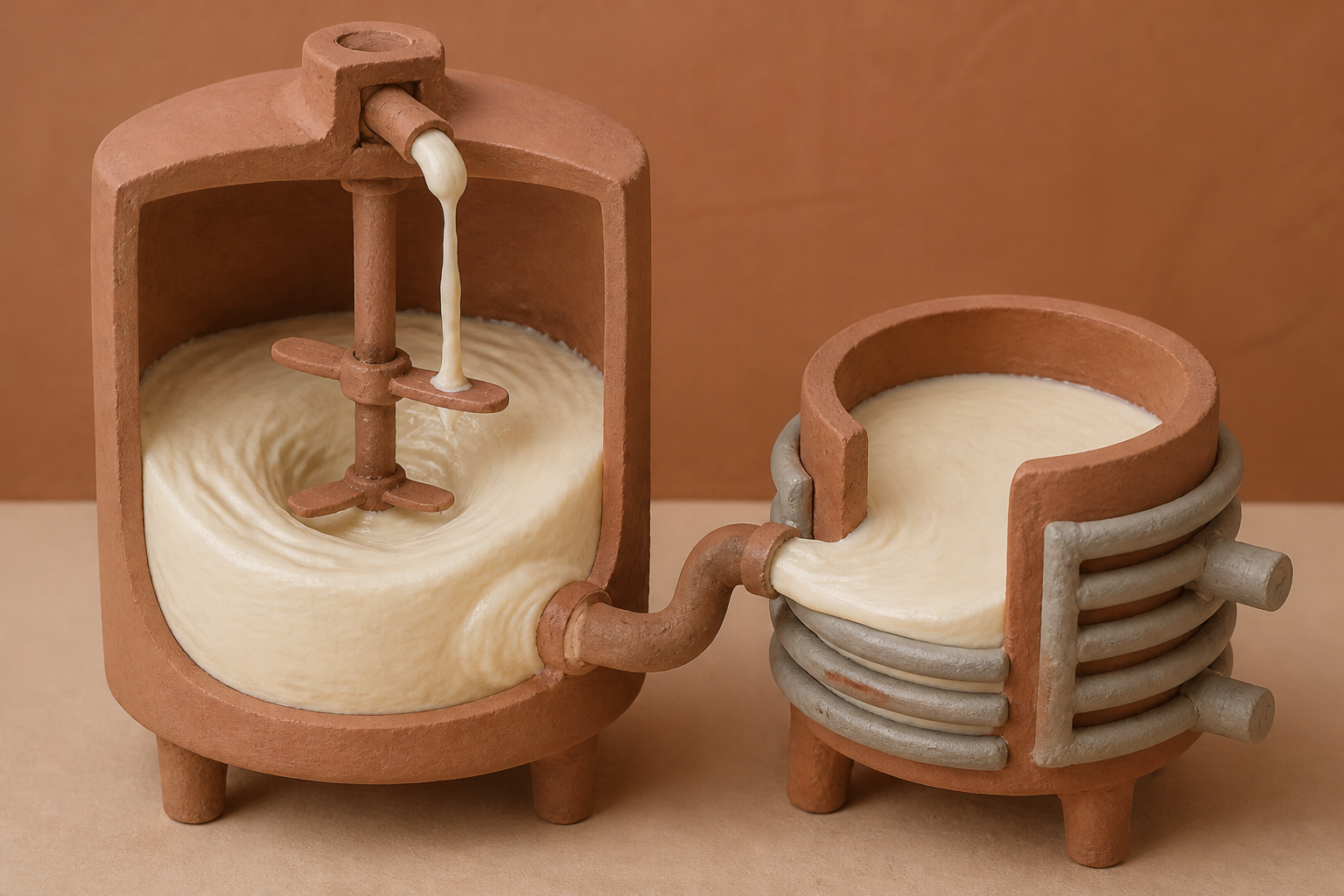
What changes in this design
Without further detail, a reader might picture fermented milk being made by fermenting a mixture and then cooling it. How conventional production is done is not stated.
Here, the mixture flows during fermentation with a milk-fermenting starter, its 90% particle diameter is kept at no more than 125 micrometres, and the fermented milk is cooled while flowing.
These details identify the conditions the process calls for: movement during both stages and a numerical particle-size limit. What those conditions are intended to measure or achieve is not stated.
The price on the shelf
The price tag makes an ordinary bottle of drinkable yogurt feel newly consequential to me. In the first half of fiscal 2025, Meiji raised prices by 3% to 36% across chocolate, cheese, butter and margarine as dairy and cocoa costs rose. Later, its dairy and Probio business reported ¥22.6 billion in operating profit for April through June 2026, up 27.7% year over year, and Probio sales up ¥2.3 billion. The company was also selling its China dairy business for about ¥7.6 billion.
A patent filing does not read to me as a diary of those decisions. Why a maker might value small gains in texture and process control becomes clear to me when the global drinking-yogurt market is estimated at $48.25 billion in 2025, with Asia-Pacific its largest region.
The moving curd
US20260256159A1, published September 3, 2026, for Method For Producing Fermented Milk, raised that question for me. Meiji filed it on March 13, 2024. The application addresses a stubborn retail contradiction: a yogurt drink should pour, yet it should not feel thin. It keeps a raw-material mix and milk-fermenting starter flowing during fermentation, holding its 90% particle diameter to 125 micrometres or less, then cools the fermented product while it continues to flow.
The departure from the usual factory sequence was more revealing to me than the title. A food-industry account describes drinking and stirred yogurt fermenting in bulk tanks at 40-44 C for three to four hours. Only afterward is the coagulum mechanically broken, while fat may be separately homogenized at 10-20 MPa for smoothness. Here, movement and particle control are part of fermentation and cooling. That is, I think, the filing's practical bet.
Numbers at pH 5.7
A changing set of limits in the claims stands out to me: Reynolds number 5 to 250,000 during fermentation, 10 to 35,000 during cooling, and a step-up in shear tied to pH falling below 5.7-5.2. Those figures are not, to me, a universal recipe. They read to me as an attempt to act at specific points while milk becomes a fragile gel.
A lineage rather than a sudden turn emerges for me. Meiji reports a 41.2% share of Japan's yogurt market, and its own account names Maroyaka Tannen Fermentation from 2004 and Kuchidoke Hojun Fermentation from 2023. Both were developed without changing bacterial strains. An earlier Meiji patent, filed in 2019 and granted in 2024, claimed curd broken to 1-20 micrometre particles, then held until it rebuilt a 100-700 mPa s viscosity at 10 C without stabilizer or thickener.
The through-line is clear to me: process engineering makes texture in timing and handling before a new microbe or additive is needed.
Carbon dioxide bubbles
This doesn't seem to me to be a solitary pursuit. In May 2026, a Chinese dairy company filed an application for bubble-fermented milk with thixotropic properties. Its proposal uses carbon-dioxide microbubbles to form a reversible gel, reported to fall to 2,560-3,760 centipoise after shaking. Two patent filings cannot tell me which method will travel beyond a plant trial.
The shared target is clear to me: smooth in motion, substantial at rest, and less dependent on conventional additives. That turns an obscure process claim into evidence of a live international race in method, not a contest over a new yogurt category. The person holding a bottle may never see the circulation path or bubbles, but we will notice whether the first sip feels watery.
The open question
The implication that shear is merely an engineering dial is the cleanest, and it persuades me least. A food-science chapter reports that sub-lethal high-pressure homogenization at 50 MPa can change lactic acid bacteria's proteolytic activity and metabolism in strain-dependent ways. This filing describes flow and shear, not that specific pressure treatment, so I cannot call the chapter a refutation. That chapter is, to me, a caution. The culture being moved is alive, and its response may not follow fluid numbers alone.
The regulatory boundary is clarifying to me. The Codex standard defines fermented milk broadly as milk fermented by starter lactic acid bacteria, so the filing does not seek a special product category or an approval. It seeks control over how a familiar food is made. This is why the patent matters, in my view. The hard question is whether factory-scale flow can make a drink reliably richer without altering the organisms that make it fermented milk.
Sources
Reporting for this piece drew on the published filing and the references below.
- US20260256159A1 - Method For Producing Fermented Milk
- US Patent Application 20260256159 - Method for Producing Fermented Milk
- Method for Producing Liquid Fermented Milk
- Reviving Traditional Yogurt with Modern Fermentation Technology
- How Yogurt Is Processed
- Bubble-fermented milk with thixotropic properties
- Meiji Holdings FY2026 Q1 Earnings Call
- Meiji Holdings H1 FY2025 Presentation Slides
- Drinking Yogurt Global Market Report
- Codex Standard for Fermented Milks (CXS 243-2003)
- Dynamic Stresses of Lactic Acid Bacteria Associated to Fermentation Processes
The record, briefly. US20260256159A1, “Method For Producing Fermented Milk” A method produces fermented milk by fermenting a raw material mix with a milk-fermenting starter while flowing it so the 90% particle diameter does not exceed 125 µm, then cooling the fermented product while flowing.
Identity details. The saved title-page transcription needs review, so names are not repeated here. Check the official published title page.
More angles on this
- CPC A23C: Dairy products, e.g. milk, butter or cheese; milk or cheese substitutes; preparation thereofThe official classification family this record was filed into, published in the USPTO Cooperative Patent Classification scheme.
- The Judgment Space Between Washing and PackagingAnother reading from the neighbouring A23B classification family, preservation of foods, foodstuffs or non-alcoholic beverages; chemical ripening of fruit or vegetables.
- A Baked Product's Specified Sugar RelationshipAnother reading from the wider A21D classification family, treatment of flour or dough for baking, e.g. by addition of materials; baking; bakery products.
- When a Queue Waits for Its CueAnother reading in the same Machines category on this site.
Read around this one:Public patent recordUSPTO published figure