Machines
When a Queue Waits for Its Cue
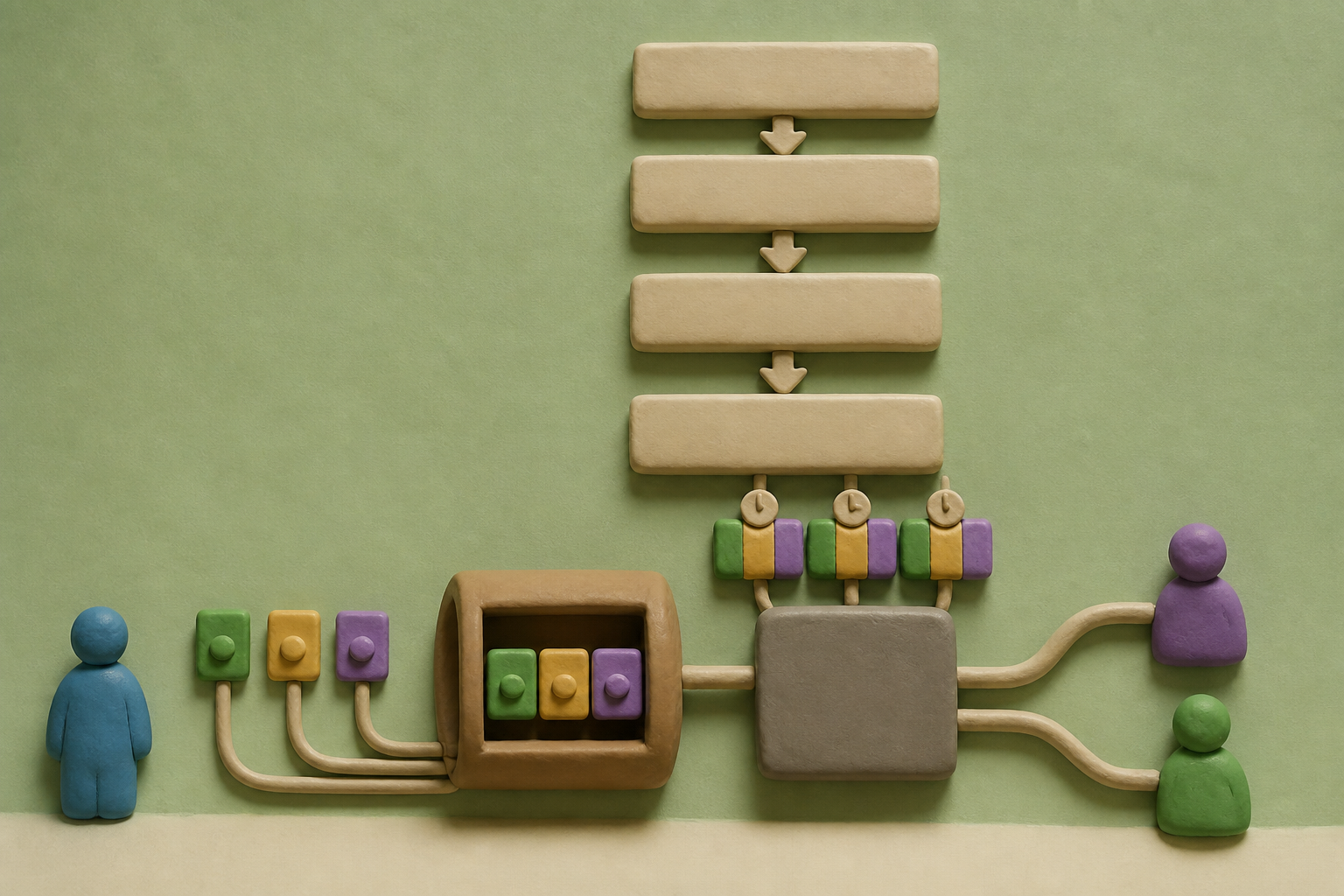
The central pairing is First Moment with Second Moment: The application obtains interactive messages in a target queue.

First, the setting
Modern life relies on messages moving between people and services: a note from a coworker, a delivery update, or a reply in a group chat. These messages do not always arrive at the same instant they are sent. People and organizations need orderly ways to handle arrivals so conversations and routine tasks stay manageable.
Someone holds a phone while walking into work, then opens a messaging screen after settling at a desk. New replies, updates, and alerts appear alongside earlier ones. Behind that familiar screen, incoming messages may wait briefly, be gathered, and be handled at chosen moments before the person sees a refreshed conversation or notice.
What changes in this design
A reader might otherwise picture messages in a queue being handled one at a time as they appear or remain waiting. It is not stated whether that is how this queue normally works.
Here, delayed messages falling between two time points are collected into an aggregate, meaning a group treated together. The group is then processed when the related processing time arrives.
That makes the timing rule visible: messages can wait, be gathered over a defined interval, and then be handled as a group. What outcome this timing is meant to achieve is not stated.
Messages Await Their Moment
At the moment an interactive message is in the target queue, you might assume the handoff simply begins. Not quite. In US20260254784A1, published August 27, 2026 as Message Processing Method And Apparatus, Device, And Medium, I see a smaller, more deliberate scene: messages are in the designated queue, and processing moments are determined. That made me look twice. The target queue has the air of a courteous lobby, not a conveyor belt.
That pause matters because the terms do useful work when we take them plainly. Here, I use target queue to mean the particular waiting line named in the arrangement; a processing moment is the point at which processing is to occur; and an aggregate is a collected group. I am keeping this reading bounded to the checked public description, which names an order rather than an outcome. The processing moment behaves less like a starting pistol and more like a stage manager's quiet cue.
With those everyday labels in place, we can follow the arrangement without giving it extra machinery. It obtains interactive messages in the target queue, determines processing moments, and aggregates delayed messages from a first moment to a second moment. When the corresponding processing moment arrives, it processes the first aggregate. The first aggregate waits as if a restrained committee had agreed to enter together.
Queue, Moments, and Aggregates
Because that order separates gathering from processing, the purpose I think is worth noticing is modest: timing becomes part of the handoff. The public description supplies that sequence, not a result beyond it. Still, the arrangement offers two concrete observations. It distinguishes work arriving from work being acted on, and it makes the interval that forms a group explicit. It feels like a librarian with a small clipboard deciding when a stack belongs together.
That division of roles leads to a modest but specific comparison. In the broad default, a queue can look like one continuous instruction: a message is present, then it is processed. This arrangement instead aggregates delayed messages from a first moment to a second moment as the first aggregate, then processes it when its corresponding processing moment arrives. It is less like a queue with a single impatient usher and more like a stage manager holding a small group until its marked entrance.
Timing Against the Default
From that modest revision, I return to an everyday systems question: when should a handoff occur? We often treat presence in a queue as enough. Not always. This record offers a narrower pattern to consider: messages are in the target queue, delayed messages are gathered between first and second moments, and the first aggregate is processed at its corresponding processing moment. I think this is worth your attention because it makes the timing question visible before the handoff. Do not let arrival stand in for the whole handoff.
The record, briefly. US20260254784A1, “Message Processing Method And Apparatus, Device, And Medium” The application obtains interactive messages in a target queue, determines processing moments, aggregates delayed messages from a first moment to a second moment, and processes the first aggregate when its corresponding processing moment arrives.
More angles on this
- CPC H04L: Transmission of digital information, e.g. telegraphic communicationThe official classification family this record was filed into, published in the USPTO Cooperative Patent Classification scheme.
- The Substrate That Gave Its Two Recesses Unequal DepthAnother reading from the neighbouring H04N classification family, pictorial communication, e.g. television.
- Editing at the Distance of a FrameAnother reading of a record filed by the same applicant, Beijing Zitiao Network Technology Co..
- Keeping Time Across a StackAnother reading from the wider H10B classification family, electronic memory devices.
- When Context Changes Hands in Healthcare InformationAnother reading in the same Machines category on this site.
Read around this one:Public patent recordUSPTO published figure