Objects
The Substrate That Gave Its Two Recesses Unequal Depth
A depth-sensor filing, lodged just after a camera-business exit, points to the hard part of measuring distance: bright, close surfaces.

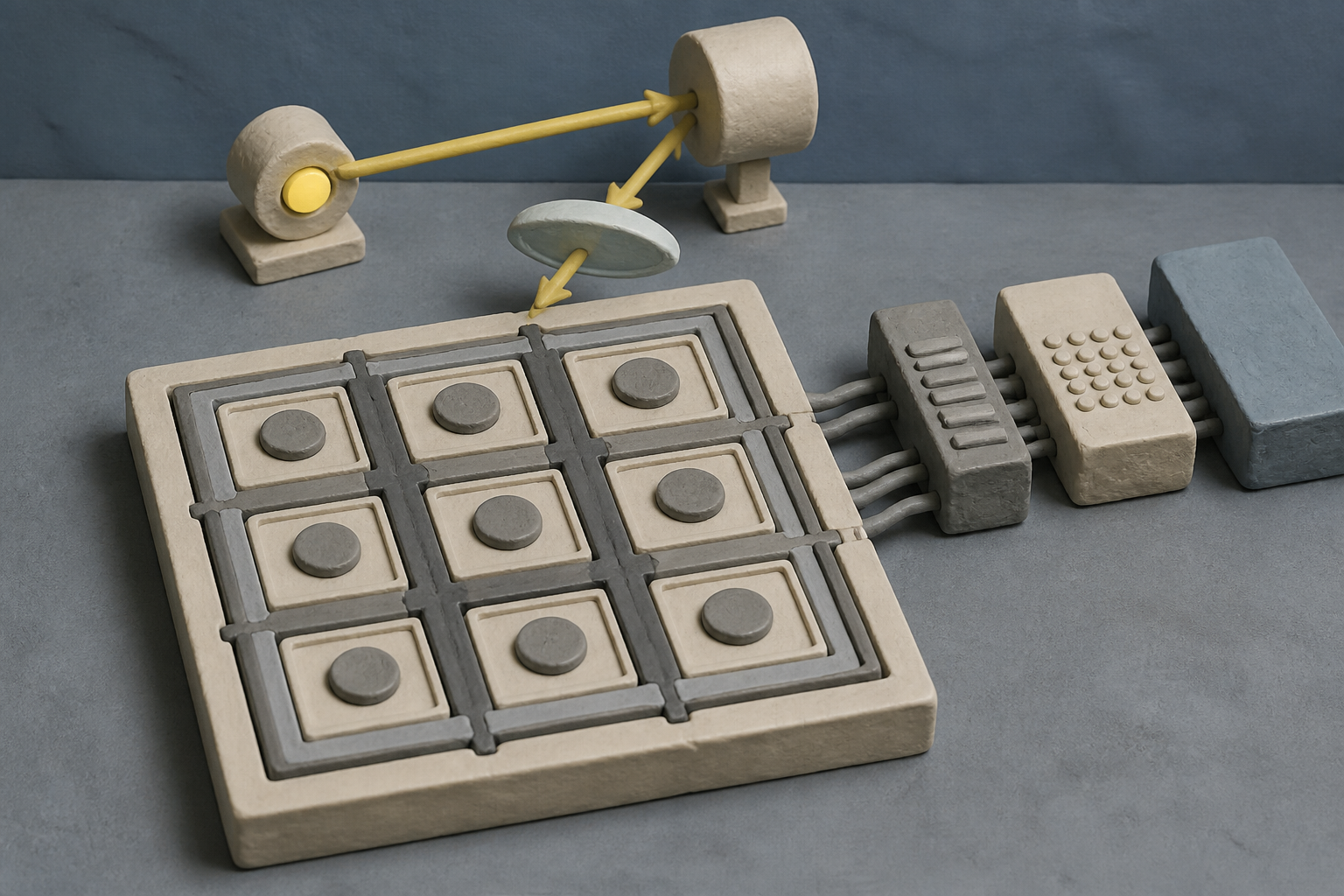
What changes in this design
Without the depth detail, a reader might picture the two inward-cut spaces in the supporting base as alike. A usual construction is not stated.
Here, the supporting base has two inward-cut spaces of unequal depth: the first is deeper than the second. It also supports pixels, light-detecting conversion elements, and grids outside pixel areas.
It matters for reading the details accurately: the two spaces are not the same depth. What the difference is meant to accomplish is not stated.
A face at arm's length
On a phone held too close to a face, a depth camera can be defeated by success. A nearer, brighter surface returns more infrared light to the sensor. That failure, I think, deserves more attention than the polished uses normally attached to depth maps: face unlock, portrait blur, and objects placed in augmented scenes.
Time-of-flight sensing is easy to describe and hard to keep honest, so I began there. It sends light out and estimates distance from its return. If a pixel fills before its measurement is complete, the result can be wrong. In a short-range, high-illumination scene, a precise sensor may be least reliable exactly where a person expects it to work.
A ring of second pixels
That problem, for me, sits behind US20260255084A1, published August 27, 2026. The application was filed July 14, 2025, and is assigned to SK hynix. The public filing describes a pixel-bearing substrate, photoelectric conversion elements, grids in non-pixel areas, and two recesses of different depths. The first recess is deeper than the second.
A technical account of the fuller disclosure frames it as a ToF sensor. A first sub-pixel is surrounded by second sub-pixels. When the first saturates in strong light or at short range, its optical charge can leak into the surrounding pixels; an image signal processor then sums their data. That strikes me as a careful idea: preserve the overflow as a signal rather than treating it only as damage. It is meant to improve dynamic range and use light more efficiently.
March 6, 2025
The filing becomes more interesting, for me, beside a date: March 6, 2025. On that day, SK hynix told employees it would discontinue its CMOS image sensor business after 18 years and move hundreds of staff toward AI memory work. The report attributed the decision to poor profitability in a market led by two rivals. Just over four months later, it filed this application.
That sequence isn't, as I read it, a promise of a new camera product. A patent application can preserve work as a product line closes. By 2026, SK hynix reported operating margins of 72 percent in the first quarter and 76.3 percent in the second, alongside its AI memory business. Those figures do not make a fable. They make the filing a durable trace of sensor work during a sharp change of direction.
The phones that moved on
The second warning I found was against treating every depth patent as a phone feature waiting to happen. Samsung put ToF cameras in phones through the Galaxy S20, then used laser autofocus in the Note 20 and S21. Reporting on a possible S22 omission pointed to weak consumer interest and AR apps that had not gained much use. A visible phone feature has to earn space, power, and cost.
Elsewhere, depth sensing has become less visible and more consequential. Sony announced its IMX459 stacked SPAD sensor for automotive LiDAR with a stated 300-meter detection distance and 15-centimeter range resolution. Another sensor supplier said in 2024 that it had already delivered two billion sensors, while adding modules for camera assist and AR/VR. A shift toward uses that can justify the extra hardware is what I see.
The part worth watching
That is why I would not judge this filing by whether it lands in a handset. Its strongest idea is not a longer range or a larger number. It is a response to saturation: use the center pixel's leaked charge in neighboring pixels, then combine their readings. The disclosure spans indirect and direct ToF, including SPAD modes. Other recent filings I found address the same overflow differently: switching between high- and low-gain readings, or draining excess charge to a power rail before timing data is corrupted. A published application cannot tell me whether any of it will become a shipped sensor.
Whether saturation is treated as a camera defect or as a condition to design around is what I'll watch. The examples I found favor the latter. Bright nearby surfaces will keep challenging ToF systems. That decision tends to be made at the bright, near edge of a scene. This application does not settle the issue. It gives us one small, specific answer from a company that had already decided to leave the market where that answer began.
Sources
Reporting for this piece drew on the published filing and the references below.
- US20260255084 - Image Sensing Device, Imaging System Including Image Sensing Device, And Method Of Operating Imaging System
- US20260255084 Image Sensing Device
- SK hynix to exit image sensor market to focus on AI chips
- SK hynix Tops Big Tech Profitability Rankings
- Galaxy S22 Might Skip The 3D ToF Sensor Yet Again
- Sony to Release a Stacked SPAD Depth Sensor for Automotive LiDAR Applications
- STMicroelectronics Expands into 3D Depth Sensing with Latest Time-of-flight Sensors
- Samsung Patent: Dual-Mode Time-of-Flight Depth Sensor
- Samsung Patent: Time-of-Flight Sensor Overflow Fix
The record, briefly. US20260255084A1, “Image Sensing Device, Imaging System Including Image Sensing Device, And Method Of Operating Imaging System” An image sensing device has substrate-supported pixels, photon-detecting photoelectric conversion elements, and grids in non-pixel areas. The substrate has first and second recesses, with the first recess deeper than the second.
More angles on this
- An 86-Millisecond Decision: The Ophthalmic Camera That Reads Its Own ExposureAnother reading from the same H04N classification family, pictorial communication, e.g. television.
- Dust Has a Data Identity CrisisAnother reading from the same G01S classification family, radio direction-finding.
- CPC H04N: Pictorial communication, e.g. televisionThe official classification family this record was filed into, published in the USPTO Cooperative Patent Classification scheme.
- CPC G01S: Radio direction-findingThe official classification family this record was filed into, published in the USPTO Cooperative Patent Classification scheme.
- Eight labels, two numbers, and the evidence a person gets before deciding anythingAnother reading from the neighbouring G01N classification family, investigating or analysing materials by determining their chemical or physical properties.
Read around this one:Public patent recordUSPTO published figure