Objects
An 86-Millisecond Decision: The Ophthalmic Camera That Reads Its Own Exposure
Takagi's new exposure patent arrives at a moment when slit-lamp photography is splitting between human judgment and automation.

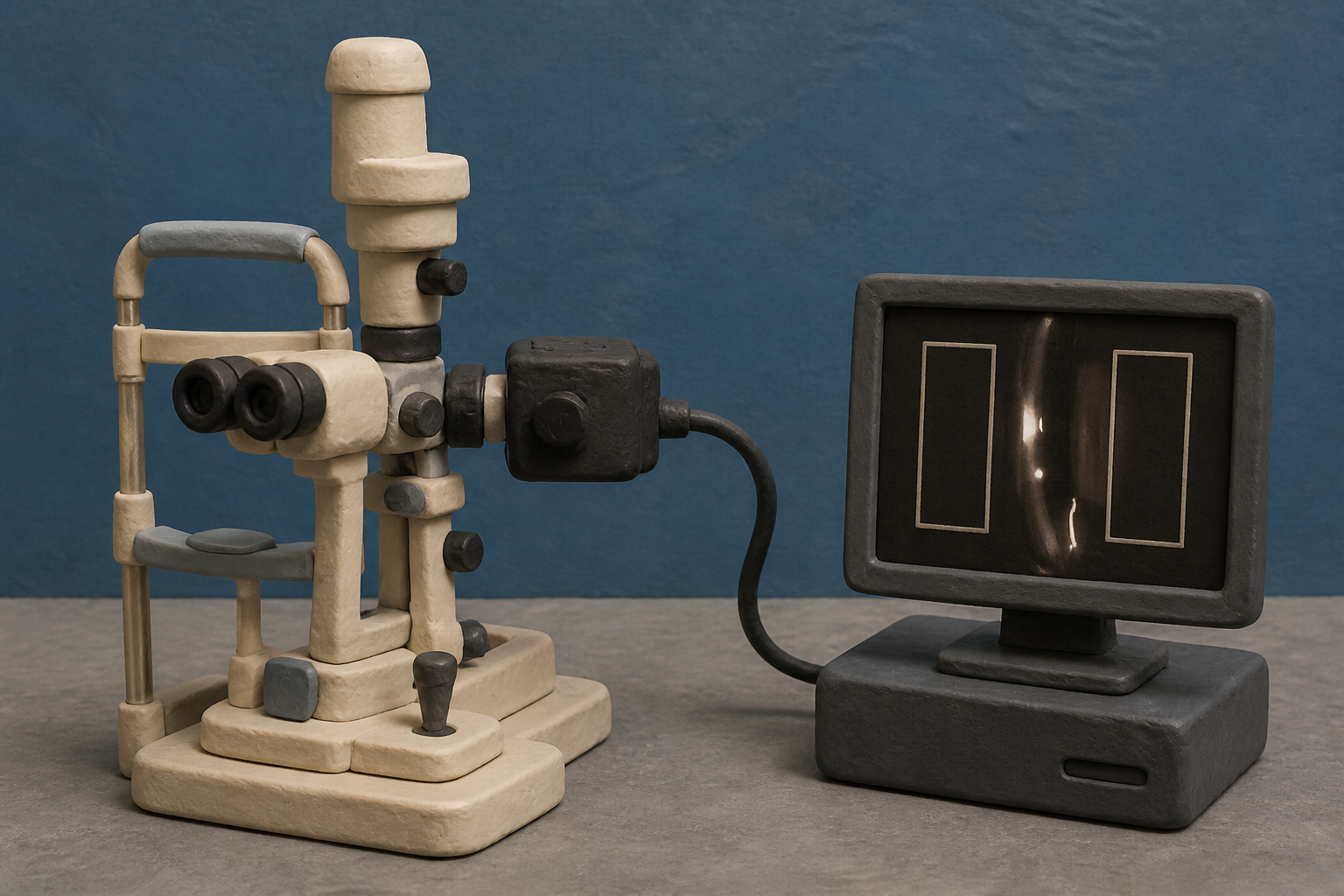
What changes in this design
A reader might assume the camera uses the brightness of its whole view to work out exposure time.
Instead, the system divides the eye-containing view into areas of differing brightness. The operator specifies one area, and that area's brightness is used to calculate exposure time.
That is worth knowing because it identifies the brightness information used in the calculation: the area selected by the operator.
A spot meter in 1988
In 1988, two ophthalmologists described a plain workaround: mount a standard 35 mm camera with spot metering on a conventional slit lamp. Their aim was to let even inexperienced operators make good clinical photographs. The light is not uniform, which is why I started there. A narrow, brilliant slice crosses an eye whose iris, cornea, lashes, and surrounding face do not reflect it in the same way.
Exposure became the nuisance, and I can see why. Bright detail can vanish into black, while a dark region can leave the beam burned out. The old fix was simple and demanding: point the meter at the patch that matters, then let that patch, not the average frame, decide exposure.
The exposure table
In an ophthalmic photographers' guide, I found the manual version: flash power, aperture, beam width, filters, and iris color all changed the result. A 0.3 neutral-density filter cost one stop; practitioners bracketed half a stop either side. Blue irides reflected more light than brown ones, and ISO 400 served dim indirect illumination.
That list isn't quaint to me. It records what an experienced photographer holds in mind while a patient waits. The lesson, I think, is not to surrender judgment to automatic exposure. A system should let the operator say which part of a difficult image deserves to be right.
A Nagano camera system
That is where US20260255068A1 enters. Published August 27, 2026, it is assigned to Takagi Seiko Co., Ltd. in Nakano, Nagano. The proposed camera captures a target range including the eye, divides it into areas of different brightness, and calculates exposure time from an operator-specified area's brightness. Dependent claims add HDR processing from high- and low-brightness acquisitions. No claim I see identifies the clinically important feature; the person at the joystick still makes that call.
That restraint fits the product history I found. In 2024, Takagi announced the TD12, a 12.4-megapixel camera and image-filing system for its slit lamps, with joystick-button capture and automatic exposure for changing lighting. It said the product launched October 1, subject to regulatory approvals. At a 2026 congress, it showed 700GL and 4ZL slit lamps with camera and filing software. Founded in 1955, the company profile lists about 236 employees and says it holds Japan's largest slit-lamp share. The filing reads to me as an effort to preserve a familiar clinical gesture while making it less fragile.
An 86-millisecond robot
This filing does not, I think, belong in a simple story of smarter cameras. At one end, I found a 2026 paper describing a contactless slit lamp on a vision-guided robot arm. It autonomously aligned with live human eyes, used programmable illumination, and reported roughly 86 milliseconds of illumination-control latency without mechanical stabilization. There, the system has taken on much of the adjustment before a photographer chooses an exposure area.
At the other end, I found a 2025 study in which 40 ophthalmologists classified 100 images: half from an iPhone 13 Pro and half from a diffuser slit lamp. With AI support, accuracy rose from 79.2 to 88.8 percent. The evidence I take from that is not that image quality stopped mattering, but that diagnosis can help across camera types. A 2026 cataract comparison points the other way: graders gave the conventional camera a 96.5 percent preference rate, yet its nuclear-opalescence grading reliability was poor, with an ICC of 0.394. From both sides, we are testing the familiar instrument's limits.
What the filing is really betting on
This is, in my view, a sensible, bounded bet. The filing assumes clinical attention will remain human at capture, even if the workflow around it becomes more automated. It does not promise a robot that finds the eye or software that names a disease. It tries to make one old decision easier to repeat: which unevenly lit portion should govern the photograph? That is, I think, more useful than making automatic exposure less specific.
Keeping the claims in proportion is still what I would do. A patent application does not show that the system works in clinics or establish clearance for this imaging accessory. The international slit-lamp standard excludes photographic equipment from its scope, making the camera system a separate engineering and validation question. For that reason, I find Takagi's choice revealing: it bets that better measurement will matter when clinicians, cameras, and software divide the work differently.
Sources
Reporting for this piece drew on the published filing and the references below.
- Ophthalmic Equipment Imaging System and Non-Transitory Computer-Readable Media
- OPHTHALMIC EQUIPMENT IMAGING SYSTEM AND NON-TRANSITORY COMPUTER-READABLE MEDIA
- Slit-lamp photography made easy by a spot metering system
- Slit Lamp Biomicrography Exposure
- TAKAGI's Imaging System TD12 Coming Soon
- APAO 2026
- Company profile of Takagi Seiko Co., Ltd.
- PubMed abstracts for robotic slit lamp, CorneAI, and MIDAS
- ISO 10939:2017 - Ophthalmic instruments - Slit-lamp microscopes
The record, briefly. US20260255068A1, “Ophthalmic Equipment Imaging System And Non-Transitory Computer-Readable Media” A system includes a camera that captures an image capture target range including a subject's eye and an exposure time calculation device that divides the range into areas of different brightness and calculates camera exposure time using an operator-specified area's brightness.
More angles on this
- A Reading Taken in the Ear, and the File It Has to ReachAnother reading from the same A61B classification family, diagnosis; surgery; identification.
- CPC H04N: Pictorial communication, e.g. televisionThe official classification family this record was filed into, published in the USPTO Cooperative Patent Classification scheme.
- CPC A61B: Diagnosis; surgery; identificationThe official classification family this record was filed into, published in the USPTO Cooperative Patent Classification scheme.
- Confectionery Receives a Second Design ReviewAnother reading from the neighbouring A61K classification family, preparations for medical, dental or toiletry purposes.
- Keeping Time Across a StackAnother reading from the wider H10B classification family, electronic memory devices.
Read around this one:Public patent recordUSPTO published figure