Machines
A Reading Taken in the Ear, and the File It Has to Reach
Bragi quit making earbuds in 2019. Nine years on, a 2017 provisional is still publishing patents about a paperwork problem someone else solved.

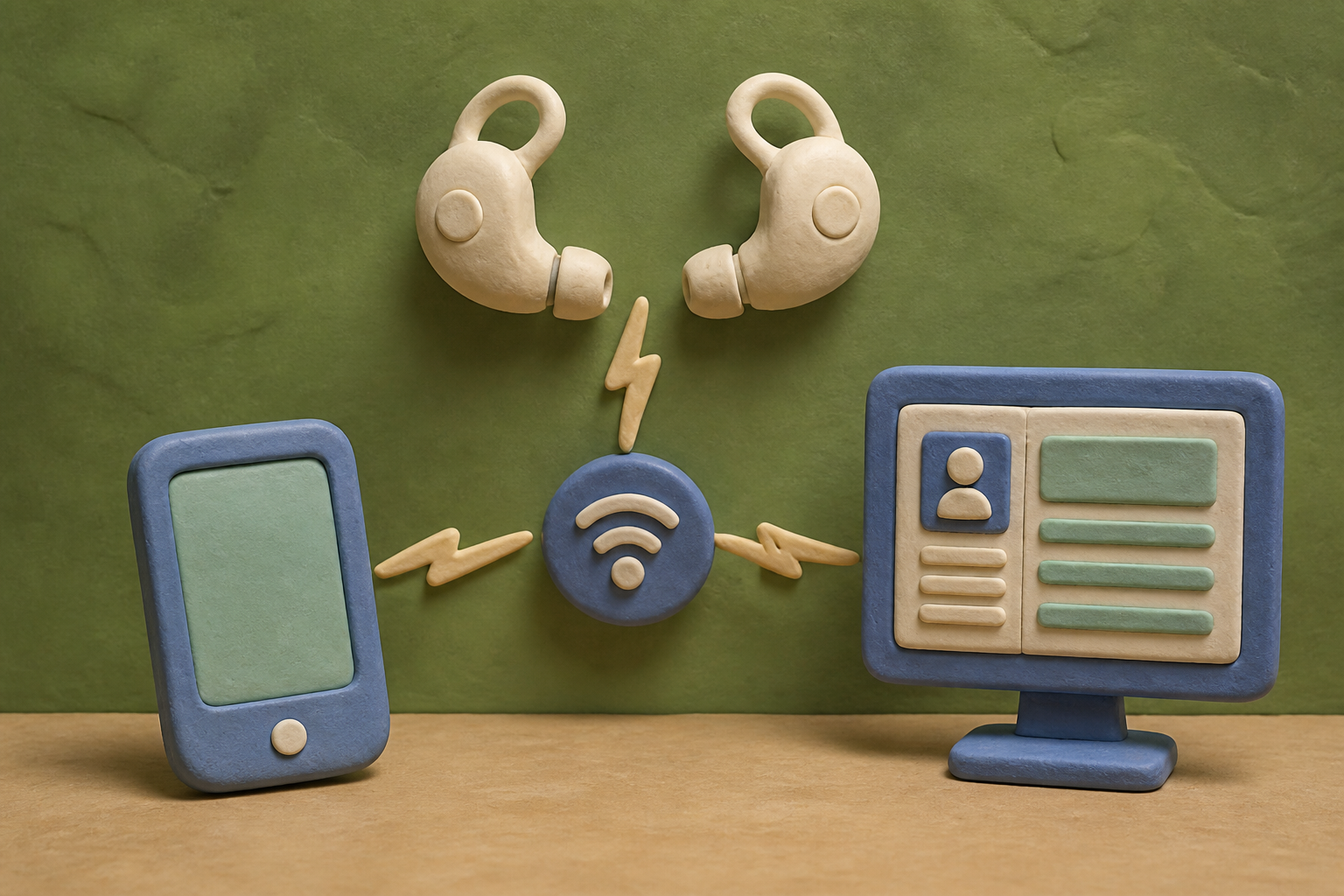
What changes in this design
Without this setup, a reader might expect information from an earpiece to need a separate step before it appears in a digital medical file.
Here, wireless earpieces provide sensor readings that are analyzed, linked to the user's electronic medical record, and used to add information to it. Communications that include the record are also sent.
It is worth knowing because it links something worn in the ear with a person's digital medical file. The kind of reading and any particular medical use are not stated.
Half the office day, spent on paperwork
The number that pulled me into this is 49 percent. In September 2016 a time-and-motion study in the Annals of Internal Medicine, "Allocation of Physician Time in Ambulatory Practice," reported that physicians spent 27 percent of the office day in direct clinical face time and 49 percent on electronic health records and desk work. Then one to two hours of their own time at night, entering data.
If you made hardware in 2016, that gap looks like an opening. A device is already in the patient's ear. It can already read a pulse. Why should anyone type what a sensor could write?
A March 2017 provisional, still publishing in 2026
That is close to the idea in a filing published this year, US20260253694A1, "System And Method For Populating Electronic Medical Records With Wireless Earpieces." Earpiece sensors take measurements, which are analyzed, matched to a person's record, used to fill it in, and sent onward. The inventor is Peter Vincent Boesen and the applicant is Bragi GmbH, whose Dash earbuds raised $3.3 million on Kickstarter in 2014 and reached buyers before AirPods did.
What caught my eye is the paperwork behind the paperwork. This traces back to a provisional filed on 22 March 2017, then through applications filed in March 2018, June 2022 and July 2023, two of which were granted in July 2023 and September 2024. Bragi filed two provisionals that same day in 2017, one for medical records and one for health records, and both families are still producing grants, the sibling one as recently as July 2025. Both are set to expire on 21 March 2038.
Bragi sold its hardware business in March 2019, and its chief executive said the company had completed its transformation into a software, AI and IP licensing company. So the earpiece in this filing is being described by a company that has not shipped one in about seven years.
What actually took the notes at Kaiser
Meanwhile the problem got solved, by a different machine listening to a different thing. Between October 2023 and December 2024, 7,260 physicians in the Permanente Medical Group used an ambient AI scribe across 2,576,627 encounters and saved close to 16,000 hours of documentation time. Of those surveyed, 88 percent said it improved the visit itself.
That approach doesn't read the ear. It listens to the conversation that was going to happen anyway, and writes prose a clinician can correct. It's a different bet about where the contents of a medical record come from, and I think it's the right one. Most of it comes out of people's mouths.
Forty percent of the signal, thrown away
The sensor half has a problem of its own. The best clinical check I found on in-ear pulse readings covered 97 patients and 2,048 hours with a CE-marked in-ear device. Quality-filtered, it tracked ECG well: bias 0.78 bpm, error 2.57 percent. Unfiltered, the same data gave 7.94 percent error and limits of agreement from 23 beats below to 27 above. Reaching the good numbers meant discarding roughly 40 percent of the raw signal, and the patients were sitting still. Accuracy during activity was not tested.
Then there is the receiving end. In a study published in May 2025, researchers interviewed 18 clinicians and 25 patients in a San Francisco safety-net system and observed 15 visits. The clinicians had no workflow for data arriving from patients' devices, and the burden landed on primary care. One asked what they were meant to do with more information, and whether a plan was in place. A separate survey of more than 2,200 physicians found medical-legal liability the top US workflow concern, with no billing code for reviewing such data in a visit.
The consortium taking the claims apart
While the applications kept coming, the claims kept falling. On 5 November 2024 the Patent Trial and Appeal Board held challenged claims of a Bragi earpiece patent unpatentable as obvious. On 22 January 2025 it did the same to a second one, as both anticipated and obvious, over prior art on hearing aids with magnetic field sensors. The petitioner both times was HIMPP, the hearing-aid industry's collective patent vehicle, whose partners supply more than 90 percent of the world's hearing instruments and which says it exists to clear the road of unjust IP obstacles.
Regulated medical function did arrive in earbuds, just not by this route. In September 2024 US regulators authorized the first over-the-counter hearing aid software, running on a large phone maker's earbuds, on the strength of a 118-subject study.
The open question
I don't think the idea here is a bad one. The granted claim in this family is careful: the earpiece sends the populated record to an authorized medical professional for validation. Someone still checks. But the friction was never getting numbers into a chart. It was a person having to read them, decide what they mean, and carry the risk of being wrong.
So what is a patent for once its premise has moved on? Twelve years of term are left on both families, while the burden they invoke is being eased by something that listens rather than measures, and the clinicians who would receive the ear data are still asking who is supposed to read it.
Sources
Reporting for this piece drew on the published filing and the references below.
- US11710545B2 - System and method for populating electronic medical records with wireless earpieces
- US12087415B2 - System and method for populating electronic medical records with wireless earpieces
- US12354715B2 - System and method for populating electronic health records with wireless earpieces
- US20260253694A1 - public record
- Bragi sells off hardware business, will focus on licenses and software (TechCrunch)
- Study: Physicians spend nearly twice as much time on EHR/desk work as patients (AHA News)
- AI-assisted notetaking gains steady support from Kaiser Permanente physicians
- Accurate detection of heart rate using in-ear photoplethysmography in a clinical setting
- Factors impacting electronic patient-generated data use in safety-net systems (JAMIA)
- Here's how to make the most of patients' wearable data (American Medical Association)
- FDA Authorizes First Over-the-Counter Hearing Aid Software
The record, briefly. US20260253694A1, “System And Method For Populating Electronic Medical Records With Wireless Earpieces” A system, method, and wireless earpieces populate a user's electronic medical record using wireless-earpiece sensor measurements. The measurements are analyzed, associated with the user's record, used to populate it, and communications including the record are communicated.
More angles on this
- A Setting Is Not a Promise: Inspecting the HingeAnother reading from the same G16H classification family, healthcare informatics.
- A Handoff Worth Watching: Fragment-Based Drug Design With an Assistant at the BenchAnother reading from the same G16H classification family, healthcare informatics.
- CPC G16H: Healthcare informaticsThe official classification family this record was filed into, published in the USPTO Cooperative Patent Classification scheme.
- CPC A61B: Diagnosis; surgery; identificationThe official classification family this record was filed into, published in the USPTO Cooperative Patent Classification scheme.
- Measurement And Analysis Method For Detecting And Quantifying Makes a Small Case for Better TimingAnother reading from the neighbouring G16B classification family, bioinformatics.
Read around this one:Public patent recordUSPTO published figure