Field Notes
A Handoff Worth Watching: Fragment-Based Drug Design With an Assistant at the Bench
One Drexel patent sits where an old drug-discovery method meets AI's first hard clinical reckoning.

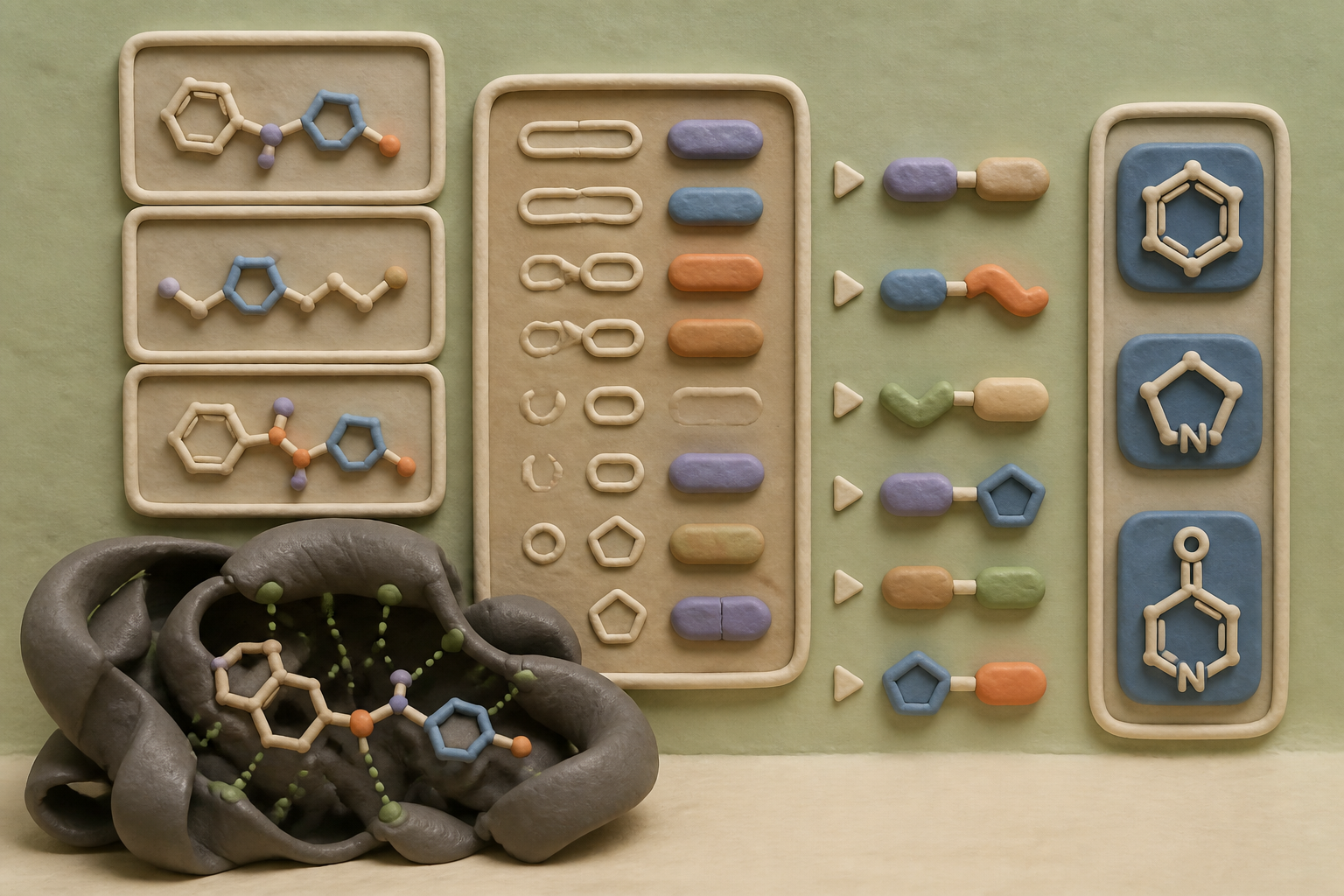
What changes in this design
A reader might expect drug discovery to mean searching for possible medicines. In this context, the immediate job is identifying compounds expected to bind strongly to therapeutic targets.
This record describes using artificial intelligence for that identification step. It identifies compounds expected to have potent binding affinities, meaning strong attachment, at therapeutic targets of interest.
This is worth knowing because expected strong binding is the focus used to identify compounds. The record does not state which diseases, targets, compounds, or results are involved.
January 2020
In January 2020, DSP-1181 entered a Phase I clinical trial and was described as the first AI-designed drug to reach that stage. The record did not end in a launch, so I start there. In July 2022, the program was discontinued after its Phase I study did not meet expected standards.
That failure isn't a verdict on computational drug design, I don't think. It is, I think, a useful measure of the distance between selecting a promising molecule and proving that it can become a medicine. That distance is where the newest filing I read deserves scrutiny.
The word assisted
The filing is US20260253664A1, assigned to Drexel University and published on August 27, 2026. The filing's story begins earlier, I found: the utility application was filed February 28, 2024, and claims priority to a provisional filed February 28, 2023. The provisional's recorded title said Artificial Intelligence Based; the later filing says Artificial Intelligence Assisted.
Assisted better matches the machinery described, I think. The first claim calls for multiple ligands to be docked to a protein representation, broken into fragments, scored for interaction energy, then computationally joined when they rank in the top 10 percent. That is a coherent search procedure. A patent claim is not, as I read it, a bench result or evidence that the resulting molecule is a drug.
250,000 ligands
To see what the patent's workflow looked like in practice, I went to the Drexel authors' associated paper. They docked a 250,000-ligand library with AutoDock VINA, fragmented the top 10,000 candidates with BRICS, and used a genetic algorithm to assemble fragments. The paper reports its best predicted VINA scores as -14.37 for TIPE2, -14.06 for bacterial RelA, and -12.49 kcal/mol for the SARS-CoV-2 spike receptor-binding domain.
The word predicted is what I want to keep attached to those numbers. A docking score ranks candidates under a computational scoring system; it does not show that a substance binds in cells, reaches its target safely, or treats disease. The authors say deep learning probes only a minute subspace of chemical structure space, so I see evolutionary search, rather than a fashionable label, as the method's central idea. The authors report better predicted VINA scores than DeepFrag and AutoGrow4. That is, to me, a useful comparison, not a clinical result.
Seven, or eight
The work was visible in public papers before this patent appeared. A first paper from the lab was published online in November 2023, and the follow-up was published online in May 2024 after peer review. That doesn't make the patent empty, I don't think: filings and papers serve different purposes. It does mean that the papers, not the title alone, are the better place to judge what was actually tested.
Fragment-based discovery had already earned its place without the newer label. A review table I found lists seven FDA-approved fragment-derived drugs, while a trade account counts eight and says more than 50 compounds are in clinical stages. That discrepancy is not one I'll flatten into a neat number. Both sources support the larger point: this is a route to medicines with a record built on experiments as well as computation.
Where the risk actually sits
The timing makes the label harder to wave through. A May 2026 status report counted more than 75 AI-designed or AI-shaped molecules in human trials, yet reported no FDA approval and judged a first approval unlikely before 2028. Two sobering Phase 2 stories from Recursion also caught my attention: one program missed its endpoint, and another produced equivocal data. A growing pipeline is not the same as clinical proof.
The risk, for me, sits in the handoff from calculation to consequence. The FDA's January 2025 draft guidance sets out a risk-based credibility assessment for an AI system in its context of use before its output supports a drug regulatory decision. That is sensible. US20260253664A1 is, to me, a useful claim to a way of searching chemical possibilities, not a shortcut past validation. A 2026 field review says AI integration has addressed challenges in fragment choice and interaction prediction, but experimental validation remains essential. That boundary is, I think, the whole story. The molecule still has to survive the work that has humbled every generation of drug design.
Sources
Reporting for this piece drew on the published filing and the references below.
- Artificial Intelligence Assisted Computational Fragment-Based Drug Design
- US Patent Application 20260253664 - Artificial Intelligence Assisted Computational Fragment-Based Drug Design
- Streamlining Computational Fragment-Based Drug Discovery through Evolutionary Optimization Informed by Ligand-Based Virtual Prescreening
- Streamlining Computational Fragment-Based Drug Discovery
- Fragment databases from screened ligands for drug discovery (FDSL-DD)
- FDA-approved drugs derived from FBDD screening campaigns
- Fragment-Based Drug Discovery (FBDD): Workflow, Benefits, and How It's Shaping the Future of Drug Research
- Delving into the Latest Updates
- AI-Designed Drugs in Human Trials 2026
- Considerations for the Use of Artificial Intelligence To Support Regulatory Decision-Making for Drug and Biological Products
- The expectations of in silico fragment-based drug design and future challenges
The record, briefly. US20260253664A1, “Artificial Intelligence Assisted Computational Fragment-Based Drug Design” Methods improve drug discovery by using artificial intelligence to identify compounds expected to have potent binding affinities at therapeutic targets of interest.
Identity details. The saved title-page transcription needs review, so names are not repeated here. Check the official published title page.
More angles on this
- Next Generation Prenatal Screening: A Probability Where a Verdict Was ExpectedAnother reading from the same G16B classification family, bioinformatics.
- CPC G16B: BioinformaticsThe official classification family this record was filed into, published in the USPTO Cooperative Patent Classification scheme.
- CPC G16H: Healthcare informaticsThe official classification family this record was filed into, published in the USPTO Cooperative Patent Classification scheme.
- In-Memory Computation System Using A Segmented Memory Architecture With Marks a Pause Worth NoticingAnother reading from the wider G11C classification family, static stores.
- When a System Learns to NapAnother reading in the same Field Notes category on this site.
Read around this one:Public patent recordUSPTO published figure