Field Notes
Next Generation Prenatal Screening: A Probability Where a Verdict Was Expected
A prenatal-screening filing arrives after a company sale, as faulty positives, regulation, and patents crowd the same decision.

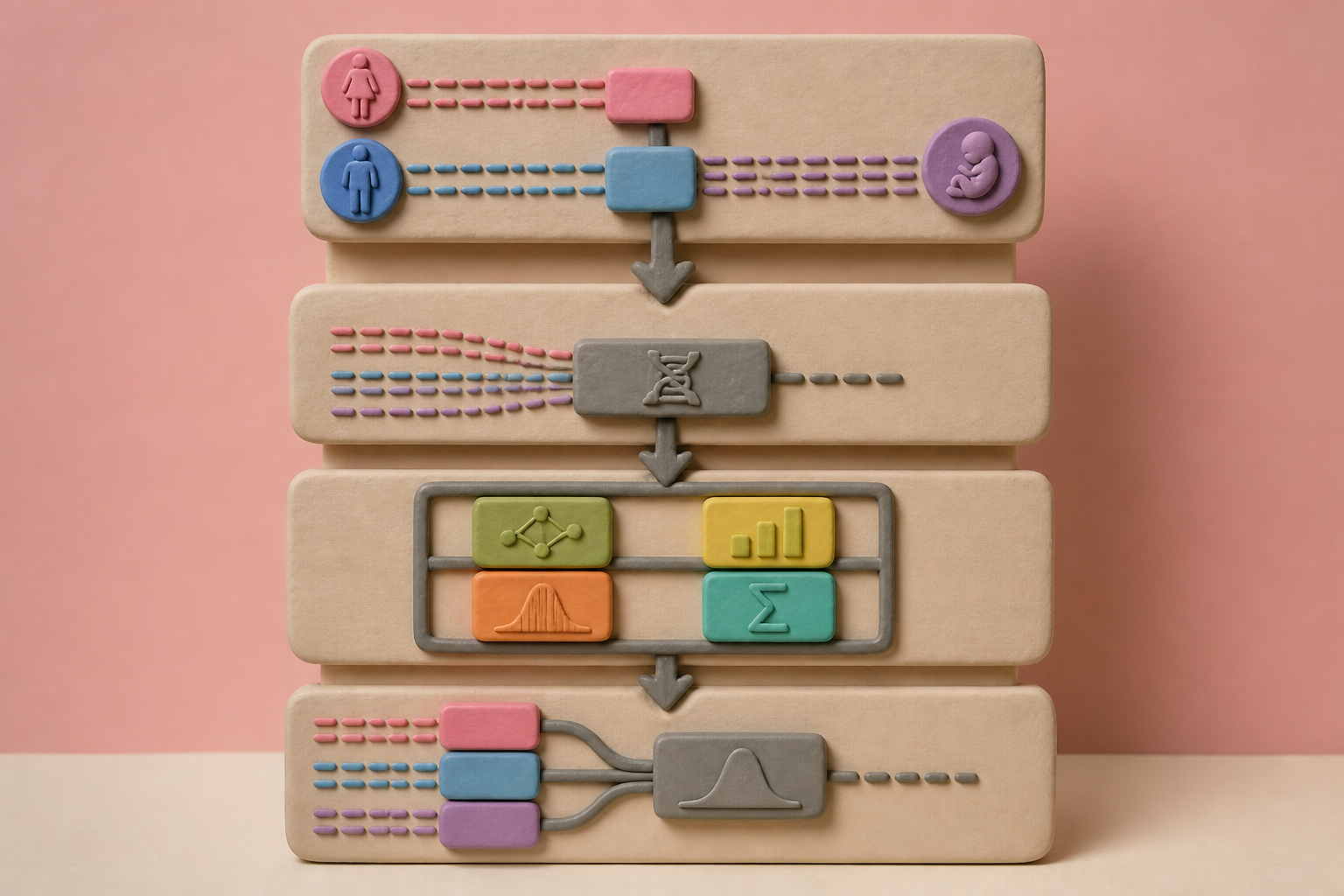
What changes in this design
A reader might expect a prenatal screening question to end with a simple answer: whether a fetus has a certain DNA variation or does not.
It processes DNA information from the fetus and parent or parents using a reference genome, then uses a Bayesian framework - a way of calculating probabilities - to work out chances for possible fetal genetic results.
For a reader, the key point is that it calculates chances for possible fetal genetic results; no rule for turning a chance into a final yes-or-no decision is stated.
Five tests, many consequences
The number I began with, about 85 percent, makes a new prenatal-screening patent hard to read calmly. A January 2022 investigation, later cited in a medical-journal account of laboratory-test regulation, found that positive results from five common prenatal genetic tests were wrong about 85 percent of the time on average. Screening is not diagnosis, but that distinction can disappear when an alarming result arrives on a phone. Noninvasive testing is a genuine advance: fetal DNA fragments in maternal plasma made it possible to screen without the small but real miscarriage risk of amniocentesis or chorionic-villus sampling. That is an advance I welcome. Yet I think a better statistical call is only helpful if we carry the uncertainty with it, all the way to the conversation a family has next.
610 fetuses in Britain
That is why I went back to a 2019 British study of fetal structural anomalies seen on ultrasound. Its researchers examined 610 fetuses, mainly as 596 parent-fetus trios, and identified a diagnostic variant in 52 cases, or 8.5 percent. Their clinical panel used Sapientia software from Congenica, the Cambridge genomics company that later filed this application. This was not population screening: every pregnancy already had a reason for closer genetic investigation. Still, it puts the filing in a real clinical lineage. Published evidence, in my view, shows that its assignee had experience with the hard work of interpreting fetal sequence data, not merely an interest in the category.
August 27, 2026
US20260253666A1 was published on August 27, 2026, after being filed on November 29, 2022. Under its title, Next Generation Prenatal Screening, it describes receiving genomic data from fetal and parental samples, processing it against a reference genome, and applying a Bayesian framework to calculate posterior probabilities for fetal genotypes. Put plainly, it is a proposed way to weigh competing genetic explanations in genomic data. That is, I think, a sensible technical target. But the application describes an inference method, not a guarantee that a positive result will be clinically meaningful. The difference matters most when the result is hard to hear.
September 2025
Timing makes this feel less like a laboratory footnote. Congenica was acquired by SeqOne in September 2025, nearly a year before the application became public. A prenatal screening product was not something I could find on its site. A hidden plan is not something I'll infer from that absence. A patent application can protect research, a possible product path, or a legal position. What I can see is an effort to hold onto a way of making fetal genetic calls while the company itself changed hands.
The $429.5 million boundary
The setting is already crowded. Professional guidance in 2020 extended cell-free DNA screening to all patients, regardless of maternal age or baseline risk. In January 2025, a federal appeals court upheld decisions sustaining prenatal genetic-testing method patents, preserving $429.5 million in damages against two testing companies. That is not, in my reading, proof that this filing conflicts with any particular patent. That is, to me, evidence that methods for obtaining or interpreting fetal genetic information carry real legal weight. Then, in May 2024, the FDA finalized a rule intended to bring laboratory-developed tests, including prenatal screens, under federal oversight after decades of enforcement discretion. Both pressures, I think, point in the same direction: any new statistical approach must be demonstrably accurate, candid about false positives and limits, and clear that a screen is not a diagnosis.
The open question
What's left is the question I care about: will this Bayesian method help families get a more reliable answer where the data are hardest to interpret, or make a probability look more certain than it is? A public prenatal product from the company is not something I have seen, and the method described here does not itself settle that question. Clinical validation that does is something I would welcome. For now, I see a carefully framed claim entering a market shaped by wide access, expensive patents, and closer scrutiny. The arithmetic deserves respect. So does the moment when someone is asked to trust it.
Sources
Reporting for this piece drew on the published filing and the references below.
- Next Generation Prenatal Screening
- US Patent Application 20260253666, NEXT GENERATION PRENATAL SCREENING
- Noninvasive prenatal testing using fetal DNA
- Prenatal exome sequencing analysis in fetal structural anomalies detected by ultrasonography (PAGE): a cohort study
- SeqOne acquires Congenica to create a global leader in AI-powered genomic medicine
- Congenica - Clinical Genomic Interpretation Platform
- ACOG Practice Bulletin #226: Screening for Chromosomal Abnormalities
- FDA Moves to Scrutinize Specialized Health Screenings
- The US FDA's New Rule for Regulating Laboratory-Developed Tests
- Desmarais LLP Earns Appellate Victories for Ravgen's Prenatal Genetic-Testing Patent
The record, briefly. US20260253666A1, “Next Generation Prenatal Screening” A method determines whether a fetal DNA sequence variant is present by receiving genomic data for fetal and parental samples, processing the samples using a reference genome, and applying a Bayesian framework to compute posterior probabilities for fetal genotypes.
Identity details. The saved title-page transcription needs review, so names are not repeated here. Check the official published title page.
More angles on this
- CPC G16B: BioinformaticsThe official classification family this record was filed into, published in the USPTO Cooperative Patent Classification scheme.
- In-Memory Computation System Using A Segmented Memory Architecture With Marks a Pause Worth NoticingAnother reading from the wider G11C classification family, static stores.
- When a System Learns to NapAnother reading in the same Field Notes category on this site.
Read around this one:Public patent recordUSPTO published figure