Field Notes
When a System Learns to Nap
An overlooked memory clock is becoming a test of whether AI infrastructure can cut idle power without adding delay.

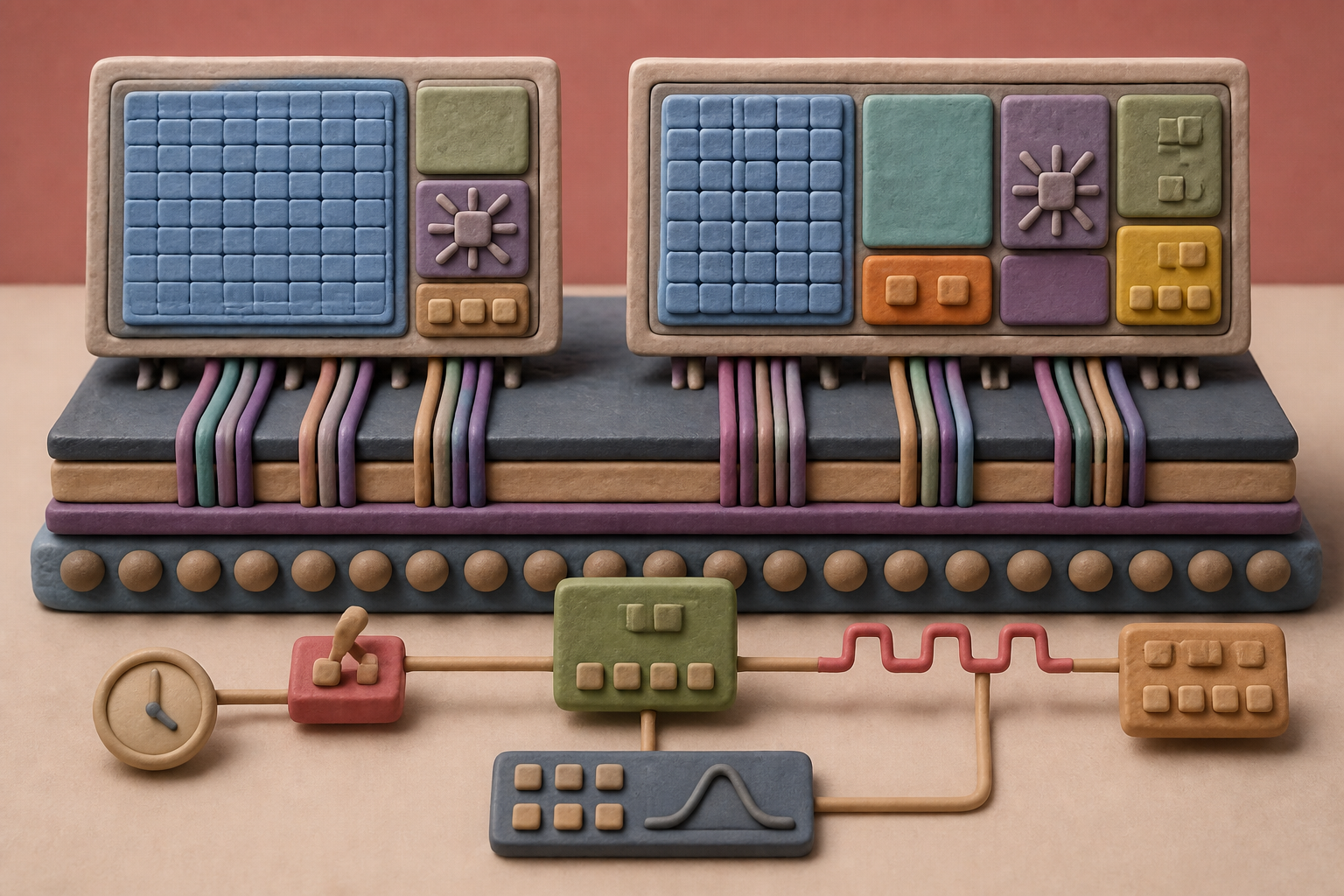
What changes in this design
Without this approach, a reader might picture the memory controller's timing signal continuing even when its interface has no activity.
This record says clock-gating logic can pause that timing signal while the interface is idle, then restore it after a memory access request for a period based on timing parameters obtained by the controller.
It gives a simple picture of the goal: avoid keeping the controller's timing signal running during idle time, to reduce memory-subsystem power use.
The 500-kilowatt line
The deadline I keep returning to was 15 May 2026, and it landed far from a chip lab. Under an EU rule, data centres with at least 500 kW of installed IT power had to report annual energy, water, waste heat, and grid-service participation. The reports do not make a server use less electricity. They make the quiet hours visible. Memory belongs in that scrutiny, as I see it: one reported industry roadmap projects per-stack power rising from about 75 W at HBM4 to 180 W at HBM8 by 2038, with 32 HBM7 stacks drawing more than 13,000 W of memory power in one future accelerator. Those are projections, not deployed products.
The base-die clock
That concern led me to US20260253626A1. Clock Gating Techniques For Memory Subsystems is a narrow-sounding publication aimed at a stubborn habit inside high-bandwidth memory: leaving the clock from a memory controller to its input/output interface running. In the described HBM system, that can be a DFI clock on the base die. Existing designs have left it free-running so training, voltage tracking, and temperature tracking can proceed. The new logic reads to me as a tighter bargain: when the request interface is idle, it gates the clock; when a memory access request appears, it starts the clock again. It can do that independently for each memory channel.
Thirty-two channels
The standard's rapid change also stood out to me. JEDEC published HBM4 in April 2025 with up to 2 TB/s per stack over a 2048-bit interface and 32 independent channels. That is context, not proof of savings, in my view. More channels may create more chances for one part of memory to wait while another is working. The filing does not treat wakeup as a generic timeout. It draws on controller timing parameters: latency values from registers, read and write preambles and postambles, strobe-to-data timing, burst length, and a programmable margin. That timing budget, I think, is the essential idea, because speed is the condition for any power saving here.
Five hundred twelve cycles
Older server-memory accounts show the underlying bind I have seen. PowerDown could use only about 4 percent of active DRAM power, but its wake took roughly 512 clock cycles. Active standby consumed about 22 percent because servers could not usually afford that exit delay, and the account put server utilization at 15 to 55 percent. Those figures are not, in my view, a measure of today's HBM. They explain, for me, why this filing seeks a gain without relying on a deep-sleep transition. The target is a smaller source of waste: a controller-to-interface clock that can be resumed on a schedule the controller already knows.
An early command signal
A related 2024 Intel application I found sits at the same controller-to-PHY boundary. It gates a PHY command clock and receiver-bias circuitry, then uses an early command indication before any command and a read indication with every read, intended to avoid added read latency. In a 16-channel, 2:1 read-to-write example, it claims about 2.25 W of savings. The comparison matters to me because it puts the fight exactly where it belongs: not in a grand shutdown, but in small, fast-waking parts of the memory path. A needed restraint I found comes from recent accelerator measurements. Loading a CUDA context produced a 26 to 66 W jump above bare idle, attributed to DVFS state rather than memory; VRAM occupancy moved idle power by less than 0.02 W per GB, and a real 7B model changed it by under 0.5 W.
What the filing is really betting on
That counterweight is not something I will smooth over. US20260253626A1 does not establish how many watts it will save in a shipping accelerator, and I would not infer a number from its design. Its more defensible bet is narrower: if a DFI clock is needlessly free-running between requests, a controller that knows its own timing can turn it off and still be ready on time. That is credible, I think. HBM4's 32 independent channels and selectable supply-voltage levels are signs that efficiency will be handled in pieces, while reporting rules make facilities count the outcome. This filing is one useful move in a larger power fight, not a verdict on where an accelerator's idle power really goes.
Sources
Reporting for this piece drew on the published filing and the references below.
- Clock Gating Techniques For Memory Subsystems
- CLOCK GATING TECHNIQUES FOR MEMORY SUBSYSTEMS - Patents-Review.com
- Data centre energy performance reporting
- Next-Gen HBM roadmap projects 6TB+ HBM7 memory and 15,000W AI accelerators within a decade
- JEDEC and Industry Leaders Collaborate to Release JESD270-4 HBM4 Standard
- The Power of Memory
- Apparatus and Method to Reduce Memory Power Consumption in a Memory PHY in a Memory Controller
- The Model Parking Tax: Quantifying the Hidden Energy Cost of Always-On GPU Model Deployment
The record, briefly. US20260253626A1, “Clock Gating Techniques For Memory Subsystems” Clock gating logic can gate a memory-controller clock when its interface is idle, then ungate it after a memory access request for a duration based on controller-obtained timing parameters, including latency values, to reduce memory-subsystem power use.
Identity details. The saved title-page transcription needs review, so names are not repeated here. Check the official published title page.
More angles on this
- A Sideways Reading of Split StaircasesAnother reading from the same G11C classification family, static stores.
- CPC G11C: Static storesThe official classification family this record was filed into, published in the USPTO Cooperative Patent Classification scheme.
- Liquid Cooling Heat Dissipation Device For Multi-Disk Drive System Marks a Pause Worth NoticingAnother reading from the neighbouring G11B classification family, information storage based on relative movement between record carrier and transducer.
- When a Vehicle Notices Something, Who Decides What the Moment Means?Another reading from the wider G06V classification family, image or video recognition or understanding.
- The Clip Needs Its ContextAnother reading in the same Field Notes category on this site.
Read around this one:Public patent recordUSPTO published figure