Groundwork
Liquid Cooling Heat Dissipation Device For Multi-Disk Drive System Marks a Pause Worth Noticing
A new patent plumbs coolant into hard disk shelves that barely draw 500 watts, which tells you the real enemy is not heat but the fans.

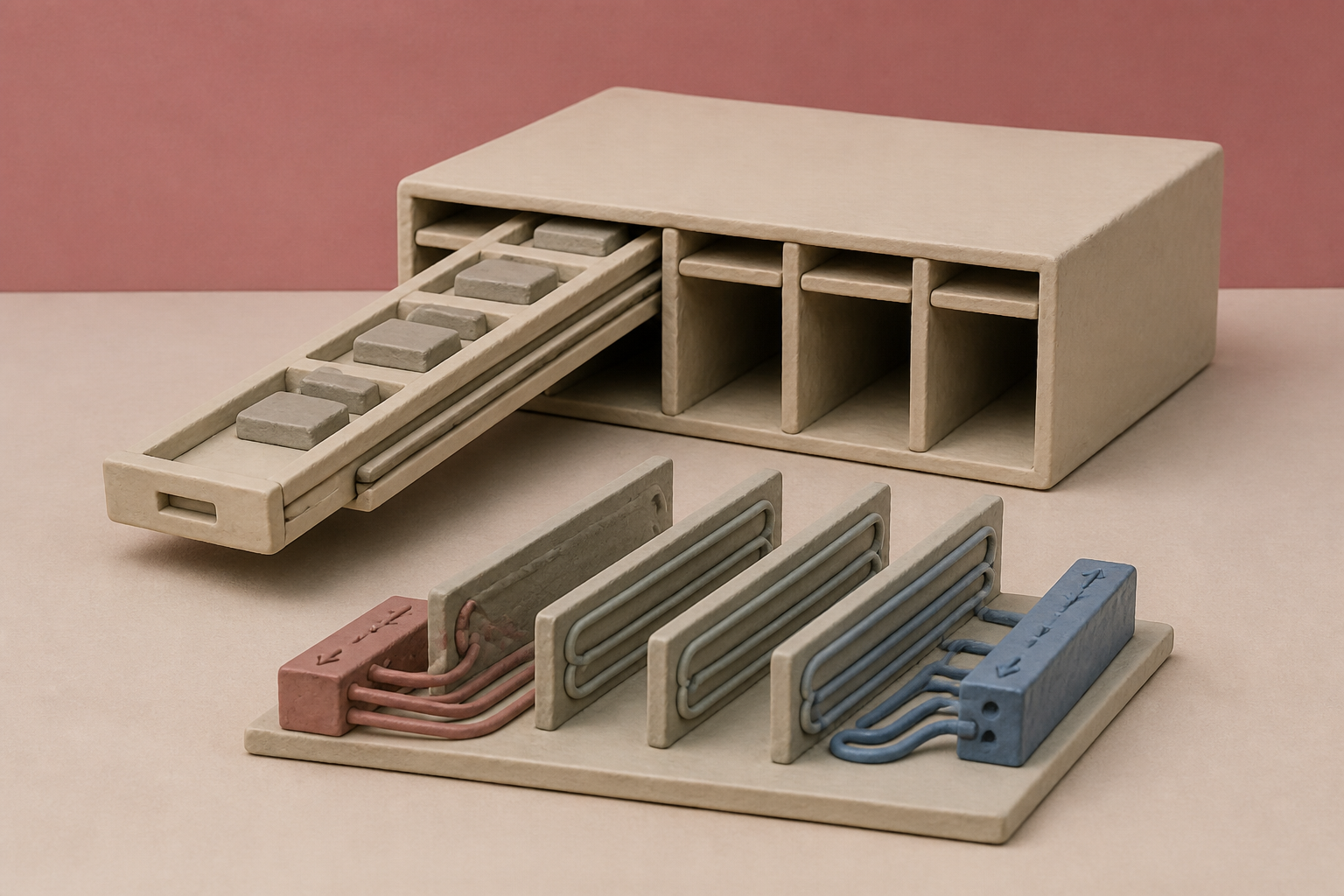
What changes in this design
Without these details, someone might picture a simple housing that merely holds several disk drives. It would not necessarily include liquid routes or removable units for each drive.
This device includes cold plates with channels for cooling liquid, inlet and outlet manifold cold plates, and removable cartridges for the disk drives.
It is more than a housing for several drives. The device includes liquid-carrying plates and removable drive units for dealing with high heat loads.
A fire suppression test that took a bank offline
In September 2016, a fire suppression test discharged inside ING's data centre in Bucharest. Nothing burned. The gas left the nozzles at over 130 decibels, which one report likened to standing fifty feet from a jet aircraft taking off, and that sound went into the racks. Read/write heads skidded off their data tracks. Card transactions, ATMs and internet banking were down for about ten hours, and the bank blamed the magnitude and complexity of the damage for the recovery time.
I keep coming back to that story because of what it proves. You can wreck a hard drive with noise alone. Heads fly less than a micrometre from the track they are reading, and vibration engineers point to guidance showing measurable throughput loss starting around 110 decibels, well below what happened in Bucharest. Sound isn't an exotic failure mode. It's just a force.
Five hundred watts for a petabyte
So when I read a new patent filing about liquid cooling for disk shelves, the numbers made me suspicious straight away. One drive maker publishes figures for a 4U enclosure with sixty 16-terabyte drives: 420 watts at idle, consistently under 500 in use, peaking at 720 during spin-up. That is 8.6 watts per drive under random read, 4 at idle. A full petabyte of storage draws less power than a single high-end AI accelerator.
You don't plumb coolant into a box like that because it's hot. Something else is going on.
What Celestica wrote in the background section
Application 19/331,935 was filed in September 2025 by Celestica's Shanghai consultancy arm and published this August. No individual inventors appear on the record. It describes a chassis of drive bays, cold plates with coolant channels, inlet and outlet manifold plates, and removable drive cartridges.
The background is the part that surprised me. In my reading, it doesn't argue the drives are too hot. It argues the fix is the problem: raising fan speeds to handle thermal load increases power draw and also exacerbates vibration and acoustic emissions, just as drives have grown more sensitive to both, capacities up and head-to-track spacing down. The claims follow the same logic. One lists supported form factors: 3.5-inch and 2.5-inch disks, 2.5-inch SSDs, E1 and E3. Another puts a temperature sensor on the outlet manifold. A third adds a valve that adjusts coolant flow to that feedback. The design isn't trying to run as cold as possible. It's trying to run quietly.
Why nobody has ever got a disk wet
Colder may not buy much anyway. The largest published field study of drive failures, from Google's own fleet, found temperature and activity levels much less correlated with failure than previously reported. In my view, that takes most of the air out of the thermal case for chilling disks harder. A two-year underwater data centre trial off Orkney reported one-eighth the failure rate of dry land, and the leading explanations were the nitrogen atmosphere and the absence of people bumping into components.
Which leaves the mechanical route, and disks have always been awkward there. A large server maker patented a design over a decade ago that boils dielectric fluid beneath the drives and cools them in the rising vapour, because submerging a spinning disk causes friction at the spindle and dissolves its lubricant. An immersion cooling company went the opposite way, sinking boards in coolant while engineering air channels so the drives could keep breathing. Same constraint, two opposite conclusions. This filing takes a third road: keep the drive dry in a cartridge, hold it against a cold plate, leave the coolant outside.
The harder half of the problem
To my mind, a cold plate is the easy part. The hard part is that drive bays get pulled. A hot-swappable liquid-cooled cartridge only works if blind-mate dripless couplings hold every time, and the open standard for those, the universal quick disconnect, comes in four sizes, rated to ten bar, with redundant seals. It was designed for a handful of joints per accelerator tray. A dense shelf implies a hundred or so per 4U, and every one is somewhere a data centre can get wet.
There's also the question of who it's for. Celestica already ships a 4U enclosure taking up to 108 dual-port 3.5-inch drives, and the claims' form factor list matches its storage line. The storage system it publicised most this year is all-flash, ranked third globally on a benchmark list, with no hard drives in it. Meanwhile drive makers are pushing sustained throughput hard, which means more actuator motion and more self-generated vibration, not less. Read that way, the filing is a bet placed in September 2025 that hard disks stay in the AI build-out long enough to be worth plumbing, and that the thing to engineer around is not the heat but the machinery installed to remove it.
Sources
Reporting for this piece drew on the published filing and the references below.
- 'Jet blast' noise KOs ING bank's spinning rust servers (The Register)
- Data Center Noise & Vibration: The Outward and Inward Problems
- Failure Trends in a Large Disk Drive Population (USENIX FAST '07)
- 1 Petabyte of Online Storage - 500 Watts (Toshiba)
- US 9,335,802 - System for cooling hard disk drives using vapor momentum driven by boiling of dielectric liquid
- Green Revolution Cooling Assigned Patent 9,756,766
- Microsoft finds underwater datacenters are reliable, practical and use energy sustainably
- UQD Couplings (CEJN, Open Compute Project standard)
- Storage Hardware Solutions - Celestica
- Celestica's Storage Platforms Anchor Record-Breaking AI Supercomputer Storage
- WD Bets 8x Bandwidth Beats More Terabytes as 40TB UltraSMR Starts Shipping
The record, briefly. US20260253618A1, “Liquid Cooling Heat Dissipation Device For Multi-Disk Drive System” A multi-disk drive liquid-cooling device includes a chassis with disk-drive mounting positions, cold plates with coolant channels, inlet and outlet manifold cold plates, and removable disk-drive cartridges to cope with high thermal loads.
More angles on this
- When a Vehicle Notices Something, Who Decides What the Moment Means?Another reading in the same Groundwork category on this site.
- Measurement Apparatus For Determining A Velocity Of A Fluid Gets a Better Next StepAnother reading in the same Groundwork category on this site.
- What a 24-Minute Width Change Teaches About Designing for the In-BetweenAnother reading in the same Groundwork category on this site.
- A Tape Surface Asked to Be Consistent, Not PerfectAnother reading in the same Groundwork category on this site.
- When a Cart Needs to Know Which Vehicle It Is MeetingAnother reading in the same Groundwork category on this site.
Read around this one:Public patent recordUSPTO published figure