Groundwork
What a 24-Minute Width Change Teaches About Designing for the In-Between
Tape's binding constraint is no longer how much you can write, but whether the ribbon holds still - and a new filing puts a stopwatch on it.

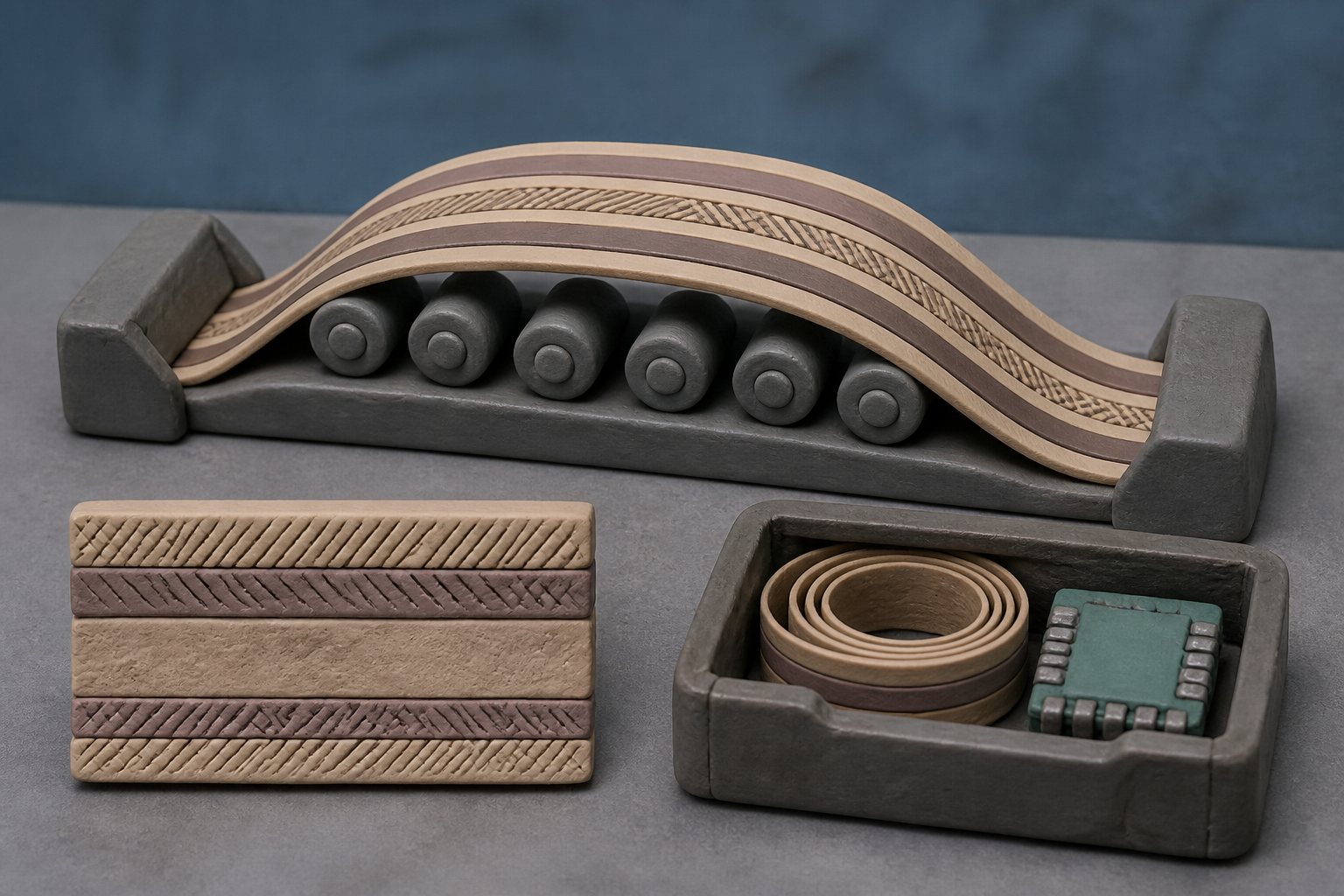
What changes in this design
Without these limits, a reader would only know that a magnetic recording material can be part of a cartridge. No maximum average thickness or time for the width to settle after the humidity change would be given.
Here, the material averages 5.3 micrometers thick or less, and its width becomes stable within 24 minutes or less at 60 C after relative humidity changes from 10% to 40%. The cartridge includes the material, a memory, and an accommodating case.
For a reader, the useful point is knowing the exact thickness limit and how long width takes to settle after that humidity change. It also clarifies that the material appears in a cartridge with memory and an enclosure.
An hour of nothing before the first byte
The first time you put a brand new LTO-9 cartridge in a drive, you can't write to it. The drive takes it, runs it, and gives you nothing usable for about forty minutes. IBM's documentation for its tape libraries says media optimisation averages 40 minutes on a cartridge's first load, that most finish inside an hour, and that some run to two. It happens once per cartridge, and the result follows the tape to other drives. That is the only reason anyone puts up with it.
The stated reason is always the same: more tracks, less room for error. That's true, but I think it's incomplete. What the drive is doing in that quiet hour is learning the exact geometry of one particular ribbon of plastic, because the geometry stopped being a rounding error.
Fifteen thousand tracks on a half-inch ribbon
In 2000 the first LTO cartridge held 100 GB across 384 tracks. LTO-9, in 2021, held 18 TB across 8,960. LTO-10 writes 15,104. The ribbon never changed width - 12.65 mm throughout - so each generation cut the same strip into finer lanes while making it thinner and longer: 8.9 um early on, 5.6 at LTO-7, 5.2 at LTO-9, 4.0 at LTO-10, with length climbing to 1,337 m.
Then the positioning. On prototype tape in 2020, IBM and a media partner reached 317 gigabits per square inch using a read sensor 29 nm wide, and reported head positioning accurate to 3.2 nm. Those numbers, I think, belong together. You are steering to within a few nanometres across a film 12.65 mm wide. At that ratio a few parts per million of swelling isn't a tolerance. It's the error.
A ribbon that swells when the room does
Plastic takes up water. When it does it widens, and tracks written at one humidity are no longer where the head expects them at another. The industry calls this off-track, and one patent in this line defines it plainly: the absence of the target track where the head is reading, or reading the wrong one. The same document notes it tends to show up during long-term storage, which, I think, is why it matters: that's what tape is for.
Sony's patents in this area, running from 2018, attack it with static numbers: width variation under 400 parts per million across four temperature and humidity corners, thermal expansion of 6 to 8 ppm per degree, humidity expansion at or below 5 ppm per percent RH, total thickness under 5.5 um. Every one of those is measured after the tape has settled.
The stopwatch is the new claim
The filing published this year, US20260253612A1, keeps a thickness ceiling - 5.3 um average or less - and adds what the earlier ones don't have. It times the settling. Move the tape from 10 percent relative humidity to 40 percent at 60 C, and its width has to stabilise within 24 minutes. The cartridge claim is the familiar three-part arrangement: the medium, an onboard memory, a case.
I couldn't retrieve the published document itself, so I won't tell you whose name is on its face. The lineage is unmistakable - same thickness ladder, same cartridge structure, same recurring inventors - but lineage isn't a signature.
The honest question is how much the media side actually buys. A 2021 patent in the same family says the recording apparatus compensates by adjusting tension along the tape's length, and specifies dimensional change of at least 660 ppm per newton. The drive is the active corrector. The media spec governs how much correcting it has to do, and how soon it can stop.
What the filing is really betting on
Set 24 minutes against the forty the drive already spends on a first load. I read that as an improvement inside an already slow ritual, not a new burden and not a breakthrough. Which suggests the bet isn't about minutes at all. It's about which of two companies gets specified.
Six firms once made LTO media. Two do now. Sony stopped selling cartridges under its own brand around July 2019 and kept supplying others, which is why it goes on patenting the width of a ribbon its logo left. Fujifilm's newest cartridge is sold partly on a wider recommended operating range, 15 to 35 C instead of 15 to 25, with humidity tolerance to 80 percent. Both now compete on environmental tolerance as much as capacity.
The last time these two fought over patents, trade rulings blocked imports on both sides and LTO-8 supply dwindled to a trickle worldwide before they settled on undisclosed terms in 2019. Shipments fell 9 percent in 2025, sixteen exabytes, then rebounded sharply in early 2026 on the 40 TB cartridge. A ribbon that stops moving in 24 minutes is a small claim. What it really stakes out is the ground the next fight would be fought over.
Sources
Reporting for this piece drew on the published filing and the references below.
- US20260253612A1 - Magnetic Recording Medium (public record)
- US11508407B2 - Magnetic recording medium having controlled dimensional characteristics
- US11521650B2 - Magnetic recording medium having a controlled dimensional variation
- US11017809B2 - Magnetic recording medium having a controlled dimensional variation
- US12400682B2 - Magnetic recording medium and cartridge
- Linear Tape-Open - Wikipedia
- Hybrid clouds will rely on magnetic tape for decades to come - IBM Research
- Media optimization - IBM Documentation (TS4500 Tape Library)
- Sony and Fujifilm tape media dispute must never happen again - Blocks and Files
- Sony Discontinue their brand of LTO media - BackupWorks
- Tape still isn't dead, but shipments slipped by 16 exabytes in 2025 - The Register
- CES 2026: New magnetic tape medium promises improved cybersecurity - Digital Journal
The record, briefly. US20260253612A1, “Magnetic Recording Medium” A magnetic recording medium has an average thickness tm of at most 5.3 um, and its width stabilizes within 24 minutes or less at 60 C after humidity changes from 10% RH to 40% RH. A cartridge includes the medium, a memory, and an accommodating case.
More angles on this
- Liquid Cooling Heat Dissipation Device For Multi-Disk Drive System Marks a Pause Worth NoticingAnother reading in the same Groundwork category on this site.
- When a Vehicle Notices Something, Who Decides What the Moment Means?Another reading in the same Groundwork category on this site.
- Measurement Apparatus For Determining A Velocity Of A Fluid Gets a Better Next StepAnother reading in the same Groundwork category on this site.
- A Tape Surface Asked to Be Consistent, Not PerfectAnother reading in the same Groundwork category on this site.
- When a Cart Needs to Know Which Vehicle It Is MeetingAnother reading in the same Groundwork category on this site.
Read around this one:Public patent recordUSPTO published figure