Groundwork
A Tape Surface Asked to Be Consistent, Not Perfect
Tape's capacity limit stopped being magnetic and became geometric, and a Fujifilm surface-roughness filing is what that shift looks like from inside a two-supplier duopoly.

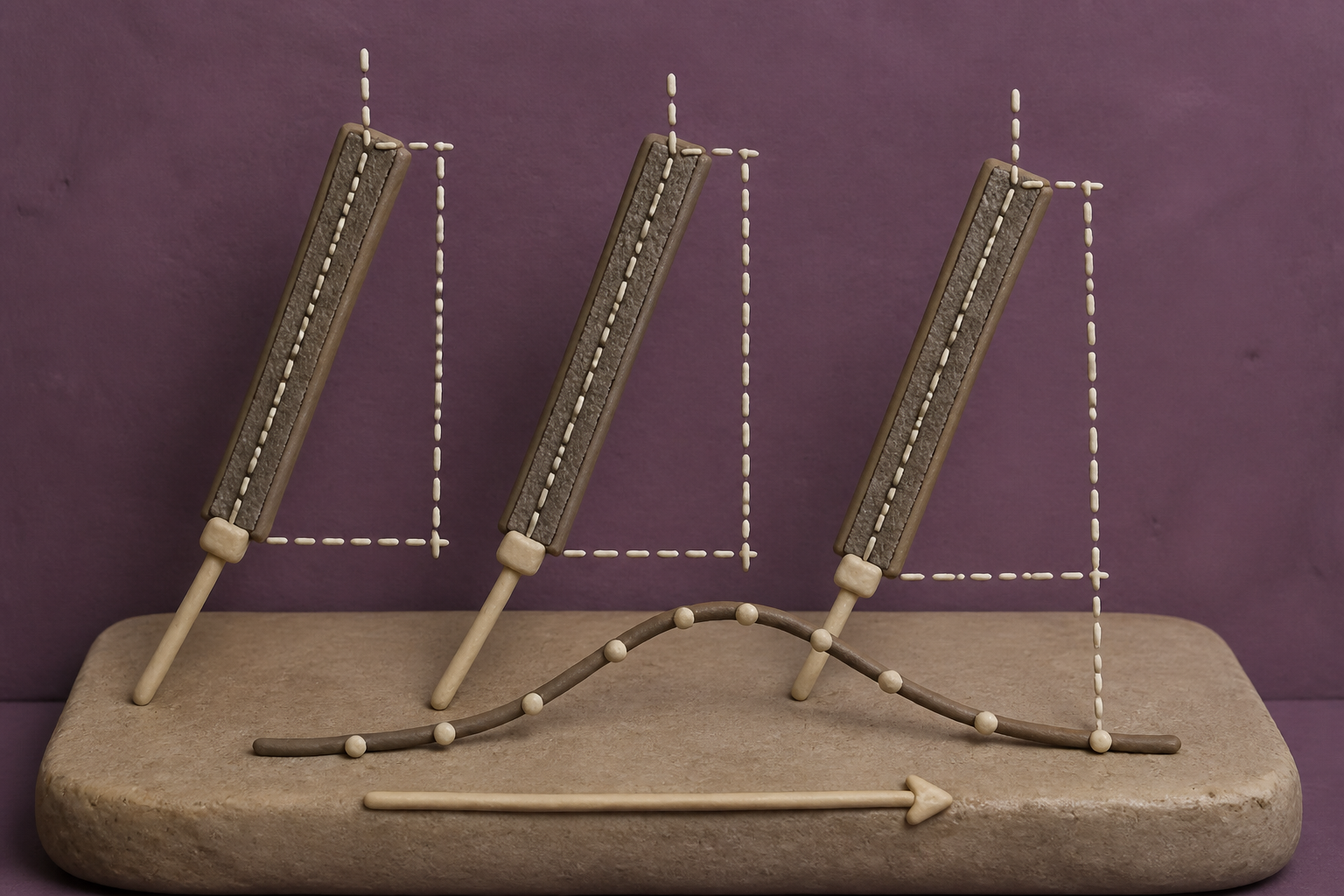
What changes in this design
Someone new to this kind of tape might picture a coated strip that holds data, without expecting numerical limits for the curvature and consistency of its microscopic surface peaks.
This record sets two numerical surface rules: Spc, a measure of average peak curvature, must be 0.30 to 0.70 per micrometer, and its variation across the width must be 0.15 per micrometer or less. It also requires a leader pin directly attached to the strip's end.
Those details show that the tape's surface and its end attachment are both being specified, not just its magnetic layer. That is worth knowing because the record does not state what practical effect the requirements have.
Forty minutes before the first byte
Load a new ninth-generation LTO cartridge into a drive for the first time and the drive doesn't write anything. It calibrates. IBM's documentation for its TS4500 library puts the average at 40 minutes per first load, most finishing inside an hour, some taking up to two. The stated reason is blunt: the increased number of tracks used to write data on tape requires greater precision. Run that arithmetic across a ten thousand cartridge library and you get roughly 6,600 drive-hours burned before a single byte of anyone's data is stored. That isn't a bug someone forgot to fix. It's a workaround, and it shipped.
A track 56 nanometres wide
Why the drive needs that long is geometry, not magnetism. In December 2020 a joint demonstration reached 317 gigabits per square inch on a prototype tape, implying 580 TB on one cartridge. Its tracks were 56.2 nm wide, against 103 nm in the previous record. Halved in a single step. Now picture what those tracks sit on: a ribbon 12.65 mm across and 4.0 micrometres thick, 1,337 metres of it wound in a plastic shell in a warehouse. If that ribbon swells or shrinks by a fraction of a micron across its width, the head is no longer over the track it believes it's over.
Zero required optimization time
The tenth generation deletes the ritual. The format's governing group advertises zero required optimization time, and a library vendor has confirmed the drives need neither media optimization nor archive unload. Good news for anyone running a library. It's also an admission with consequences: the tolerance the drive was quietly absorbing has to go somewhere, and the only place left is the media. Five months after launch that generation was respecified from 30 TB native to 40, credited to a new head design and an aramid base film enabling thinner and smoother tape. Thinner and smoother is precisely the direction that makes width stability harder to hold.
Spc between 0.30 and 0.70
Which brings me to the filing. Fujifilm's application published on 27 August 2026, out of an October 2024 international filing and three Japanese priority applications reaching back to October 2023, claims a tape whose magnetic-layer surface has an arithmetic mean peak curvature between 0.30 and 0.70 per micrometre, with the standard deviation of that figure across the tape's width held to 0.15 or less. A leader pin is attached directly to the end.
That parameter, Spc under ISO 25178, is the average sharpness of the peaks on a surface. Low means rounded peaks that spread contact load. High means points that concentrate it. You need 3D profiling to see it at all. And the background is direct about the target: the longer the storage period, the more likely width deformation becomes, producing off-track, which worsens as track density climbs.
Twelve patents in one batch
I'd read this differently if it stood alone. It doesn't. In one assignment batch in October 2025, twelve of the same applicant's patents issued, and five carry this exact title. Neighbouring ones claim an abrasion value and surface recesses. A sibling patent attacks the same off-track failure from the servo side instead, capping timing-pattern nonlinearity at 10 percent of track pitch, and never mentions Spc at all. The surface is being staked out one metric at a time.
That matters because only two companies are licensed to make this media. The last time they fought over patents, starting with a 2016 complaint, an import ban on Sony product in 2018, an order the other way in 2019 and a settlement that August on undisclosed terms, eighth-generation media became effectively unobtainable.
The harder half of the problem
I think the filing is honest and narrow, and I think it's a real answer. Rounder, more uniform peaks across the ribbon's width is a sensible thing to specify once the drive has stopped compensating on your behalf.
There's a reading I can't dismiss, though. One archive migration firm points at the same environmental envelope written into the specification, 15 to 25 °C and 20 to 50 percent humidity with no more than five degrees or five percent of change per hour, and concludes the format has become a liability rather than an archive. Two generations running, the roadmap number and the shipped number haven't matched: 18 TB against 24, then 30 against 36. The newest drives read nothing older, not even the generation immediately before them.
A surface you can specify to a hundredth of a reciprocal micron is the easier half. The harder half is a warehouse in August.
Sources
Reporting for this piece drew on the published filing and the references below.
- US 2026/0253611 A1 - Magnetic Tape, Magnetic Tape Cartridge, And Magnetic Tape Apparatus
- Spc (Arithmetic Mean Peak Curvature) - Area Roughness Parameters, KEYENCE
- Media optimization - IBM TS4500 Tape Library Documentation
- LTO Program Announces New 40 TB LTO-10 Cartridge Specifications and Refreshes Its Roadmap
- Latest generation LTO-10 tape arrives at Spectra Logic - Blocks & Files
- IBM and Fujifilm demo 580TB tape. Yes it's a record - Blocks & Files
- Fujifilm Launches LTO Ultrium 10 (40TB) Data Cartridge
- Sony and Fujifilm tape media dispute must never happen again - Blocks & Files
- FujiFilm Assigned Twelve Patents - StorageNewsletter
- US12080322B2 - Magnetic tape, magnetic tape cartridge, and magnetic tape device
- Rethinking LTO: When Good Technology Hits Its Limits - Tape Ark
The record, briefly. US20260253611A1, “Magnetic Tape, Magnetic Tape Cartridge, And Magnetic Tape Apparatus” A magnetic data tape has a magnetic-layer surface with ISO 25178 arithmetic mean peak curvature Spc from 0.30 to 0.70 (1/um), width-direction Spc standard deviation of 0.15 (1/um) or less, and a leader pin directly attached to an end part.
More angles on this
- Liquid Cooling Heat Dissipation Device For Multi-Disk Drive System Marks a Pause Worth NoticingAnother reading in the same Groundwork category on this site.
- When a Vehicle Notices Something, Who Decides What the Moment Means?Another reading in the same Groundwork category on this site.
- Measurement Apparatus For Determining A Velocity Of A Fluid Gets a Better Next StepAnother reading in the same Groundwork category on this site.
- What a 24-Minute Width Change Teaches About Designing for the In-BetweenAnother reading in the same Groundwork category on this site.
- When a Cart Needs to Know Which Vehicle It Is MeetingAnother reading in the same Groundwork category on this site.
Read around this one:Public patent recordUSPTO published figure