Groundwork
When a Cart Needs to Know Which Vehicle It Is Meeting
Eleven years ago a driverless grain cart in Illinois could already pick the right vehicle. A new patent shows what the industry built instead.

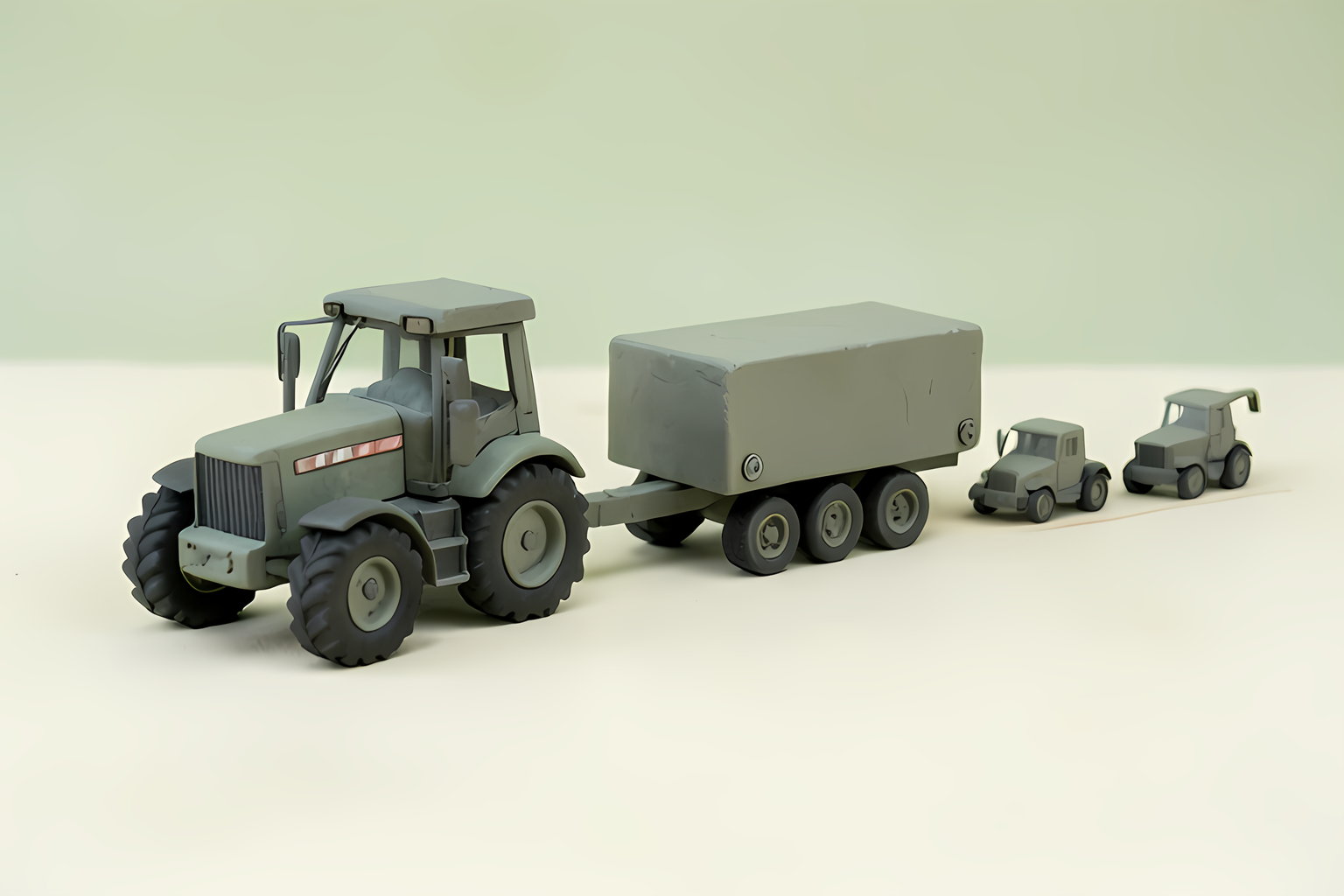
What changes in this design
Without more information, a reader might picture a farm vehicle and cart simply approaching a transport vehicle, with no stated way to choose which one they will meet.
This record says they receive transport-vehicle messages, gather sensor readings when needed, receive a selection, and align with the transport vehicle that was selected.
It is worth noticing that the meeting is tied to a received choice. The vehicle and cart are described as lining up with that chosen transport vehicle, rather than just any one.
Three Illinois farms, autumn 2014
In the autumn of 2014, three farmers in Illinois were harvesting with driverless grain carts. The system had been in farmer testing since 2012. It ran multiple combines and multiple autonomous carts at once, used side radar to move safely down narrow corridors, and gave the combine operator an aerial view from the cab. It also, according to Kinze's own announcement that December, automatically selected the most appropriate grain cart for the operator to unload into when asked. The maker said it wanted to evaluate performance before selling it widely. It never became a broad commercial product.
What claim 1 asks a human to do
I have been reading a patent published on 27 August 2026, filed that February and claiming a provisional from February 2025. Two assignees: AGCO International GmbH and PTx Trimble. The system it describes is an autonomous grain cart that finds and lines up with a semi truck. Claim 1 requires it to determine whether the transport vehicle is a single transport vehicle or a plurality of transport vehicles. If there is one, it aligns. If there are several, it captures sensor data, provides that data to at least one remote device, and waits to receive a selection of a transport vehicle before it moves.
The classification codes include vehicle-to-vehicle communication and location-based services, so the trucks broadcast their own position rather than merely being spotted. The machine knows they are there. It just will not choose between them. Eleven years after those Illinois fields, that is the state of the art being protected.
The remote device is a tablet one machine away
The remote device is not a control room. It is the shipping product this filing extends: a retrofit autonomy kit whose grain cart mode runs driverless from the field edge to the combine, supervised by the combine operator on a tablet while they stay in their own seat. A satellite link handles rural connectivity. Proximity sensors slow the machine and then stop it. Virtual boundaries keep it where it belongs. The first supported tractor is a competitor's, which follows from how the joint venture behind it was sold. Its product page claims neither road operation nor autonomous truck loading. This filing is that missing leg.
Eighteen percent, and two and a half centimetres
The only peer-reviewed measurement I found on any of this is modest. Researchers put skin-conductance wristbands on nine grain cart tractor operators and six combine operators across more than 200 unload events with a rival automation system, and published in 2024. Cart operator stress dropped 18 percent, which held up statistically. The combine operator's 12 percent drop did not. On straight passes the machine beat the human driver's cross-track error by 2.5 centimetres. That rival keeps people in both cabs and costs roughly $10,000 installed. The loudest number in the field, 23 percent more combine productivity, belongs to a different maker's automated unloading, which reached farms in late 2025 - the same leg of the job this filing builds past.
Where the safety standard stops at the field gate
A line runs through the middle of this task. The 2024 international standard for autonomous agricultural machinery, whose verification part was published that August, replaced one earlier document with four parts and explicitly excludes public road operations from its scope. A cart hunting for a semi truck is inside that standard while both are in the field, and outside it the moment the truck is parked on an approach or a road. Handing the choice to a person on a tablet is, among other things, the cheapest way to stay inside the tested envelope.
What the filing is really betting on
The market for the machines this bolts onto is shrinking fast. The assignee's 2025 sales were $10.1 billion, down 13.5 percent, with North American combine units off 27 percent in a single year, and it forecasts another 15 percent decline in North American large agriculture for 2026. The labour argument for autonomy is weaker than it sounds, too: hired farmworker employment rose from 1.07 million in 2010 to 1.18 million in 2024. What changed is cost and paperwork - H-2A certifications went from about 48,000 positions in 2005 to about 385,000 in 2024, and real farm wages rose to $18.12 an hour, still around 60 percent of nonfarm pay.
So I don't think the bet is that a cart will one day pick its own truck. The bet is that farms will pay for one supervisor's attention and then reuse it across more jobs - the same kit has already been extended from harvest to tillage, and the company describes each step as building on proven technology toward autonomy across the whole operation. Claim 1 is the most honest sentence in the document. It says out loud that the hard part is still a person, looking at a screen, pointing.
Sources
Reporting for this piece drew on the published filing and the references below.
- US 2026/0252119 A1 - Autonomous Agricultural System Including Guidance System for Locating and Selecting a Transport Vehicle
- Patent record: US 20260252119 (Justia)
- OutRun Retrofit Autonomy Kit - PTx Trimble
- Kinze Adds New Features to Its Autonomous Harvest System
- Harvesting in sync: Purdue and John Deere develop automated unloading technology
- An Automated On-The-Go Unloading System Reduces Harvest Operator Stress Relative to Manual Operation
- Raven Rolls Out Grain Cart Automation, Urges Farmers to Build Tech-Management Systems
- AGCO, Trimble Close $2B Joint Venture Deal, Form PTx Trimble
- AGCO Reports Fourth Quarter and 2025 Full Year Results
- OutRun Tillage from AGCO's PTx Trimble Wins 2026 Davidson Prize at Commodity Classic
- BS EN ISO 18497-4:2024 - Safety of partially automated, semi-autonomous and autonomous agricultural machinery
- Farm Labor - USDA Economic Research Service
The record, briefly. US20260252119A1, “Autonomous Agricultural System Including Guidance System for Locating and Selecting a Transport Vehicle Based on Received Communication Data and Related Methods” The public record describes an agricultural vehicle and cart that receive transport-vehicle communication data, capture sensor data when needed, receive a selection, and align with the selected transport vehicle.
More angles on this
- Liquid Cooling Heat Dissipation Device For Multi-Disk Drive System Marks a Pause Worth NoticingAnother reading in the same Groundwork category on this site.
- When a Vehicle Notices Something, Who Decides What the Moment Means?Another reading in the same Groundwork category on this site.
- Measurement Apparatus For Determining A Velocity Of A Fluid Gets a Better Next StepAnother reading in the same Groundwork category on this site.
- What a 24-Minute Width Change Teaches About Designing for the In-BetweenAnother reading in the same Groundwork category on this site.
- A Tape Surface Asked to Be Consistent, Not PerfectAnother reading in the same Groundwork category on this site.
Read around this one:Public patent recordUSPTO published figure