Field Notes
Measurement And Analysis Method For Detecting And Quantifying Makes a Small Case for Better Timing
A dissolved startup's patent exposes the distance between a striking nanopore result and a diagnostic patients can actually receive.

What changes in this design
A reader might expect an unknown antigen concentration simply to be measured directly. The record does not say what ordinary laboratory approach it is being compared with.
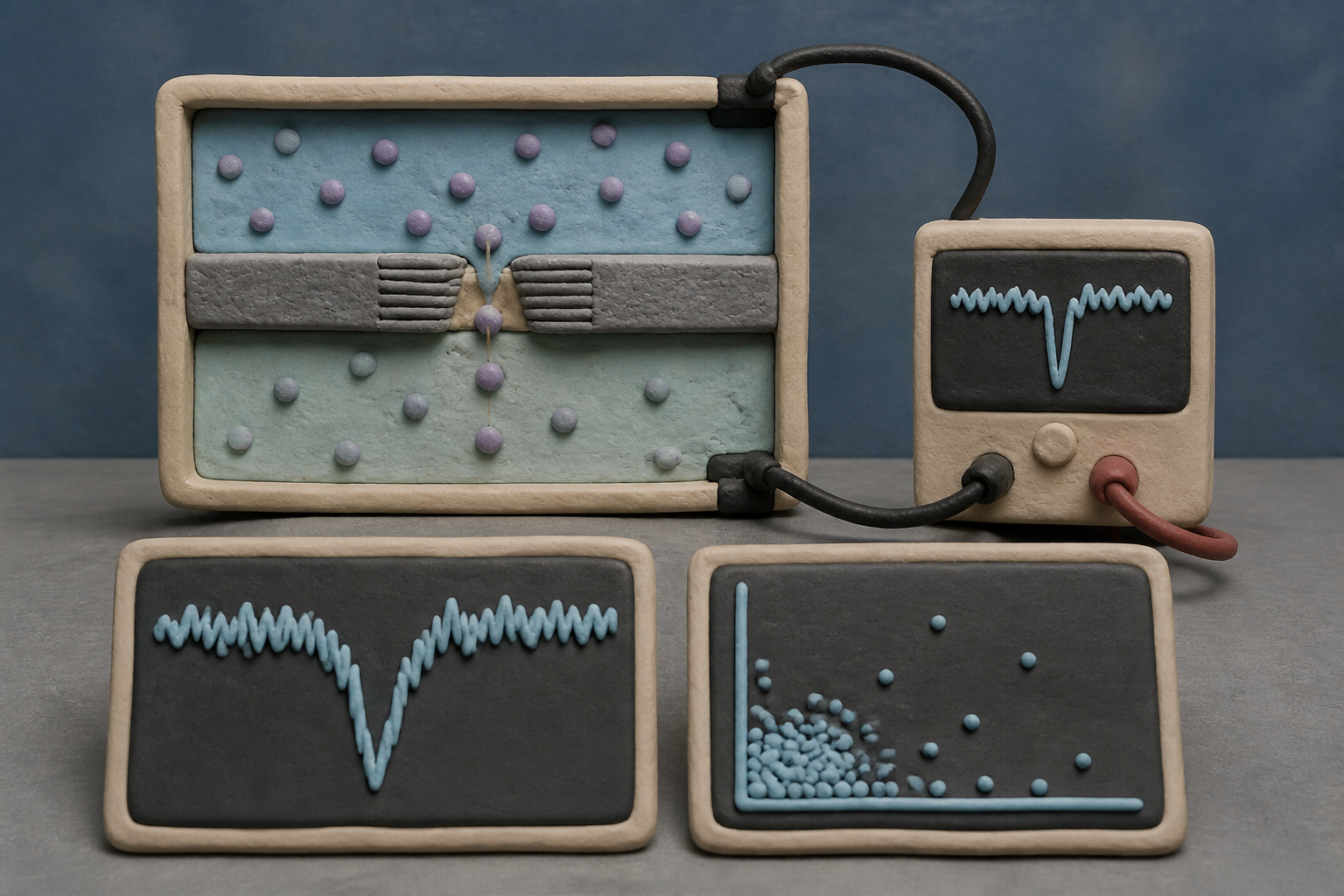
This record sets out a data-focused route: measure temporary ionic-current changes through a pore in a known sample, derive pulse-shape and distribution information, and train a model with known antigen concentrations.
It makes clear that the goal is not merely noticing a signal. Information from the readings, together with known antigen concentrations, is intended to support an estimate for a sample whose concentration is unknown.
March 9, 2026
On March 9, 2026, Aipore Inc. was dissolved. Later that year its U.S. patent appeared: US20260253676A1, for measuring pathogens, microorganisms, and proteins. That mismatch in time is more revealing than a fresh patent's title, so I began with it. A public application can preserve a technical idea after the company that pursued it has disappeared.
I don't take the dissolution as proof that the underlying science failed. The record gives no cause, and I won't invent one. But the timing puts the filing in its frame: this is not a clean story of a new diagnostic arriving in clinics. It is evidence from the uneasy stretch between a convincing experiment and an approved, paid-for medical device.
Five Minutes of Saliva
The results I found make the closure harder to wave away. In 2021, a Nature Communications study paired the company's machine-learning analysis with a nanopore instrument to test 100 saliva samples, 50 positive and 50 negative. Each measurement took under five minutes; reported sensitivity was 90 percent and specificity 96 percent. The instrument was explicitly described as a scientific instrument, not an approved medical device.
Then came a 2023 follow-up: 100 percent sensitivity and 96 percent specificity for omicron in patient saliva over a 10-minute measurement, plus discrimination among six viral variant signatures. I can see why the university lab says the COVID-19 device was validated on more than 10,000 real clinical samples and used to screen the Spring Koshien high-school baseball tournament. Those are serious milestones. They do not show a diagnostic can survive routine clinical use, procurement, reimbursement, and regulation.
A 300-Nanometer Hole
At the center is a 300-nanometer through-hole in silicon. This mechanism is compelling to me: apply voltage, let molecular events disturb an ionic current, and turn each transient pulse into data. The PCT counterpart describes antibody-modified particles and a known-concentration antigen in one chamber. It extracts pulse-waveform features and a distribution feature, then trains a machine-learning system against the known antigen concentration.
That is the ambition behind the later U.S. filing. It aims to estimate an unknown concentration, not merely detect a target. I think that is a real technical wager, not marketing decoration. Yet the learned signal pattern is only as trustworthy as the samples, calibration, and conditions behind it. A laboratory result can be precise while still being narrow.
A company profile claimed that one to ten measurements could be enough for training data. That is, to me, a company claim, not independent validation.
The fg/mL Problem
Here is why I resist calling this a sensing breakthrough. Conventional ELISA has genuine sensitivity limits, but established single-molecule immunoassays already work in the femtogram-per-milliliter range. Published examples cited in a review detected PSA at 30 fg/mL and TNF-alpha at 10 fg/mL, at least 15,000- to 30,000-fold better than published ELISA. The same review warns that ultrasensitive platforms must rule out contamination artifacts and prove signal specificity.
Nor is Aipore alone in using machine learning against variable nanopore signals. A 2025 independent study classified two cancer biomarkers in mixtures at six voltages, but researchers said human-serum testing remained to be shown. That study is a reality check to me. Clever processing can inform a sensor; it cannot establish what a clinical sample, rather than a prepared mixture, means.
What would have to be true
An easy commercial triumph in nanopores isn't apparent to me, either. Oxford Nanopore, whose devices sequenced a quarter of the world's SARS-CoV-2 viral genomes, reported 2025 revenue of GBP 223.9 million and an operating loss of GBP 155.3 million. That lab records an earlier DNA-sequencing spin-out concluding activities in 2023 and Aipore in 2025, before formal dissolution. I cannot infer the reasons from those facts, but the pattern is hard to ignore.
Independent studies would have to show quantitative accuracy across intended clinical samples, not only selected saliva cohorts or prepared targets, for me to call this route a practical diagnostic advance. Direct comparison with the high-sensitivity assays it would have to beat, including limits of detection, false positives, specificity, reproducibility, and performance across sites, is what I would want. The analysis would need a clear plan for calibration drift as real samples change.
Regulatory clearance, payment, and a clinic-ready workflow are also things I would need to see. A patent publication establishes none of that. The method is not something I am dismissing. The public record leaves it where I am placing it: a clever approach with credible research behind it and a large final gap unclosed. This filing arrived after its owner was already gone.
Sources
Reporting for this piece drew on the published filing and the references below.
- US20260253676A1 - Measurement and Analysis Method for Detecting and Quantifying Pathogens, Microorganisms, or Proteins
- Startups - Taniguchi Lab, SANKEN, Osaka University
- Aipore - KEPPLE corporate database
- Aipore - STARTUP DB company page
- Results of Research on Identification of Covid-19 Viruses Utilizing Advantest's nanoSCOUTER
- Osaka University report on omicron saliva testing
- Emerging Technologies to Increase Ligand Binding Assay Sensitivity
- Nanopore Signals, Machine Learning Unlock New Molecular Analysis Tool
- Oxford Nanopore Technologies
The record, briefly. US20260253676A1, “Measurement And Analysis Method For Detecting And Quantifying Pathogens, Microorganisms, Or Proteins, And Computer Program For Performing Said Method” The method prepares data for estimating an unknown antigen concentration by measuring transient ionic-current changes through a pore from a known measurement target sample, calculating pulse-waveform and distribution features, and training an AI model using the distribution feature and known antigen concentration.
Identity details. The saved title-page transcription needs review, so names are not repeated here. Check the official published title page.
More angles on this
- Methods For Treatment Of Thyroid Cancer Treats the Relationship as the PointAnother reading from the same G16B classification family, bioinformatics.
- Next Generation Prenatal Screening: A Probability Where a Verdict Was ExpectedAnother reading from the same G16B classification family, bioinformatics.
- CPC G16B: BioinformaticsThe official classification family this record was filed into, published in the USPTO Cooperative Patent Classification scheme.
- CPC G01N: Investigating or analysing materials by determining their chemical or physical propertiesThe official classification family this record was filed into, published in the USPTO Cooperative Patent Classification scheme.
- Dust Has a Data Identity CrisisAnother reading from the neighbouring G01S classification family, radio direction-finding.
Read around this one:Public patent recordUSPTO published figure