Machines
When Context Changes Hands in Healthcare Information
A new patent filing enters a crowded effort to turn scattered medical records into useful, accountable information.
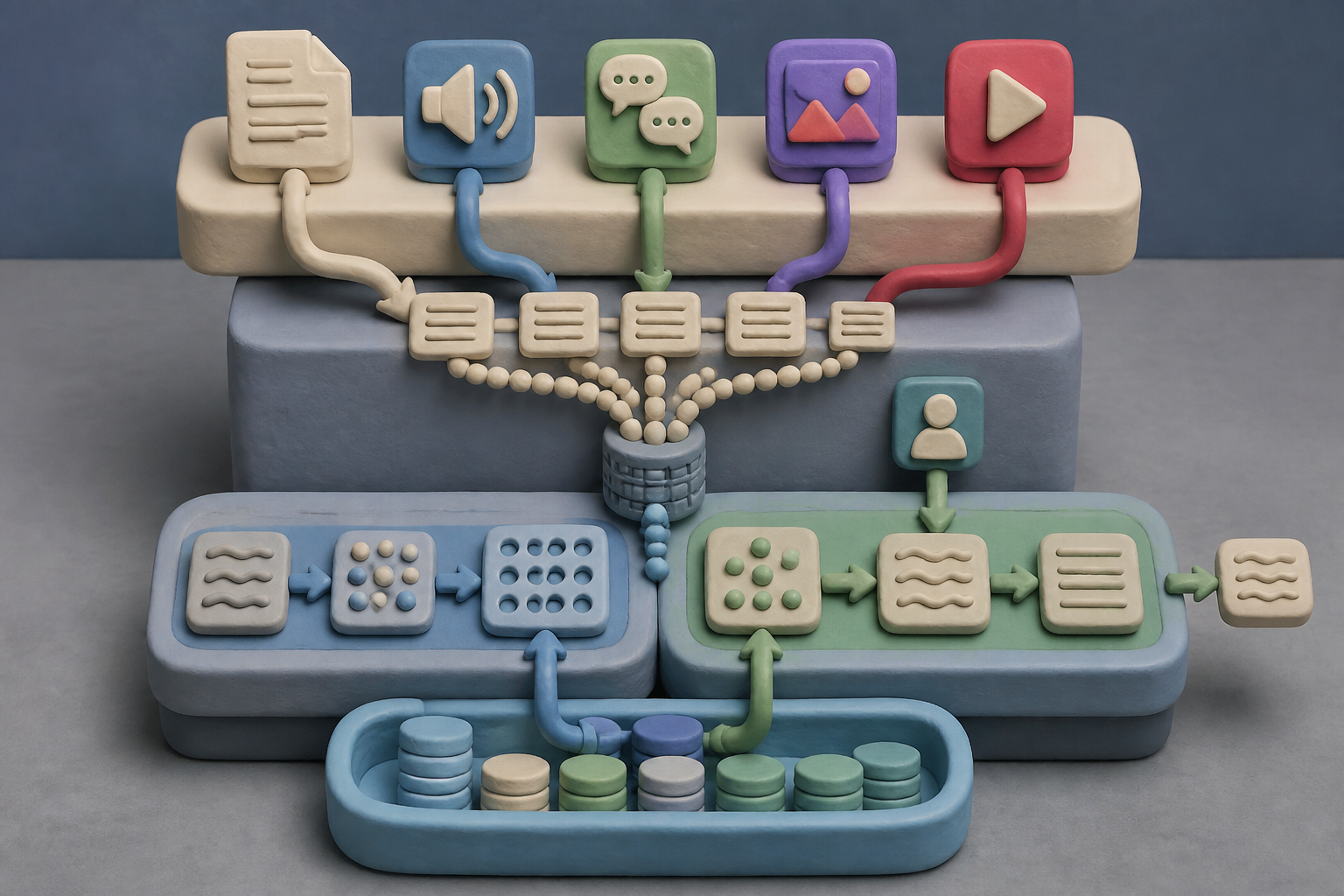
What changes in this design
Without the system described here, a reader might expect patient healthcare information to remain in whatever form it arrived in, making a later request depend on looking through that material.
This record describes taking relevant details from received patient healthcare information, putting them into a structured database, and returning pertinent information when a user asks for it.
That is worth knowing because the record focuses on turning received health information into an organized collection that can be queried for information connected to a user's request.
The 49.2 percent
The number I began with still bothers me: 49.2 percent. In a 2016 study of 57 U.S. physicians observed for 430 hours, nearly half the office day went to electronic records and desk work, while 27.0 percent went to direct face time. That works out to about two hours of desk work for every hour with a patient, plus one to two hours of record work at night. The workload makes it easy for me to see why someone would try to make the chart sort itself.
February 21, 2025
That pressure sits behind US20260253684A1, Ai-Driven Healthcare Information Management System, filed February 21, 2025, and published August 27, 2026. The filing reads to me less as a new medical need than as a bid to claim one way of handling an old one. Its proposed system receives patient healthcare information, extracts relevant material, puts it into a structured database, and retrieves pertinent information when a user asks.
The public record lists Han Mo as sole inventor and no company assignee. The public record leaves me unable to identify the person further, and the timing matters more to me. The claims invoke retrieval augmented generation, GraphRAG, vector embeddings, and a language model instruction that includes each database field's definition. The filing itself names fragmented records and proprietary electronic record formats as the problem.
Forty hospitals
More than six months before the filing, on August 14, 2024, Kaiser Permanente announced ambient documentation technology across 40 hospitals and more than 600 medical offices in eight states and Washington, D.C., serving 12.5 million members. That announcement is not, to me, a complete legal answer: whether it affects patentability depends on the deployment details and the claims. But it puts the filing in a public, working market already operating at scale.
Kaiser Permanente required patient consent and clinician review. That, I think, is the difficult part. Extracting words is only part of the task; people still need to know what was captured, decide whether it is right, and correct it when it is not.
1,744 hospitals
By 2025, a study counted 1,744 of 2,784 U.S. hospitals running Epic as adopters of an ambient AI documentation tool, reporting adoption at 62 percent. That scale, I think, changes the question. That scale means we need to ask whether this particular technical method does something distinct enough to merit patent protection.
Scale has not automatically produced a dramatic workday. In a study of 8,581 clinicians at five health systems, I found 13.4 fewer EHR minutes and 16.0 fewer documentation minutes per eight scheduled patient hours, with no significant change in after hours record time. About 32 percent of adopters captured most of the benefit. Those 16 minutes are not something I dismiss, but I resist calling it a transformation.
A brighter result I found was this: 7,260 physicians used ambient scribes across 2,576,627 encounters over 63 weeks, with 15,791 documentation hours saved. Eighty-four percent reported better patient communication and 82 percent better job satisfaction. Taken together, the studies tell me the tools can help, but unevenly.
Six canceled claims
The published application marks claims 2, 3, 5, 7, 19, and 20 canceled. The public document alone does not tell me why, so I will not turn those cancellations into a verdict. Still, the visible version is already narrower than the application began.
The public page reporting zero citations struck me, even though clinical text processing predates large language models by years. In 2019, researchers called the often repeated claim that 80 percent of electronic health record data are unstructured an unproved conjecture. That warning is one I take seriously. A familiar frustration and newer vocabulary do not, by themselves, make an invention.
The part worth watching
The boundary between a useful workflow and a patentable technical contribution is what I'd watch. This application is still pending, and publication is not a grant. A 2025 appeals decision has been read as friendlier to AI claims tied to technical improvements, but that signal cannot decide whether these claims clear the abstract idea test.
The rules forming around the work are also something I'd watch. The FDA says its list of AI-enabled medical devices is not comprehensive; the newest visible entries I found were dated March 30, 2026. Federal health IT rules created transparency requirements for certain AI and predictive algorithms in certified systems, with USCDI version 3 the certification baseline from January 1, 2026. This filing is, for me, a claim arriving after adoption, mixed evidence, and oversight have made the harder questions impossible to ignore.
Sources
Reporting for this piece drew on the published filing and the references below.
- US20260253684 patent record
- AI-Driven Healthcare Information Management System - US Patent Application 20260253684
- US20260253684A1 patent page
- Physicians spend two hours on EHRs and desk work for every hour of direct patient care
- Kaiser Permanente Improves Member Experience With AI-Enabled Clinical Technology
- New Study Finds Nearly Two-Thirds of U.S. Hospitals Using Epic Have Adopted Ambient AI
- JAMA Study: AI Scribes Deliver Modest EHR Time Savings Across 5 Major Health Systems
- AI scribes save 15,000 hours - and restore the human side of medicine
- The Revival of the Notes Field: Leveraging the Unstructured Content in Electronic Health Records
- ONC Health Data, Technology, and Interoperability Certification Program (HTI-1 Final Rule)
- Artificial Intelligence-Enabled Medical Devices
- From Abstract to Applied: How Desjardins Can Reframe Patent Protection for AI in Health Care
The record, briefly. US20260253684A1, “Ai-Driven Healthcare Information Management System” A healthcare information management system uses interface, processing, and database layers to extract relevant data from received patient healthcare information, populate a structured database, and retrieve pertinent information in response to user requests.
More angles on this
- A Setting Is Not a Promise: Inspecting the HingeAnother reading from the same G16H classification family, healthcare informatics.
- A Handoff Worth Watching: Fragment-Based Drug Design With an Assistant at the BenchAnother reading from the same G16H classification family, healthcare informatics.
- CPC G16H: Healthcare informaticsThe official classification family this record was filed into, published in the USPTO Cooperative Patent Classification scheme.
- CPC G06F: Electric digital data processingThe official classification family this record was filed into, published in the USPTO Cooperative Patent Classification scheme.
- Measurement And Analysis Method For Detecting And Quantifying Makes a Small Case for Better TimingAnother reading from the neighbouring G16B classification family, bioinformatics.
Read around this one:Public patent recordUSPTO published figure