Objects
The Judgment Space Between Washing and Packaging
A new patent filing asks charged droplets to close a stubborn food-safety gap that decades of washing have not closed.

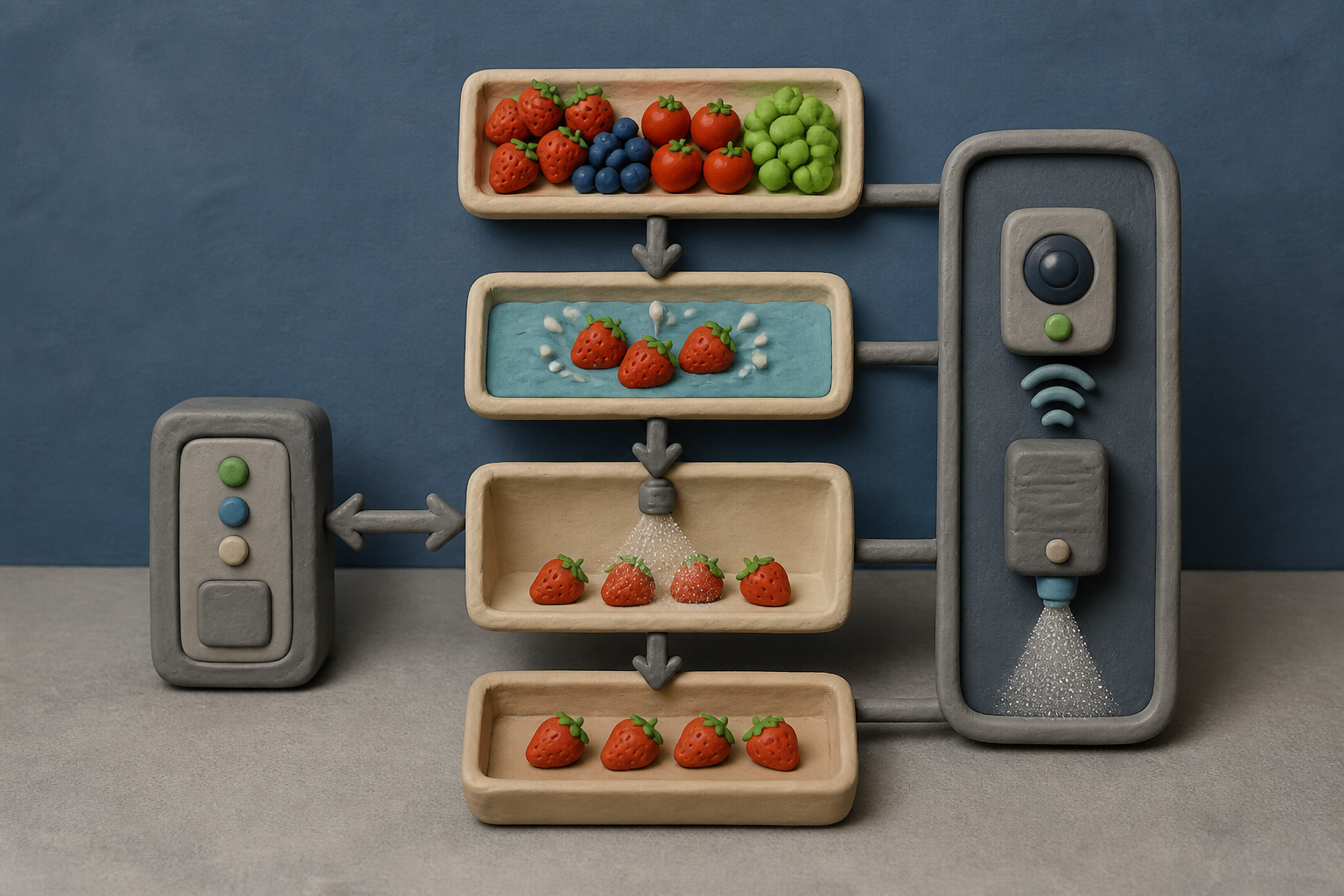
What changes in this design
A reader might assume harvested goods are simply washed and then placed in packaging. That picture does not include a separately applied substance or direct-application tools.
It includes wet or dry washing, application of a substance with a carrier before packaging, and direct-application devices such as electrostatic chargers or nebulizers. Those devices are included to enhance sanitizer efficacy, quality, safety, and shelf life.
It helps a reader see that preservation here involves treatment between washing and packaging, plus tools meant to improve sanitizer efficacy. What is measured is not stated.
The spinach that stayed with us
In 2006, contaminated bagged spinach made 199 people sick across 27 US states and Ontario. Three people died, and roughly 141 were hospitalized. Food preservation can sound abstract until lunch becomes an outbreak, and the case was traced to cattle-manure-contaminated water or its proximity at a California ranch; that's why I start there.
That episode isn't proof that one later machine could have prevented it, in my view. The causes of produce outbreaks sit before harvest, in water, soil, animals, equipment, and people. The episode is, I think, the right scale for judging a new promise at the packing line: a treatment should be measured against the stubbornness of contamination, not against a clean laboratory surface.
The wash-tank limit
Peer-reviewed work on fresh produce gives the problem sharp edges. Under commercial conditions, post-harvest washing generally cuts pathogens by about 1 to 2 log units, regardless of sanitizer or wash time in the studies reviewed. That can mean, as I translate it cautiously, a 90% to 99% reduction, useful but far short of removal. Controlled lab tests can reach 5 log reductions, a gap that matters when the remainder can still travel through a supply chain.
The same review makes me wary of easy instrumentation stories. It describes failure to maintain free chlorine in a wash tank as a documented contributor to a major E. coli outbreak and finds oxidation-reduction-potential monitoring unreliable for tracking sanitizer performance in real time. Washing is not useless. It is simply, I think, a weak final barrier when upstream controls have failed.
The charge at the nozzle
That is where US20260256156A1 enters. The filing covers a sequence for harvested perishable goods: wet or dry washing, application of a substance using a carrier, and packaging. Its distinguishing hardware is direct application through devices such as electrostatic chargers or nebulizers. The proposal reads, to me, as an attempt to put a treatment more deliberately onto the product, rather than relying only on a communal wash tank.
Charged-droplet spraying is not science fiction. A trade account traces the method to work by a Georgia spray-equipment company and a government space agency, describing droplets around 40 microns that can wrap around a surface. The trade account offers no adoption or cost figures that I found. The filing proposes better sanitizer efficacy, quality, safety, and shelf life; it does not, from the material before me, demonstrate those outcomes in commercial use. Its public entry has no recorded CPC classification; the 2021 parent was categorized across produce preservation, spraying, and packaging.
A family, not a debut
This isn't, to me, a debut by a new entrant. The 2021-published parent application carries the same title and claim structure, including electrostatic charging devices, nebulizers, and carrier-based application. It was filed in 2020 with a 2019 priority date, and names Randall Craig Bowden and Robert W. Herdeman, working through RLMB Group LLC. That continuity matters to me: this is a long-running effort to refine delivery, not a sudden solution.
Herdeman's trail reaches back further. In 1993, he filed a controlled-atmosphere shipping-container patent for perishable products that later issued in 1994, assigned to a major produce company. That three-decade arc changes the meaning of this publication for me. It suggests accumulated practical attention to postharvest handling, but it also raises the bar: persistence is not evidence that the newest configuration works at scale.
The part worth watching
Another branch of the field makes the question less tidy. Apeel Technology's 2017 patent uses a 50% to 90% ethanol sanitizing solvent with plant-derived monoacylglycerides to leave a persistent coating. That is a different route from focusing on charged droplets, and I would not call the approaches legally interchangeable. Yet both force the same consumer question: what is applied, what stays behind, and how clearly is that disclosed?
An advocacy group argues that coatings can escape ingredient-label disclosure and has raised questions about formulation residues; it notes that the FDA found those residues below applicable limits. The FDA's revised agricultural-water rule took effect in 2024, and its final compliance phase, for very small farms, begins April 5, 2027. That timing is, I think, a reminder that prevention before harvest remains a live policy project. Separately, a 2026 patent survey found current shelf-life filings clustering around high-pressure processing, supercritical carbon dioxide, and heat treatment, not electrostatic or nebulizer delivery. This filing strikes me as a thoughtful engineering bet at the edge of the current conversation. What I would watch now is simple: independently measured pathogen reduction in real packing houses, the treatment chemistry, and whether the method adds a reliable barrier rather than a more precise way to distribute one.
Sources
Reporting for this piece drew on the published filing and the references below.
- US20260256156A1 - Systems And Methods For Applying Treatments For Preservation Of Perishable Goods
- US20210368831A2 - Systems and methods for appyling treatments for preservation of perishable goods
- Challenges in the microbiological food safety of fresh produce
- 2006 North American E. coli outbreak in spinach
- From Space to Soil: How the Electrostatic Spray Nozzle Benefits Farms and Food Safety
- US5333394A - Controlled atmosphere container system for perishable products
- US10092014B2 - Method for preparing and preserving sanitized products
- Apeel and Edible Coatings: Your Questions Answered
- 2026 patents: food shelf life without preservatives
- FSMA Final Rule on Pre-Harvest Agricultural Water
The record, briefly. US20260256156A1, “Systems And Methods For Applying Treatments For Preservation Of Perishable Goods” The publication describes treating harvested perishable products by wet or dry washing, applying a substance using a carrier, and packaging, with direct application devices such as electrostatic chargers or nebulizers to enhance sanitizer efficacy, quality, safety, and shelf life.
Identity details. The saved title-page transcription needs review, so names are not repeated here. Check the official published title page.
More angles on this
- The Potato Product Makes Its Entrance in SlicesAnother reading from the same A23B classification family, preservation of foods, foodstuffs or non-alcoholic beverages; chemical ripening of fruit or vegetables.
- CPC A23B: Preservation of foods, foodstuffs or non-alcoholic beverages; chemical ripening of fruit or vegetablesThe official classification family this record was filed into, published in the USPTO Cooperative Patent Classification scheme.
- CPC B65D: Containers for storage or transport of articles or materialsThe official classification family this record was filed into, published in the USPTO Cooperative Patent Classification scheme.
- A Baked Product's Specified Sugar RelationshipAnother reading from the neighbouring A23G classification family, cocoa.
- A Quiet Range for Crop-Row AlignmentAnother reading from the wider A01B classification family, soil working in agriculture or forestry.
Read around this one:Public patent recordUSPTO published figure