Groundwork
A Quiet Range for Crop-Row Alignment
Farm steering is already ordinary equipment. The new contest is over software rules that decide when a tractor corrects itself.

What changes in this design
Without this approach, a reader might picture a vehicle receiving a simple steering correction after it drifts away from a crop row, without any stated range for how that correction changes.
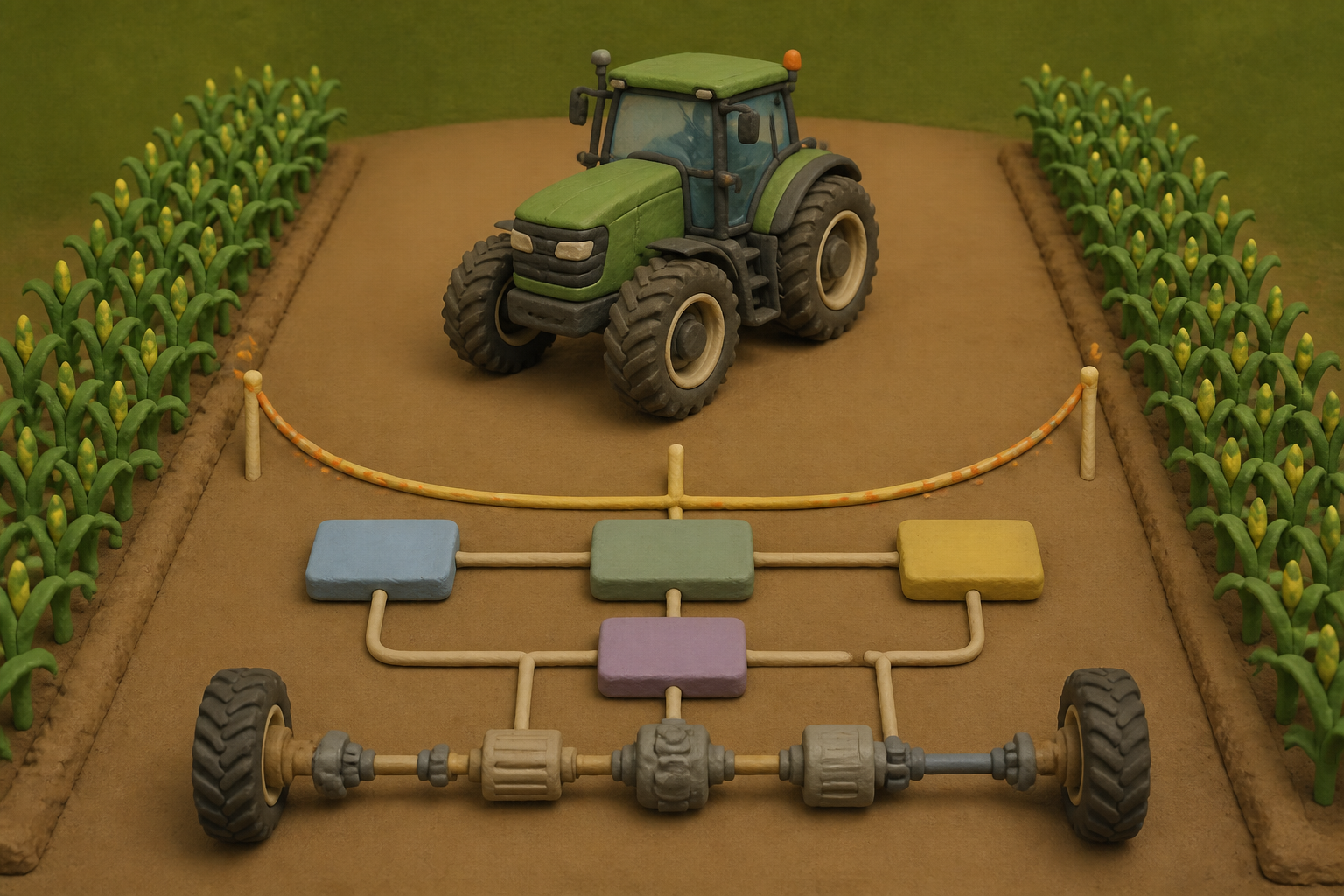
Here, information about both the vehicle and the crop rows is used to check the vehicle against a virtual wall with minimum and maximum thresholds. The steering angle is then increased from the minimum threshold to the maximum threshold.
This is worth knowing because it makes the two limits central to the steering decision. The record does not say how those limits are selected or what outcome is measured.
Four inches of error
Four inches is the number from 2004 I keep returning to. That was the claimed accuracy of a GPS correction service born from 1990s space-navigation work. By 2015, self-guidance was reported to cover 60 to 70 percent of North American acreage. The hard part, then, isn't making a tractor follow a line. It's deciding what it should do when the line and the field disagree.
That adoption has given me no reason to treat it as a finished story. A straight GPS path is not necessarily the same thing as reliable row guidance. Crop rows, physical sensors, weeds, drainage gaps, turns, and crop density can all make the simple instruction - stay centered - into a chain of decisions.
Two invisible lines
That is where a September 3 publication from CNH Industrial America LLC becomes interesting. It is an application, not a granted right, filed February 25, 2026 and published as US20260256038A1. It proposes a virtual wall with a minimum and maximum boundary for a row-following vehicle. As sensed vehicle position moves from the inner threshold toward the outer one, its steering correction rises with it. The controller needn't wait for a hard limit; it can steer the tractive elements more sharply as risk grows.
CNH's claims also describe changing those thresholds with crop density, disengaging the wall during end-of-row turns, and using ultrasound, vision, or mechanical feelers to judge a row. The proposal, as I read it, is an attempt to define the decision layer around familiar hardware. The important claim isn't a new sensor. It is a rule for how strongly the machine responds as it approaches trouble.
Rows with gaps
This filing doesn't, I think, stand alone. A John Deere application filed June 26, 2025, addresses the same uneasy fact: row sensing can become unreliable. It describes maps and cameras detecting weeds or drainage gaps, then overriding tactile row sensors with GPS-based steering. The approaches differ, but both focus on the moment a machine must choose among imperfect signals rather than simply hold course.
That choice already matters at scale. Survey figures put GPS guidance or auto-steer on a majority of acreage for corn, winter wheat, soybeans, and cotton between 2016 and 2019. These filings look to me less like a bid to introduce autonomous steering than a contest over how ordinary machinery behaves at uncertain edges.
A ten million dollar quarter
The timing makes me pause. CNH reported first-quarter 2026 net income of $10 million, down from $132 million a year earlier. North American tractor sales above 140 horsepower fell 27 percent year over year, and the company was reducing dealer inventory by roughly $500 million in 2026. Those figures don't let me infer why a single application was filed. The claims arrived, I can say, while the market for large tractors was under pressure.
That doesn't make a steering algorithm a rescue plan. CNH had shown cabless autonomous tractor concepts in 2016, so this looks to me like another move along a long technical path. Yet a technical path can become a property boundary, especially once the machine's decisions are made in software.
The open question
The public fight is not only about who writes those rules. On July 8, 2026, the FTC and five states secured a 10-year consent decree requiring Deere to give farmers and independent repairers the same access to fault codes, reprogramming, and diagnostic software available to its dealers. In 2023, CNH's farm-equipment brands also signed a nationwide right-to-repair agreement promising diagnostic and manual access, while preserving intellectual property and excluding changes to safety and emissions controls.
That tension is, I think, the real news around this filing. Farmers may gain the ability to inspect and repair systems on their machines while manufacturers seek rights over steering logic inside them. Access to diagnose is not permission to alter, reproduce, or build around a claimed control method. The question we should watch is whether repair access brings practical independence, or simply a better view of a black box whose crucial decisions sit behind claimed software rules.
Sources
Reporting for this piece drew on the published filing and the references below.
- Virtual Wall For Bounded Performance Of Auto-Guidance Of Agricultural Vehicles
- Virtual Wall for Bounded Performance of Auto-Guidance of Agricultural Vehicles
- GPS Correction Technology Lets Tractors Drive Themselves
- US20250318465A1 - Context-based row sensing guidance control
- CNH CEO: 'Passing Through Lowest Period' of Current Ag Cycle
- Autonomous Solutions Inc. and CNH Industrial Unveil Concept Autonomous Tractor
- FTC, States Secure Settlement with Deere & Company, Advancing Farmers' Right to Repair
- Case IH and New Holland sign right-to-repair agreement with American Farm Bureau
The record, briefly. US20260256038A1, “Virtual Wall For Bounded Performance Of Auto-Guidance Of Agricultural Vehicles” A vehicle uses sensed positional data for the vehicle and field crop rows to compare vehicle position with a virtual wall having minimum and maximum thresholds, then adjusts tractive-element steering so the steering angle increases from the minimum to the maximum threshold.
Identity details. The saved title-page transcription needs review, so names are not repeated here. Check the official published title page.
More angles on this
- A Field Robot's Route Plan Reads Less Like a Map and More Like a Rehearsal ScheduleAnother reading from the same A01B classification family, soil working in agriculture or forestry.
- System And Method For Emergency Dispatch Questions the Default ArrangementAnother reading from the same G06V classification family, image or video recognition or understanding.
- CPC A01B: Soil working in agriculture or forestry; parts, details, or accessories of agricultural machines or implements, in generalThe official classification family this record was filed into, published in the USPTO Cooperative Patent Classification scheme.
- CPC A01D: Harvesting; mowingThe official classification family this record was filed into, published in the USPTO Cooperative Patent Classification scheme.
- A Plate, a Stage, and One QuestionAnother reading from the neighbouring G01L classification family, measuring force, stress, torque, work, mechanical power, mechanical efficiency, or fluid pressure.
Read around this one:Public patent recordUSPTO published figure