Machines
System And Method For Emergency Dispatch Questions the Default Arrangement
When devices speak first in an emergency, the hardest question is not what they detect, but who has earned the right to believe them.
What changes in this design
The record does not lay out the usual path for emergency dispatch. A reader might otherwise picture a responder system receiving information and responding without this computer-generated code.
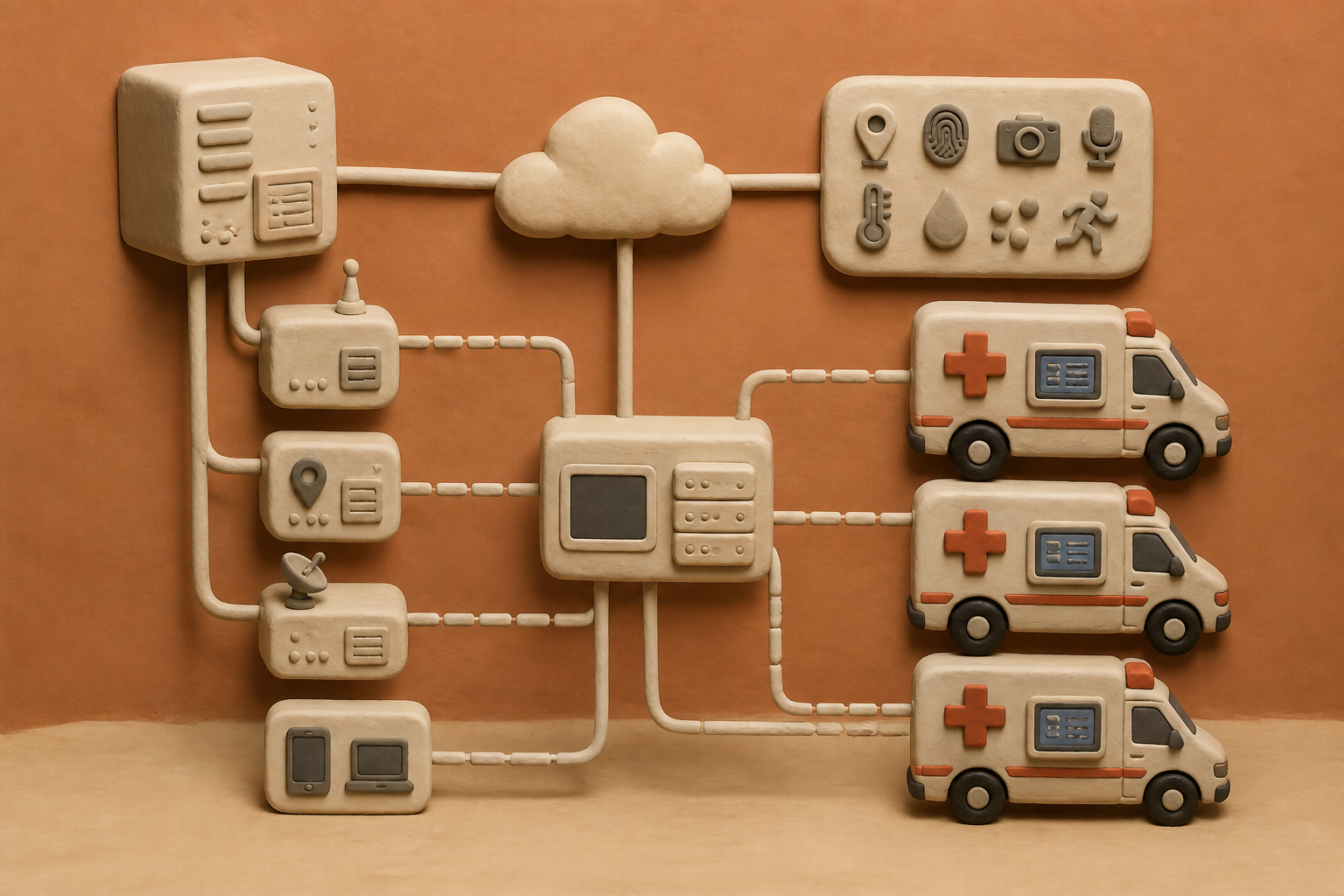
Here, a computer device receives external sensor data and may receive answers from an information provider. It works out data values and how likely an emergency is, produces a determinant code from that likelihood, and gives the code to an emergency responder system.
What matters is the handoff: the responder system receives a code that reflects the computer's emergency-likelihood assessment. The record does not say what the code contains, what it measures, or how the responder system uses it.
185 calls in one week
The Summit County, Colorado, number I keep returning to is 185. During one week in January 2023, its 911 center received that many automated crash-detection calls from a large phone maker, roughly twice its normal call volume. Those calls aren't, to me, a case against a device asking for help after a possible wreck. The episode is, to me, a warning that an alert and an emergency are not the same thing.
That week matters to me because a call center has to make room for the false alert without making the real caller wait. A single sensor can be useful. The final word doesn't, I think, belong to a single sensor when every minute carries a cost.
A determinant code
Following that problem led me to US20260255143A1, a newly published application titled System And Method For Emergency Dispatch. It describes a computer device that receives external sensor data and, in some cases, answers from an information provider. It weighs those values for emergency likelihood, generates a determinant code, and provides that code to an emergency responder system for dispatch.
What caught my attention was the restraint built into the idea. The filing belongs to a family whose earlier continuation frames the rule plainly: no individual external device should determine an emergency; independent sensor data should be compiled instead. The patent's most sensible premise, I think, is that corroboration may make a device alert less brittle before it becomes an instruction inside a pressured room.
April 23, 2021
The filing is not, I found, a standalone invention. Two earlier issued patents in the same continuation chain trace to an April 23, 2021 priority date: one granted in March 2024 and another in April 2025. Together they link the 2026 publication to Priority Dispatch Corp, Jeffrey J. Clawson, and Ronald McDaniel, with the same basic move: pair structured dispatcher questioning with IoT sensor evidence and calculate a determinant code from corroborated sources.
The long lineage matters, I think. Clawson's dispatch work reaches back to 1976-79, when he worked as a Salt Lake City EMT and dispatcher; the Medical Priority Dispatch System rolled out with the city's fire department in 1978. Priority Dispatch says its approach has cumulatively handled hundreds of millions of emergency calls. The reach I see in that figure isn't proof that the triage logic always finds the right path.
Four calls in Salt Lake City
That promise couldn't, for me, be separated from a 2015 Salt Lake City case. Breann Lasley sued Priority Dispatch after a home invasion and stabbing, alleging that the scripted Police ProQA protocol did not get police dispatched despite four 911 calls. The company defended its software. McDaniel, the company's president and a co-inventor in this patent family, said the deeper problem was location: "In 911, we don't know where you are on literally 70 to 80 percent of the calls."
An allegation is not, to me, a verdict on a protocol. The episode does, I think, put a hard boundary around this filing's promise. More corroboration can reduce a bad alert, yet it cannot locate someone when location is unavailable or repair a questioning sequence that has already missed the danger. A determinant code is still an input. It is not an ambulance or an officer at a door.
Where the risk actually sits
A different route to the same ambition also surfaced for me. Corti, a Danish company, reported that its system identified cardiac arrest in about 170,000 Copenhagen emergency calls 95% of the time, compared with 73% for human dispatchers alone. A company-reported result is not, in my reading, a final verdict. Still, it shifts the question: should a dispatcher system listen more closely to live call audio, rather than wait for devices to corroborate one another?
Another patent holder, RapidSOS, lists more than 51 issued U.S. patents involving device data delivered to 911 systems. Competition, I see, is over the route by which a call center learns, not a settled answer about what it should believe. The handoff is what I keep coming back to. A federal watchdog reported roughly 240 million 911 calls each year and found in September 2024 that only seven of 11 federal agencies running call centers had begun planning Next Generation 911 upgrades. A code can be carefully calculated and still meet a center without the money, location data, or systems to turn it into help. That is where I think this patent's risk actually sits.
Sources
Reporting for this piece drew on the published filing and the references below.
- US20260255143A1 - System And Method For Emergency Dispatch
- US11937160B2 - Emergency Dispatch System
- US12267908B2 - System and Method for Emergency Dispatch
- Medical Priority Dispatch System
- About Priority Dispatch
- Woman Stabbed in 2015 Home Invasion Suing 911 Dispatch Company
- AI Called Corti Accurately Spots Heart Attacks Over 911 Calls
- Patent Notice
- Apple Crash Detection Is Overwhelming Some 911 Centers
- GAO-24-106783: Next Generation 911
The record, briefly. US20260255143A1, “System And Method For Emergency Dispatch” A computer device receives external sensor data and, in some embodiments, answers from an information provider; it determines data values and an emergency likelihood, generates a determinant code based on that likelihood, and provides the code to an emergency responder system for an emergency dispatch response.
More angles on this
- Medical Devices And Related Systems And Methods For Reducing Signal Treats the Relationship as the PointAnother reading from the same A61B classification family, diagnosis; surgery; identification.
- Apparatus And Method For Vehicle External Communication Questions the Default ArrangementAnother reading from the same H04W classification family, wireless communication networks.
- CPC H04W: Wireless communication networksThe official classification family this record was filed into, published in the USPTO Cooperative Patent Classification scheme.
- CPC A61B: Diagnosis; surgery; identificationThe official classification family this record was filed into, published in the USPTO Cooperative Patent Classification scheme.
- Apparatus And Method For Reorder Buffer With Sliding Window In A Treats the Relationship as the PointAnother reading from the neighbouring H04L classification family, transmission of digital information, e.g. telegraphic communication.
Read around this one:Public patent recordUSPTO published figure