Groundwork
Apparatus And Method For Vehicle External Communication Questions the Default Arrangement
External Vehicle and Sensor form one stated connection: An apparatus generates a user's location from an external vehicle sensor.

First, the setting
People often interact with a car from just outside it: approaching a parked vehicle, speaking through a partly open window, or asking for help. Designers work on these moments because a vehicle can be a barrier between people who need to see, hear, and respond to one another.
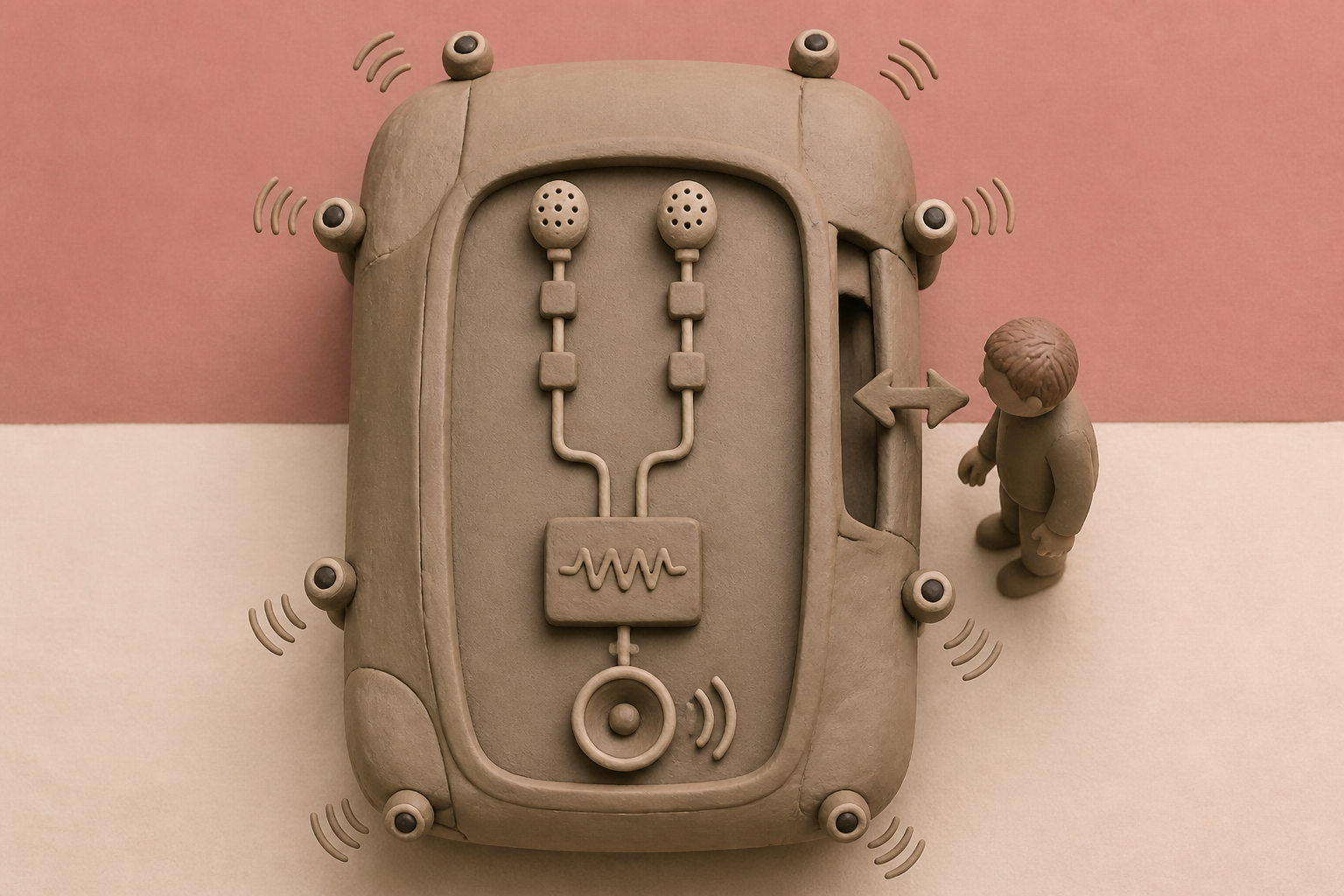
A person stands beside a parked car while someone inside speaks. An outside sensor notices where the visitor is, the window moves, and sound comes through the speaker nearest the person. The exchange happens at a curb, driveway, pickup area, or gate.
What changes in this design
Without this approach, a reader might expect a vehicle's speaker and window to operate without first using the user's location.
Here, the user's location is used to control a window, while voice signals from in-vehicle microphones are processed and guidance goes to the closest speaker.
It is worth knowing because the system links a person's location to both window control and the choice of speaker for guidance.
Inside the external vehicle
I find the detail that first looks like background in Apparatus And Method For Vehicle External Communication Questions the Default Arrangement is often the condition that keeps the whole arrangement legible. The first correction is to separate the apparent headline from the actual arrangement. The point becomes clearer when the result is folded back into the facts that support it. The published description says: An apparatus generates a user's location from an external vehicle sensor, controls a vehicle window using it, processes voice signals from in-vehicle microphones, and outputs guidance through the speaker closest to the user. Apparatus And Method For Vehicle External Communication becomes friendlier once the sequence is allowed to form a line instead of a traffic jam.
The labels now identify what belongs inside that condition. The labels make the condition visible without treating it as mere background scenery. External Vehicle means the named external vehicle in the source's described arrangement; Sensor means a component named with the actuator in the hitch-control arrangement. The remaining named details, including Processes Voice Signals, refine that same picture rather than starting a new one. External Vehicle gets its turn before Sensor, which saves everyone a little paperwork.
Reading the sensor
The same condition also sets a fair boundary for comparison. A related description can be placed beside this one by asking whether it names the same condition around external vehicle and sensor. The public record identifies no named predecessor and does not establish legal novelty, infringement, market success, or a head-to-head performance result.
What the record actually names
The next question is how the source uses that condition within the arrangement. The important move is their placement: External Vehicle and Sensor are not loose labels but part of one stated sequence. That is the disclosed stated sequence, not an extra mechanism supplied by the reader.
That placement explains why the condition matters. For Apparatus And Method For Vehicle External Communication, the immediate value is clarity: the record gives a reader one concrete design choice to inspect instead of a long title to decode. The immediate reader value is a specific design choice to inspect: how external vehicle and sensor remain part of one account.
The reader can keep the condition in view without turning it into an oversized claim. Apparatus And Method For Vehicle External Communication is easiest to explain as an ordered chain in which external vehicle and sensor appear as part of the same account. A faithful short account of Apparatus And Method For Vehicle External Communication Questions the Default Arrangement keeps those roles together instead of turning the invention into a list of detached nouns. The order is modest, but it keeps the explanation from wearing roller skates.
The record, briefly. US20260255138A1, “Apparatus And Method For Vehicle External Communication” An apparatus generates a user's location from an external vehicle sensor, controls a vehicle window using it, processes voice signals from in-vehicle microphones, and outputs guidance through the speaker closest to the user.
Identity details. The saved title-page transcription needs review, so names are not repeated here. Check the official published title page.
More angles on this
- The Substrate That Gave Its Two Recesses Unequal DepthAnother reading from the same H04N classification family, pictorial communication, e.g. television.
- An 86-Millisecond Decision: The Ophthalmic Camera That Reads Its Own ExposureAnother reading from the same H04N classification family, pictorial communication, e.g. television.
- CPC H04W: Wireless communication networksThe official classification family this record was filed into, published in the USPTO Cooperative Patent Classification scheme.
- CPC E05F: Devices for moving wings into open or closed positionThe official classification family this record was filed into, published in the USPTO Cooperative Patent Classification scheme.
- One window, several models: a reading of Model Functionality MonitoringAnother reading from the neighbouring H04L classification family, transmission of digital information, e.g. telegraphic communication.
Read around this one:Public patent recordUSPTO published figure