Objects
Medical Devices And Related Systems And Methods For Reducing Signal Treats the Relationship as the Point
A new image-signal filing lands in the uneasy gap between safer disposable scopes and the failures that still reach the screen.

What changes in this design
If nothing else were known, a reader might picture a device that simply sends images to a screen. How other devices deal with image-signal distortion is not stated.
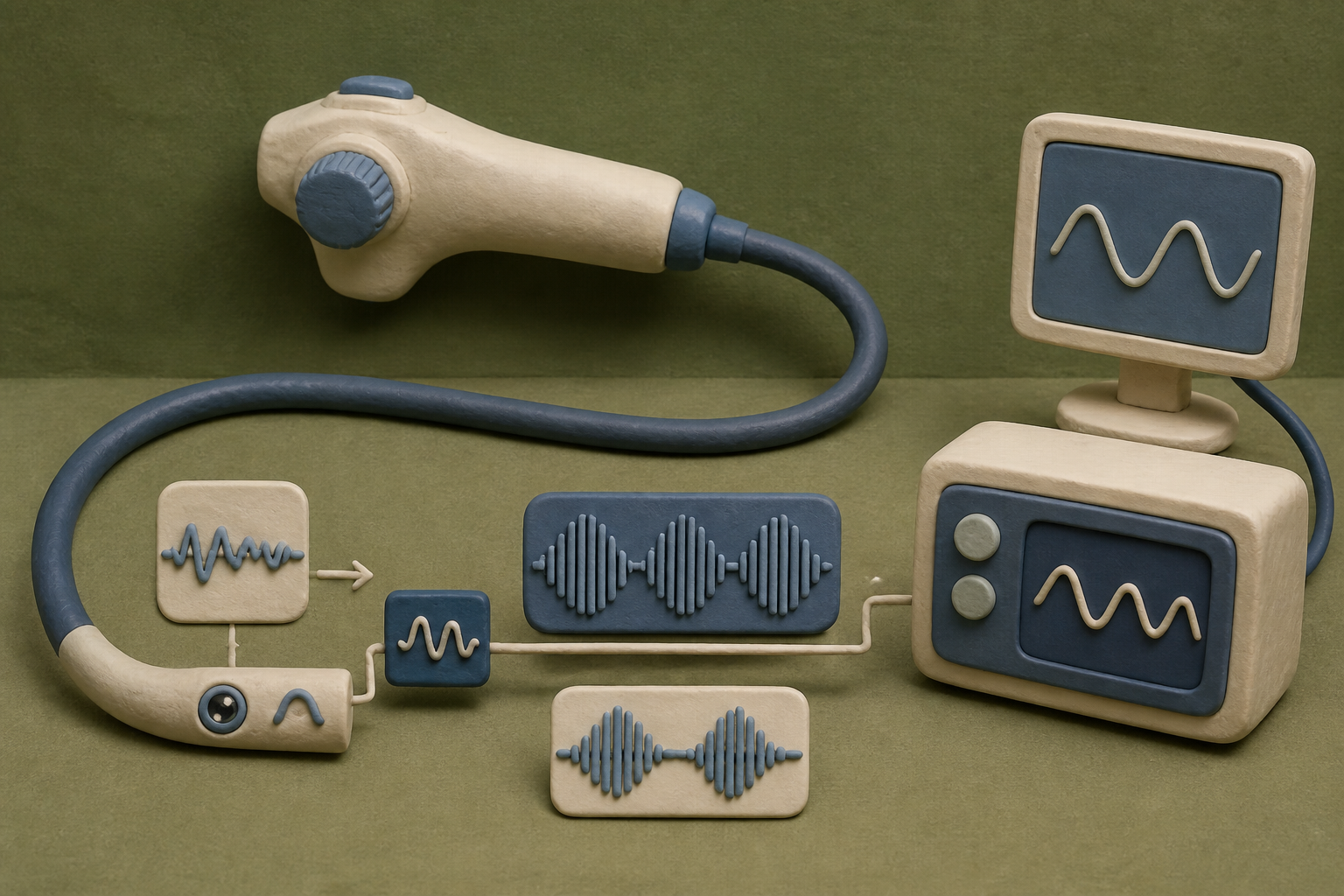
Here, the system may include a shaft, an image-making part, a component that works with signals, and a control unit. The control unit receives a signal, performs de-modulation, and outputs a third signal to an electronic display.
This matters because the topic includes image-related information sent to a display, not only the part that makes images. Reducing distortion is the stated aim; the amount of reduction and method are not stated.
A blurred lens in 2023
On October 3, 2023, Boston Scientific began recalling EXALT Model D single-use duodenoscopes after it identified poor image quality from fluid ingress in the lens. The Class 2 action covered 667 units, 586 of them in the United States. That detail keeps drawing me back because a disposable instrument is meant to remove one clinical worry, not trade it for a compromised view when a physician needs to see.
Its case was clear to me: a new sterile scope for each patient avoids the hard task of cleaning a device with intricate channels and a hard-to-reach tip. Boston Scientific received FDA clearance for the EXALT Model D in 2019 as the first fully disposable duodenoscope. But the 2023 recall makes the tradeoff plain. Sterility does not settle every engineering question.
Scopes after cleaning
The turn toward disposables is understandable, I think. In 2010, a Dutch group linked a fixed-cap duodenoscope to infection transmission. U.S. cases involving drug-resistant bacteria followed in 2012 and 2013, including one outbreak with 39 cases across 35 patients. The FDA says it was alerted in 2013 to a possible connection between multidrug-resistant bacteria and duodenoscopes used according to cleaning instructions.
Reprocessing studies show why that alarm stuck. A 2018 Dutch study found contamination on 39% of scopes judged ready for patients, with gastrointestinal organisms on 15%; the review points to biofilm as a likely reason. Newer reusable designs have improved: a 2022 postmarket study of one newer model found 1.1% high-concern contamination and no low-concern contamination. That history isn't one I'd flatten into a claim that reusable scopes are simply unsafe. The problem is real, but so is progress.
One wire down the shaft
That is the context in which I read US 2026/0255070 A1, published August 27, 2026 and assigned to Boston Scientific Scimed. It is a published application, not proof that a product has changed. The filing describes an imaging device at the far end of a shaft, a signal modulator, and a control unit that demodulates the image signal before it reaches a display.
The point is spare and practical. Rather than carrying the image over a bundle of separate conductors, the design proposes placing a modulated image signal on a single-wire carrier inside the long, thin shaft. The drawings show a handle with an elevator lever and control dial, familiar features of a duodenoscope-style device. The disclosed choices include amplitude modulation, pulse-amplitude modulation, pulse-width modulation, and frequency modulation. The emphasis reads to me as an attempt to reduce wiring and cost in a disposable scope, where every component must earn its place.
Lens and signal path
The dates matter. This application claims priority to a provisional filed July 27, 2023, more than two months before the October recall began. And the recall identifies fluid ingress in a lens, while this filing addresses distortion in an electrical image-signal path. Those are related only in the broadest sense: both can leave the clinician with a poorer picture. This document isn't one I can fairly call the fix for the recalled defect.
The connection still isn't one I dismiss. A scope's image is a chain: light reaches a lens, an imager produces data, conductors carry it, electronics reconstruct it, and a display shows it. Failure at any link can matter. This filing acknowledges a real constraint of the single-use format: bringing reliable imaging through a slim shaft without filling it with expensive wires. That is useful evidence of where the difficult work remains.
The part worth watching
The competition is already clear to me. In April 2024, Ambu received FDA clearance for its own single-use duodenoscopy system, including a 4.2 mm working channel. Meanwhile, the economics are unsettled. A review reported disposable per-procedure costs of $797 to $2,068, compared with $612 to $1,362 for reusable scopes, depending on hospital volume. Bench testing found comparable image-quality scores, but lower navigation scores for disposables than reusable models.
The promise of a fresh sterile scope is, in my view, strong enough to deserve serious engineering, not easy celebration. This new filing is interesting because it narrows in on an unglamorous limit: signal integrity along a disposable instrument's shaft. Clinical performance, failure rates, and costs across ordinary hospitals are the evidence beyond a filing I will watch for. Until then, a single wire is a design proposal, not a verdict.
Sources
Reporting for this piece drew on the published filing and the references below.
- US 2026/0255070 A1 - Medical Devices And Related Systems And Methods For Reducing Signal Distortion In Image Signals
- Boston Scientific Receives FDA Clearance For World's First Single-Use Duodenoscope, EXALT Model D
- Class 2 Device Recall: EXALT Model D Single-Use Duodenoscope
- Infections Associated with Reprocessed Duodenoscopes
- Single Use (Disposable) Duodenoscope: Recent Development and Future
- Ambu secures FDA clearance for new duodenoscopy solution
The record, briefly. US20260255070A1, “Medical Devices And Related Systems And Methods For Reducing Signal Distortion In Image Signals” A medical device system for visualizing internal patient anatomy may comprise a shaft, imaging device, signal modulator, and control unit that receives, de-modulates, and outputs a third signal to an electronic display.
More angles on this
- Apparatus And Method For Vehicle External Communication Questions the Default ArrangementAnother reading from the same H04N classification family, pictorial communication, e.g. television.
- The Substrate That Gave Its Two Recesses Unequal DepthAnother reading from the same H04N classification family, pictorial communication, e.g. television.
- CPC H04N: Pictorial communication, e.g. televisionThe official classification family this record was filed into, published in the USPTO Cooperative Patent Classification scheme.
- CPC A61B: Diagnosis; surgery; identificationThe official classification family this record was filed into, published in the USPTO Cooperative Patent Classification scheme.
- One window, several models: a reading of Model Functionality MonitoringAnother reading from the neighbouring H04L classification family, transmission of digital information, e.g. telegraphic communication.
Read around this one:Public patent recordUSPTO published figure