Objects
A Plate, a Stage, and One Question
A new rheometer attachment brings warning sensors to the lab bench, where the hardest question is still whether small failures scale up.

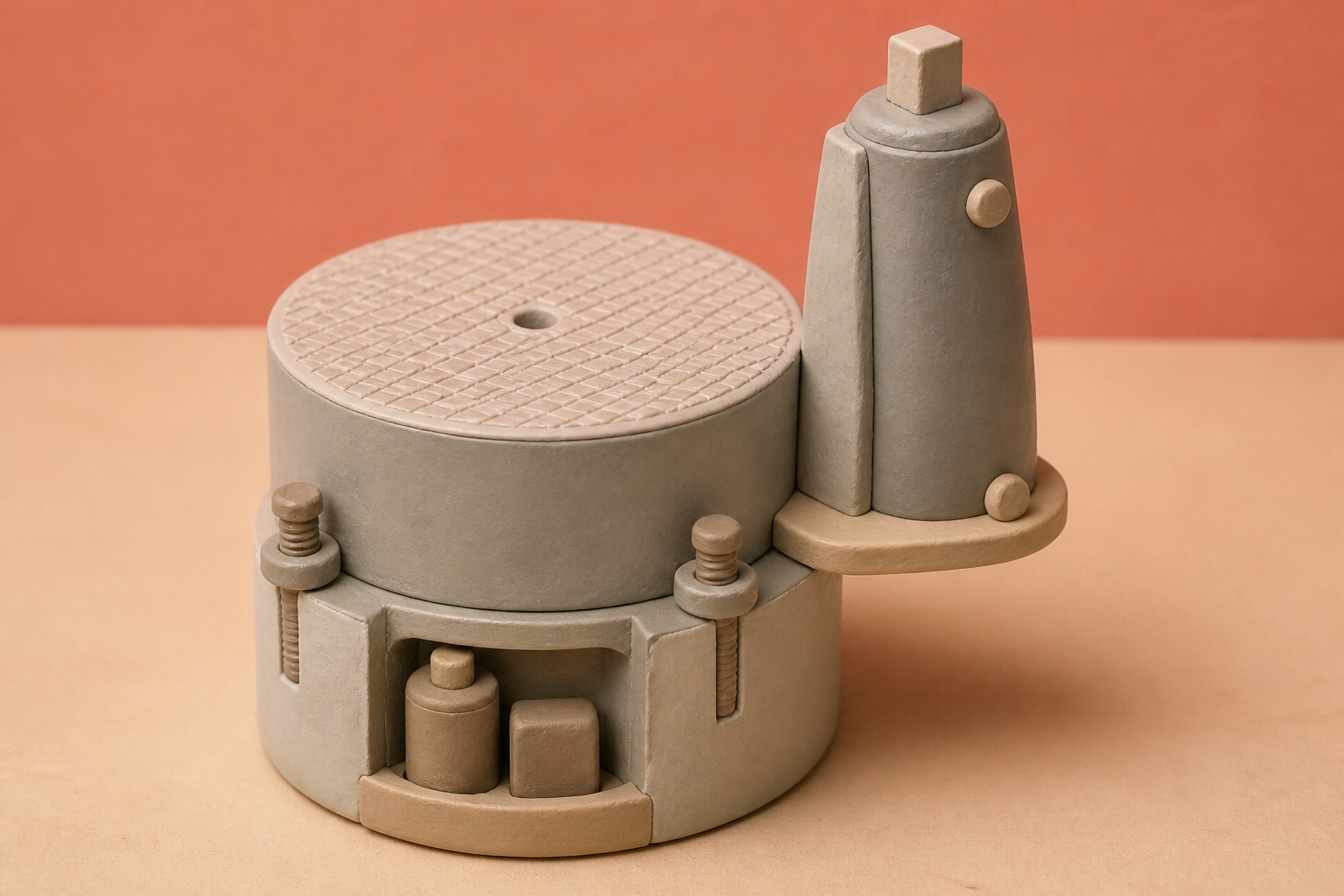
What changes in this design
A reader could otherwise expect a plate, a stage, and testing instruments to be separate pieces instead of components of one add-on.
This item is one attachment containing a fixing plate, a stage split into upper and lower sections, a micro-pore water pressure gauge, a microseismometer, and an acoustic emission instrument.
It is worth knowing because the item is not just one instrument: the record presents a combined testing attachment. Its operation, what it measures, and any results are not stated.
Fourteen loading cycles
The fourteenth loading cycle kept drawing me back. In a 2025 physical model of a pile-reinforced loess slope, researchers added 4 kPa at a time and listened with six acoustic-emission sensors. At cycle 14, a measured Felicity ratio fell below 1.0 before the pile and slope failed. That is the kind of number I understand immediately: a possible warning before a failure that can become sudden.
The room also has to stay in view. The model was built at 1:20 scale, and the researchers excluded rainfall, earthquakes, and excavation. The result can, I think, be treated as a controlled precursor, not as proof that a hillside under changing weather and human work will give us the same notice.
Thirty centimetres of soil
The same restraint appeared, I found, in two other laboratory models. In one 300 x 100 x 100 mm box, an active waveguide was built because soil can attenuate acoustic-emission signals by more than 10 dB per centimetre. Its reported peak energy was 5,462 mV x ms, compared with 19.34 mV x ms for a passive sensor, roughly 280 times higher. That engineering result is striking to me, but it belongs to a box 30 centimetres long, not to a real slope.
In another 2024 model, six waveguide rods in a 0.5 x 0.6 x 0.8 m box registered a 474% rise in cumulative acoustic-emission ringing counts before collapse. The authors' own caution caught my attention in particular: scale effects between a model and real engineering scenarios remain unresolved. The signal should be taken seriously without pretending its distance has already been crossed.
Four measuring geometries
The question I wanted answered before reaching this patent filing was whether the rheometer itself had already settled the matter. The rheometer hasn't. A 2015 study put debris-flow slurry, with 15% to 31% clay, through four rotational-rheometer geometries: concentric cylinder, parallel plate, vane, and ball. The yield-stress readings differed because of wall slip, and the authors judged only the vane and ball systems reliable at high shear. The attachment is, to me, not peripheral hardware. It changes the number we think we are measuring.
A later study of material from the 2018 Montecito debris flow found that yield stress and viscosity collapsed onto one curve after rescaling for distance from jamming. Its authors also described earlier slurry measurements as highly variable and sometimes contradictory. No contradiction emerges between that advance and the older comparison, at least not for me. The field still appears to be working out which readings travel from one setup to another.
Three instruments on one rheometer
That uncertainty is why US20260255509A1 caught my attention. The publication, titled Multi-Functional Integrated Testing Attachment For Rotational Rheometer, describes a fixing plate and upper and lower stage sections that hold a micro-pore water-pressure gauge, a microseismometer, and an acoustic-emission instrument on a rotational rheometer. The arrangement reads to me as an effort to put pressure, vibration, and cracking measurements beside the same material test.
That is useful, but I would not mistake it for a field warning system. An earlier U.S. landslide test apparatus already combined pore-water-pressure sensors with displacement monitoring and shear-surface detection in a field-oriented design. This filing heads in a different direction, toward a bench-top rheometer. Sensor cost also remains on my mind: a low-cost transducer paper reported that expensive miniature pressure sensors can make laboratories limit their number or avoid risky model positions. This publication doesn't tell us whether it solves that cost problem.
Where this leaves things
This attachment is most interesting, I think, as an admission that the measurement problem remains open. A mining research group's account of microseismic slope monitoring reports successful tests in two open-cut mines, while underground trials were still in progress; it also says conventional networks can miss weak events that trigger fewer than three geophones. Three instruments on a lab machine aren't, to me, a promise that this gap has closed.
I would build the rig, then make it earn trust across materials, geometries, scale, rainfall, earthquakes, and excavation. The attachment should, until those comparisons exist, be called a way to make laboratory questions more disciplined, not a settled means of warning people below a slope. That is a smaller claim. It is also, I think, the honest and valuable one.
Sources
Reporting for this piece drew on the published filing and the references below.
- Acoustic Emission Precursors in Pile-Reinforced Loess Landslides
- Monitoring warning criterion of acoustic emission active waveguide system based on loess deformation and failure
- Model Test on Acoustic Emission Monitoring of Loess Slope Failure
- Comparison of Rheometric Devices for Measuring the Rheological Parameters of Debris Flow Slurry
- Rheology of debris-flow materials is controlled by the distance from jamming
- US20260255509A1 - Multi-Functional Integrated Testing Attachment For Rotational Rheometer
- Landslide Detection Test Apparatus - US Patent 9,488,561
- A low-cost miniature immersible pore water pressure transducer
- Microseismic monitoring for slope stability
The record, briefly. US20260255509A1, “Multi-Functional Integrated Testing Attachment For Rotational Rheometer” A multi-functional testing attachment for a rotational rheometer includes a fixing plate, a stage assembly with upper and lower sections, and a testing assembly comprising a micro-pore water pressure gauge, microseismometer, and acoustic emission instrument.
More angles on this
- Duo-Pump Liquid Cooling Device Treats the Relationship as the PointAnother reading from the same H05K classification family, printed circuits.
- Liquid Crystal Polymer Dielectric Powder Or 3D Printed Material Marks a Pause Worth NoticingAnother reading from the same H05K classification family, printed circuits.
- CPC H05K: Printed circuits; casings or constructional details of electric apparatus; manufacture of assemblages of electrical componentsThe official classification family this record was filed into, published in the USPTO Cooperative Patent Classification scheme.
- CPC G01L: Measuring force, stress, torque, work, mechanical power, mechanical efficiency, or fluid pressureThe official classification family this record was filed into, published in the USPTO Cooperative Patent Classification scheme.
- Inside the haptic deviceAnother reading from the neighbouring G01H classification family, measurement of mechanical vibrations or ultrasonic, sonic or infrasonic waves.
Read around this one:Public patent recordUSPTO published figure