Machines
Duo-Pump Liquid Cooling Device Treats the Relationship as the Point
A dual-pump patent arrives as an old AIO restriction recedes, data centers heat up, and the contest shifts from cooling to ownership.

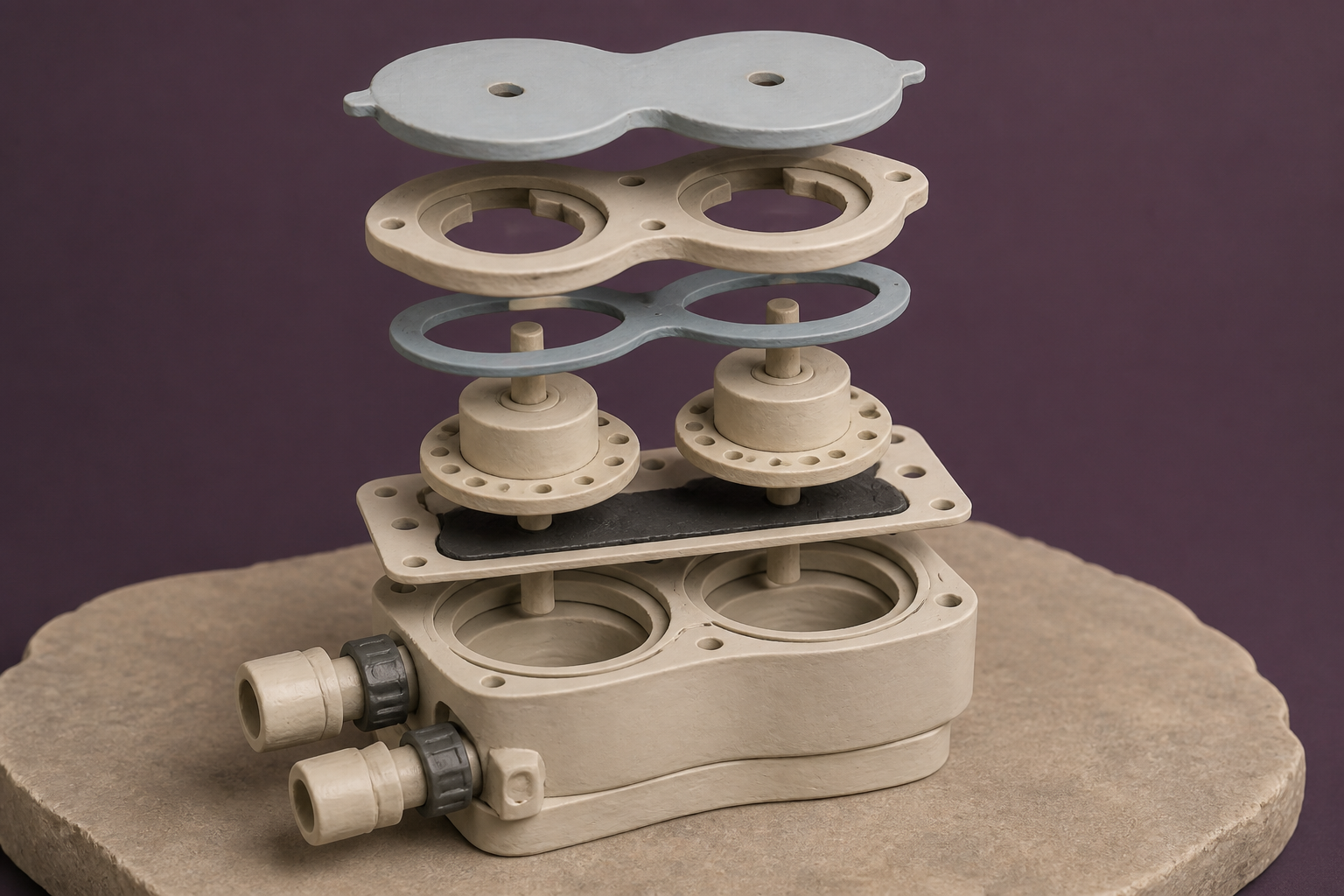
What changes in this design
How liquid cooling is ordinarily arranged is not stated. The basic job is moving cooling liquid from an inlet through a unit and out an outlet while heat is exchanged.
This unit includes two pumps, a base seat, a separating assembly, and a bottom seat. Its cooling liquid route goes through groups of openings, flow-diverting grooves, a group of slots, and a chamber for exchanging heat.
A reader can see that the unit includes both pumping and a route for the liquid that carries heat. Its stated aims are increased liquid flow and carrying heat away more efficiently.
February 21, 2024
On February 21, 2024, Cooler Master sued two PC-cooling brands over all-in-one cooler designs. Shenzhen Apaltek made the units at issue, putting a supplier into a fight over the little water block that sits on a processor, which is why I start there. That block tends to draw our notice only when a fan howls or a machine slows itself down.
That detail changes how I read the new application. It is part of a company already involved in contested AIO hardware, not an isolated engineering exercise. Apaltek's current catalog revealed to me equipment aimed at AI data centers as well as PC coolers, including in-rack cooling distribution units rated up to 150 kilowatts.
The 2005 water block
The history revealed one unusually long patent constraint when I traced it. Asetek filed the application behind its foundational U.S. patent for putting a pump inside the CPU water block on May 6, 2005. Reporting on the dispute records a 2014 win against Cooler Master, a 2022 loss to another cooling specialist, and a case against Apaltek that was later dropped.
The foundational patent was reported to have lapsed in 2025 after a fee problem. That isn't a clean slate to me: other patents can still cover particular layouts. But it changes the terms of the contest. Cooler Master had already filed its own pump-and-water-block application in 2021, and another large vendor filed a parallel single-pump design in 2022. Those applications later issued as U.S. patents.
Apaltek had reason to know the old boundary. Its earlier single-pump U.S. patent, granted in August 2025, cites three patents associated with Asetek's founder as prior art. Against that history, the new filing doesn't read to me as though two pumps had appeared from nowhere.
The figure-eight housing
The new filing is US 2026/0255539 A1, published on August 27, 2026. Apaltek filed it on August 8, 2025, claiming priority to a Chinese application from February 27 of that year. Qineng Xiao, who led the earlier single-pump patent, is named with Dagao Zheng and Dabiao Ling. What this new claim actually put on the table was what I wanted to know.
The drawings make the core arrangement legible. Two side-by-side impeller units form a figure-eight-shaped water-block housing and feed a single micro-fin heat-exchange plate. The device combines a base seat, bottom seat, separating assembly, and two pumps; its inlet, through-hole groups, diversion grooves, channels, slots, and outlet guide coolant through a heat-exchange chamber. The applicant describes the result as higher flow and better heat dissipation, and I can see why.
Still, two pumps do not strike me as a new category by themselves. An independent Taiwanese inventor received a U.S. patent in May 2025 for a dual-pump radiator application filed in 2023. Apaltek's filing is different in a useful way: it places the paired pumps at the block and makes the internal route central to the design.
The 150-kilowatt catalog
Where Apaltek now sells cooling gear is also where I found a clue. Its catalog lists in-rack cooling distribution units up to 150 kilowatts, in-row units up to 2.5 megawatts, and GPU-specific modules. An industry forecast puts liquid cooling on 53% of AI chips in 2026, up from roughly 33% in 2025, and projects nearly 60% in 2027.
A patent application can't tell me whether this block will ship in a server, a desktop cooler, or neither. It does not establish a product or a measured result. The timing, I think, changes what the drawing means: when dense computing equipment needs more thermal plumbing, a detailed claim over the plumbing can matter before a buyer sees a finished device.
The harder half of the problem
The filing's stated benefit is increased coolant flow. Flow alone doesn't strike me as making this a major temperature breakthrough. In one cooler maker's extreme-load testing, increasing pump speed from about 80% to 100% changed CPU temperature by only 1-2 degrees Celsius. Raising fan speed in the same test lowered coolant temperature by 10 degrees Celsius.
Those figures do not disprove this specific design. Testing of it isn't something I've seen, and a different loop can behave differently. They do show why I would not take the second pump as proof of a dramatic cooling gain. This reads to me more as a claim to position in a partly opened, increasingly valuable category: a supplier with an earlier single-pump patent, a dispute around AIO blocks, and a dual-pump design arriving as the foundational patent's grip recedes. The harder question is whether extra flow produces a meaningful improvement after heat reaches the radiator.
Sources
Reporting for this piece drew on the published filing and the references below.
- Cooler Master is a "bully" says defendant in AIO design case
- One company's 20-year stranglehold on CPU coolers is finally ending
- Liquid Cooling Heat Exchange Apparatus - US 11,821,439 B2
- Fluid Heat Exchanger with Pump - US 11,953,274 B2
- Water-Cooling Heat Dissipation Device - US 12,392,558 B2
- Duo-Pump Liquid Cooling Device - US 2026/0255539 A1
- Dual Liquid Pump Liquid Cooling Radiator and Liquid Cooling Heat Dissipation Device - US 12,295,124 B2
- APALTEK
- Liquid Cooling Becomes Standard for High-End AI Infrastructure, with Penetration Expected to Reach 53% in 2026
- Pump Speed vs Fan Speed: Which Makes the Biggest Difference for AIO Performance?
The record, briefly. US20260255539A1, “Duo-Pump Liquid Cooling Device” The device includes a base seat, two pumps, a separating assembly, and a bottom seat. Its inlet, grooves, channels, and outlet route coolant through through-hole groups, diversion grooves, a slot group, and a heat exchange chamber to increase coolant flow and improve heat dissipation efficiency.
More angles on this
- Liquid Crystal Polymer Dielectric Powder Or 3D Printed Material Marks a Pause Worth NoticingAnother reading from the same H05K classification family, printed circuits.
- CPC H05K: Printed circuits; casings or constructional details of electric apparatus; manufacture of assemblages of electrical componentsThe official classification family this record was filed into, published in the USPTO Cooperative Patent Classification scheme.
- CPC F04D: Non-positive-displacement pumpsThe official classification family this record was filed into, published in the USPTO Cooperative Patent Classification scheme.
- Medical Devices And Related Systems And Methods For Reducing Signal Treats the Relationship as the PointAnother reading from the wider H04N classification family, pictorial communication, e.g. television.
- When Context Changes Hands in Healthcare InformationAnother reading in the same Machines category on this site.
Read around this one:Public patent recordUSPTO published figure