Groundwork
A Field Robot's Route Plan Reads Less Like a Map and More Like a Rehearsal Schedule
A farming-robot patent shows route-planning software outrunning the law and market needed to put it to work.

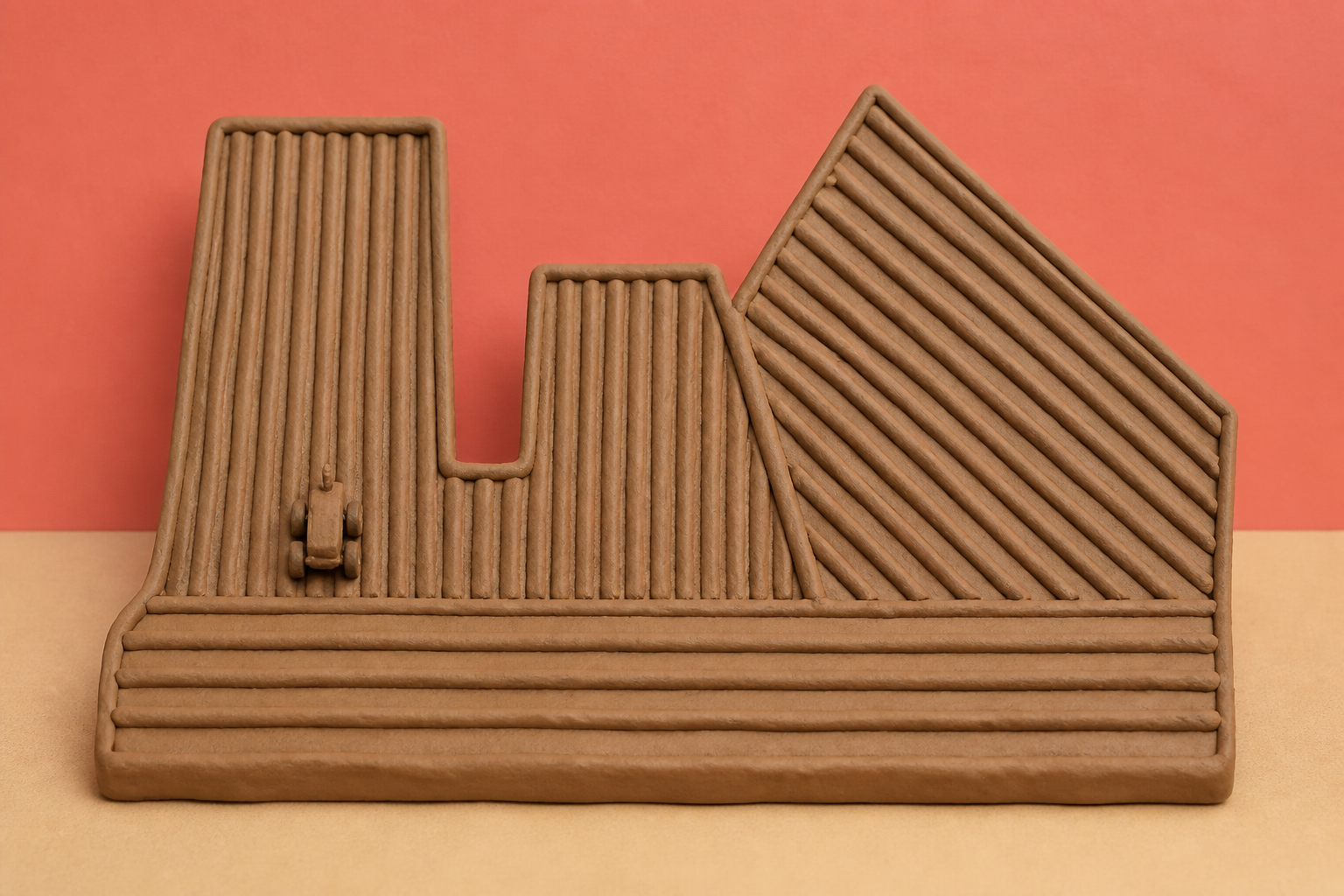
What changes in this design
A reader might assume that covering a plot means setting parallel paths in one direction and using that same direction everywhere.
Here, planning begins from an initial direction, identifies areas that are not optimal, considers alternate directions for those areas, repeats calculations when needed, and shows one proposed movement plan for the entire plot.
It helps explain why the final display covers the entire plot even though different areas can be considered with different travel directions.
Five tractors, still waiting
Kuhn says it tested five robot tractors in real field conditions over a recent season. Its cabless KARL machine is market-ready as a vehicle, management told a trade publication, but its commercial launch is paused. Suppliers interpret existing autonomous-vehicle rules differently, leaving liability unresolved. The need for that distinction is why I started there: a working vehicle can still be unable to enter a working market.
At 175 horsepower, 8.5 tonnes, and a stated 15 km/h top speed, KARL is not a small device. Planning software has to guide that mass through a field and back to its next job. This isn't a novelty story in my view. The case I see is one where code, law, and a customer's willingness to pay must arrive together.
Routes across the plot
US20260256037A1 belongs in that problem. It lays out a semi-automatic way to determine paths for agricultural robots working a plot. The method begins with a reference orientation and parallel paths. Where those paths leave non-optimal areas, it considers alternate orientations, recalculates where needed, and displays a proposed configuration of movements for the whole plot. The important restraint, to me, is that the system proposes and visualizes a plan; it does not present field work as a solved, hands-off act.
This filing, in my reading, sits beside two earlier Kuhn applications. A May 2022 French filing covers headland collision avoidance for at least two agricultural robots. A United States publication in April 2025 sets out a preferred headland portion where a robot can automatically refuel. Both use closely related language about working a plot, and one has a United States family member. Together, they make a sequence plausible: coordinate machines at the field edge, replenish them there, then determine paths across the plot. Whether these publications are KARL's exact internal architecture is something I cannot confirm. Still, Kuhn says its mission-creation software can plan an entire field's autonomous work path from an office in under five minutes, with virtual fencing to enforce plot boundaries.
The open route planner
The open alternative is one I don't want to skip. Fields2Cover, a free, open-source coverage-path-planning library, already compares candidate swath orientations across a field to minimize travel distance and overlap. That is closely related to the practical operation here. Whether it anticipates any particular claim is something I cannot tell from this high-level resemblance: that turns on precise language, priority history, and legal review. But the comparison changes my reading. The commercial value may sit in integration with robot coordination, refueling, boundaries, and operator workflow, not merely in rotating a set of lines.
Two kilometres an hour
A French agricultural report describes rules that cap autonomous operation in open fields at 2 km/h and prohibit unmanned vehicles on public roads. It expects a new European regulation, entering into force in 2027, to accommodate autonomous agricultural machines. Rules can change and differ by place, so I would verify the applicable regime before assuming deployment. But the timing helps explain why a ready vehicle can remain on hold.
Economics adds a second brake. Reporting places competing multi-task robots at 200,000 to 350,000 euros, while single-task machines can cost under 100,000 euros. A French rival with Ted and Oz robots entered judicial receivership on June 6, 2025, with 53 employees and about 2.5 million euros in revenue, amid weak machinery sales and a wine-sector crisis. One failure isn't, in my reading, a verdict on the technology. One failure is evidence, in my reading, that technical capability alone has not secured a market.
Where this leaves things
The pressure behind this work is real. Reported figures put the average EU farmer's age at 57, with 12 percent under 40. A patent survey counted agricultural-robotics publications rising from 989 in 2016 to 2,248 in 2018, within roughly 11,000 patent families over two decades. Those figures give me a reason to take route planning seriously, not proof that a purchase order follows.
The result leaves me cautious. This filing is evidence of a sustained effort to let a field robot plan its work rather than merely follow a route drawn by hand. Yet the core orientation problem is being explored openly, while the harder barriers are liability, operating rules, and a business case farmers can support. The algorithms, I think, are arriving early. The test is whether law and demand catch up before more capable machines spend another season waiting.
Sources
Reporting for this piece drew on the published filing and the references below.
- US20260256037A1 - Method For Determining Semi-Automatically Paths To Be Followed By At Least One Agricultural Robot To Work A Plot
- FR3135376A1 - Procédé et installation de travail d'une parcelle avec au moins deux robots agricoles
- US20250113757A1 - Method and installation for working a plot of land with at least one replenished agricultural robot
- KARL, our autonomous solution for crop production
- Agritechnica 2023: Kuhn goes driverless with 175hp Karl tractor unit
- Autonomous tractor Karl on hold
- La robotique agricole à la croisée des chemins
- Naïo Technologies placé en redressement judiciaire
- Fields2Cover: An open-source coverage path planning library for unmanned agricultural vehicles
- Cartographie des brevets du domaine de la robotique agricole
- Are self-driving tractors the key to tackling agriculture's labour crisis?
The record, briefly. US20260256037A1, “Method For Determining Semi-Automatically Paths To Be Followed By At Least One Agricultural Robot To Work A Plot” The method calculates agricultural-robot paths parallel to an initial reference orientation, determines non-optimal areas and alternate orientations, repeats calculations where needed, and visualizes a proposed configuration of movements for the entire plot.
More angles on this
- The Leveling Bar Has a Very Firm Opinion About LevelAnother reading from the same A01B classification family, soil working in agriculture or forestry.
- A Work Vehicle, Taking Its Job Quite PersonallyAnother reading from the same A01B classification family, soil working in agriculture or forestry.
- CPC A01B: Soil working in agriculture or forestry; parts, details, or accessories of agricultural machines or implements, in generalThe official classification family this record was filed into, published in the USPTO Cooperative Patent Classification scheme.
- CPC G05D: Systems for controlling or regulating non-electric variablesThe official classification family this record was filed into, published in the USPTO Cooperative Patent Classification scheme.
- Ruts Have Filed a Formal ComplaintAnother reading from the neighbouring G05B classification family, control or regulating systems in general.
Read around this one:Public patent recordUSPTO published figure