Machines
A Bat Cavity and the Quiet Work of Alignment
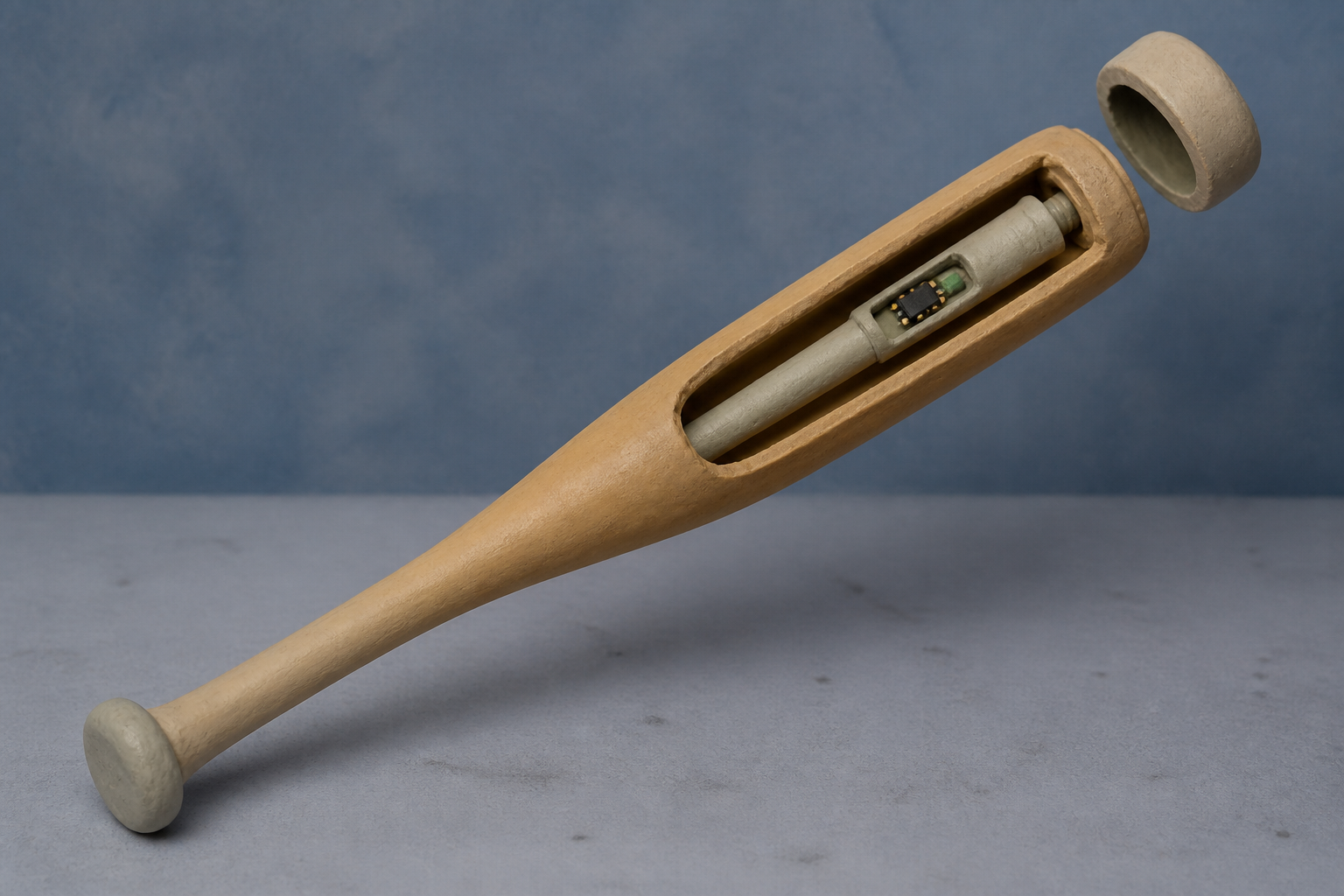
Longitudinal Axis and Insertable Adjustment Member are the useful handles: A bat swing training aid includes a bat with a longitudinal axis.

First, the setting
Batting practice is a familiar part of baseball and softball. Players repeat swings while coaches, teammates, or family members watch the path of the bat and the flight of the ball. People pay attention because a swing is a fast, physical movement that can be difficult to notice clearly in the moment.
A player grips a bat in a batting cage, backyard, practice field, or indoor training space. The bat moves through the hitting area as balls are pitched or placed on a tee. A coach may stand nearby, watching the motion, while information from equipment in or around the bat can be reviewed away from the swing.
What changes in this design
Without these listed features, a reader would likely picture practice with a regular bat used on its own, rather than one with an internal adjustment piece and electronics.
This record specifies a bat with a lengthwise reference line, a cavity near the barrel's outer wall, a tapered transition, a cap, and an insertable adjustment piece. It also includes a microchip with a sensor, storage, and wireless transmission.
For someone drawn in by the illustration, this shows that the training aid combines physical bat components with electronics that handle remote data. What the sensor detects and how the adjustment changes the bat are not stated.
Inside the Barrel
An outer-wall cavity in a bat barrel, the broad hitting end, is the physical detail you can picture first in US20260257116A1, published September 3, 2026 and titled Bat Swing Training Aid. That is the obvious headline: a familiar object contains a deliberately named interior feature. But the more useful question is quieter: how does the filing ask you to notice the alignment of the pieces it gathers around that feature?
That condition opens a small scene rather than a spectacle. You can imagine the bat as a long form with its barrel cavity, while a cap and an insertable adjustment member enter the picture as separately named physical details. The cavity has the air of a small reserved seat inside the barrel, waiting for one specific passenger. What made me look twice was the compositional insistence that a space and other named parts be noticed together.
Terms That Locate Parts
The formal vocabulary makes the pictured relationships easier to locate. The longitudinal axis is a line imagined running from one end of the bat to the other; the tapered transition is the section where the form narrows; and the insertable adjustment member is a component the filing describes as able to be inserted. The microchip, a compact electronic component, is described with a sensor, storage for data, and a wireless module for remote data transmission.
Alignment Beyond the Surface
Once those labels are in view, the mechanism can stay modest and concrete. The filing describes a bat with that longitudinal axis, outer-wall barrel cavity, tapered transition, cap, and insertable adjustment member, together with a microchip with the sensor, data storage, and wireless module. The consequence is not a conclusion about results; it is an invitation to follow how a physical arrangement and a remote data path are placed in the same account.
That shared account lets one relationship become visible: the familiar outside of a bat and the interior-and-electronic description are not competing images but parts of one frame. The wireless module is less like a brass-band announcement and more like a librarian passing a note to a distant desk. The cap has the air of a quiet stage manager, present while the named arrangement holds its places. This is a source-bounded distinction, not a claim that every bat shares the described features.
That contrast is why the fit deserves your attention. One transferable observation is that a system becomes easier to think about when its empty space is named as clearly as its hardware; another is that remote transmission is clearer when you keep its sensor and storage in the same mental frame as the object described alongside them. I cannot tell you more than the published description establishes, but I think its quiet lesson is durable: alignment is often an act of making relationships legible. Return, then, to the outer-wall cavity in the barrel, where this tour began, and let that modest hollow keep the whole arrangement in view.
The record, briefly. US20260257116A1, “Bat Swing Training Aid” A bat swing training aid includes a bat with a longitudinal axis, an outer-wall barrel cavity, a tapered transition, a cap, an insertable adjustment member, and a microchip with a sensor, storage, and wireless module for remote data transmission.
More angles on this
- What an Anchored Exercise Bike Lets You SeeAnother reading from the same A63B classification family, apparatus for physical training, gymnastics, swimming, climbing, or fencing; ball games; training equipment.
- When a Basketball Court Becomes a MessageAnother reading from the same A63B classification family, apparatus for physical training, gymnastics, swimming, climbing, or fencing; ball games; training equipment.
- CPC A63B: Apparatus for physical training, gymnastics, swimming, climbing, or fencing; ball games; training equipmentThe official classification family this record was filed into, published in the USPTO Cooperative Patent Classification scheme.
- An Inflatable Costume Prepares for Lift-OffAnother reading from the neighbouring A63H classification family, toys, e.g. tops, dolls, hoops or building blocks.
- When a Ramp Turns Containment Into a Checkable SequenceAnother reading from the wider A62C classification family, fire-fighting.
Read around this one:Public patent recordUSPTO published figure