Groundwork
When a Ramp Turns Containment Into a Checkable Sequence
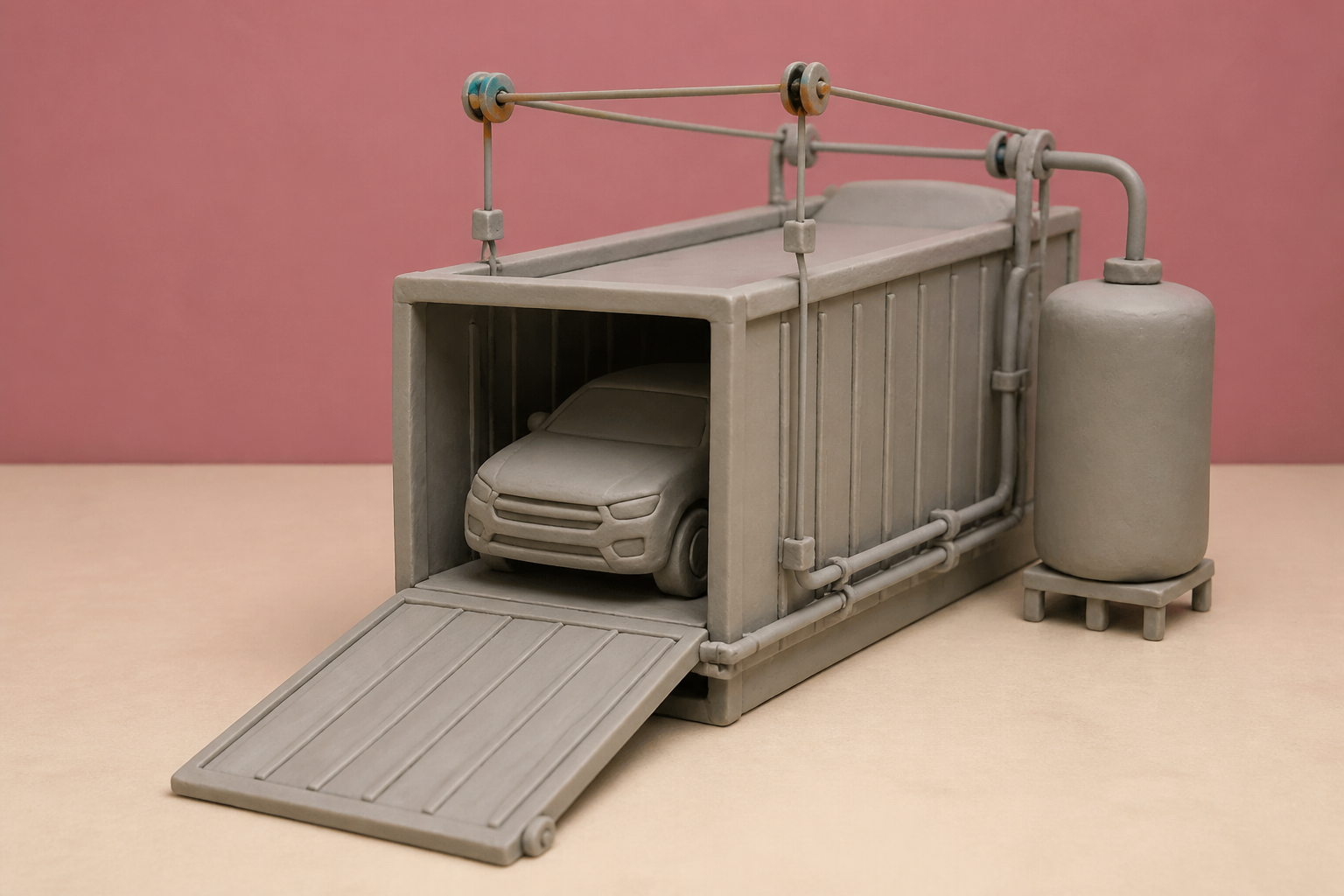
Key detail is the feature that helps someone grasp how this setup operates. Here, the ramp matters because it changes from an entry slope into a nearly water-tight closure.

First, the setting
Vehicles carry people, goods, and energy through daily life. When a vehicle catches fire, nearby people need space to move away while responders work safely. Garages, depots, repair sites, and transport yards therefore plan for emergencies involving heat, smoke, water, and access.
At a depot or emergency response area, a driver guides a vehicle up a ramp into a large enclosed bay. The ramp rises behind it. Nearby staff stand clear as hoses and a water tank are readied; people outside may see a contained work area and restricted access.
What changes in this design
The record does not say how fires in these vehicles are ordinarily handled, so it gives no usual method for comparison.
Instead, it places the vehicle in a container, uses a lifting ramp as a nearly water-tight closure, and delivers water into that container while the ramp is raised.
That makes the physical picture clear: entry, closing the opening, and putting water inside belong to one setup.
Ramp, Container, and the Question
Fire is the cause named in publication US20260257090A1, restriction is the effect its title sets out, and the next choice is worth your attention: how does a design make that response inspectable? The obvious headline is an apparatus for restricting fire in electric or alternative fuelled vehicles. The more useful question is whether its arrangement gives you a sequence to examine before you form a verdict.
That contrast leads to the terms. The published application, dated September 3, 2026 and titled An Apparatus For Restricting Fire In Electric Or Alternative Fuelled Vehicles, describes a container for a road vehicle and a ramp, meaning the sloped movable surface used for entry. The ramp lowers for the vehicle to enter, then raises to form a substantially water-tight seal: a seal described as holding water back to a meaningful degree, not as a promise of flawless perfection. The ramp has the air of a stage manager lowering the scenery, then closing the scene behind the vehicle.
With those terms in place, the picture becomes more concrete. A road vehicle enters the container while the ramp is lowered; the ramp is then raised; water is sent into the container. The raised ramp is less like a loose barrier and more like a librarian returning a book to its proper shelf. What made me look twice was the dependency between position and action: water delivery is described while the ramp is raised, so the design asks you to notice a condition, not merely an object.
Water Arrives After the Seal
That condition turns the picture into a mechanism. A water tank and delivery means, meaning the parts that send water where it is needed, deliver water into the road vehicle container while the raised ramp forms the substantially water-tight seal. Rather than leaving fire restriction as a broad instruction, the filing describes a defined response that replaces a guess: entry first, containment next, then water delivery. The water tank and delivery means arrive as if a restrained committee had finally chosen a single next step. What becomes inspectable is the link between a boundary and the action taken within it.
Judgment Beyond the Container
That defined response deserves restraint as well as attention. Nothing in the published record provided here establishes how the apparatus will perform in any particular circumstance, and that is not the point worth importing into the reading. Its stated purpose is to restrict fire through an arrangement whose parts and order can be followed. The practical test is simple: can you identify what changes state, what that change permits, and what happens only after it?
That test travels beyond this container without turning the filing into a promise about anything else. One transferable observation is that a system becomes easier to judge when setup and operating conditions are visibly distinct. Another is that a boundary becomes more meaningful when the action inside it depends on that boundary being in place. You can carry that consequence into any design question where a broad aim sounds persuasive but a defined sequence gives you something better: a condition you can inspect.
The record, briefly. US20260257090A1, “An Apparatus For Restricting Fire In Electric Or Alternative Fuelled Vehicles” An apparatus restricts fire in electric or alternative fuelled vehicles using a container with a ramp that lowers for vehicle entry and raises to form a substantially water-tight seal. A water tank and delivery means send water into the road vehicle container while the ramp is raised.
More angles on this
- CPC A62C: Fire-fightingThe official classification family this record was filed into, published in the USPTO Cooperative Patent Classification scheme.
- The Quiet Work of Alignment at HeightAnother reading from the neighbouring A62B classification family, devices, apparatus or methods for life-saving.
- When a Shredder's Boundary Becomes the QuestionAnother reading from the wider A47J classification family, kitchen equipment; coffee mills; spice mills; apparatus for making beverages.
- Before Remote Modes: What Reaches the Device?Another reading in the same Groundwork category on this site.
Read around this one:Public patent recordUSPTO published figure