Field Notes
When a Shredder's Boundary Becomes the Question
A new adjustable shredder filing sits within a long effort to manage worn blades, while related machines still expose workers to grave risks.

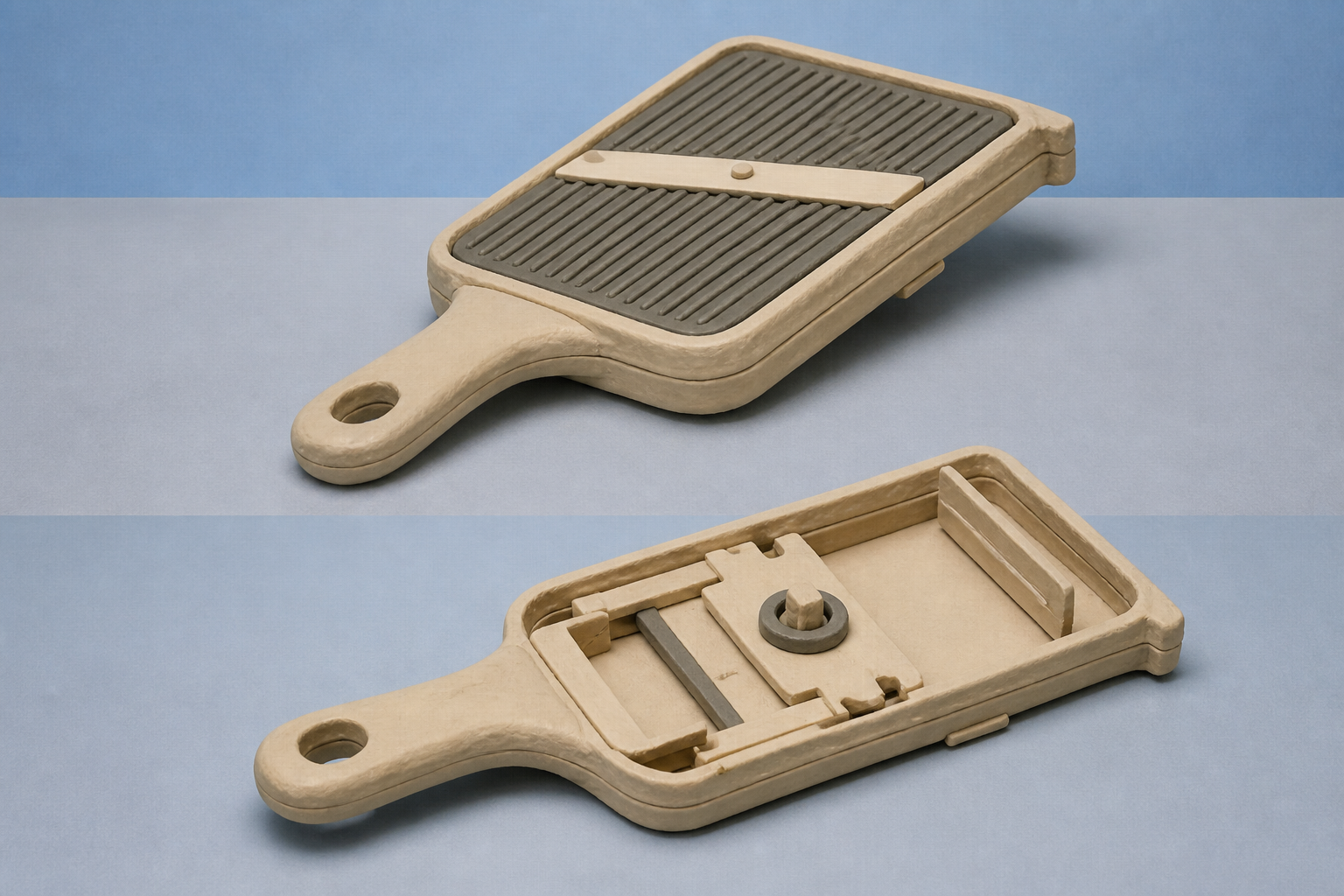
What changes in this design
A reader might otherwise expect the lower panel and blade height to stay fixed in one position.
In this version, a lifting seat, sliding seat, handle, and guide lug are provided to adjust the height of the lower panel and blade.
It tells you that changing height is the focus, while what the shredder processes is not stated.
One thousand revolutions
A federal workplace-safety bulletin records the deaths of a 19-year-old and a 15-year-old worker in wood-chipper incidents. Chipper discs and drums can spin at 1,000 to 2,000 revolutions a minute. That bulletin describes two recurring fatal patterns: a worker is pulled through the feed mechanism, or a hood or cover breaks loose and strikes someone nearby. The detail I can't shake is where those risks meet: beside the blade, under the hopper, in the hardware meant to keep movement controlled.
That is the setting in which a title as plain as Adjustable Shredder starts to matter. US20260256321A1 places a horizontal blade and a vertical blade between upper and lower panels in a frame, and makes the height of the lower panel and blades adjustable. The mechanism is small. The question behind it is not.
A pasta maker in 1935
Adjustment is not a new ambition in shredding. The first paper-shredder patent was filed in 1909 but never built after its inventor died. The first manufactured machine, in 1935, was a German device adapted from a hand-crank pasta maker. The first cross-cut model arrived in 1959. For more than a century, designers have treated control over cutting as unfinished work.
By 1988-89, a garden-chipper patent described a horizontal rotating blade plate beneath a hinged, swing-away hopper and set operation below 300 rpm to reduce noise and jamming. Carl D. Waterman's 1991-92 chipper design used a threaded screw and angled pin-and-slot linkage to advance a knife after resharpening changed its width and balance. An industrial-shredder patent issued in 1993 used ten-thread-per-inch rings to shift cutter-disk spacing by increments as small as 0.012 inch. What I found is repetition, not a single clean solution: blades wear, dimensions drift, and engineers keep devising ways to reset them.
The lifting seat
The publication names the moving hardware: a lifting seat, sliding seat, handle and guide lug. Those elements adjust the lower-panel and blade height. The older examples do not describe one identical machine. They span paper shredders, garden chippers, wood chippers and industrial equipment, while this publication is titled only Adjustable Shredder.
I cannot responsibly call it a wood chipper or transfer the exact hazards in those safety reports onto it. Still, the comparison is fair at the level of design pressure. In each older case, adjustment answers a changing blade or cutting geometry. In this case, the stated result is a changed lower-panel and blade height. My hesitation isn't about whether adjustment can help. An adjustable mechanism earns its value only if it stays aligned, stays fastened and remains understandable to the person operating it.
Seventy-nine loose parts
That last condition has a recent, concrete record. In September 2023, the CPSC recalled about 5,900 DR Power chipper-shredders sold from 2019 to 2023 after 79 reports of internal metal parts coming loose and being ejected. It also received three reports of hopper assemblies detaching in use. Those machines sold for $945 to $3,800. That recall does not establish a link to this publication, and I would not imply one.
An analysis of U.S. emergency-department data estimates 1,200 to 1,300 chipper/shredder visits each year, about 120 leading to hospital admission. Among hospitalized homeowners, 59.3% of injuries were severe hand or finger trauma, including major amputations and open fractures. The same account puts one hand-amputation surgery at more than $60,000. The number that stopped me was not 79. It was 59.3%.
The part worth watching
None of this proves that the adjustable shredder is dangerous, useful, or commercially destined. A patent application is not a product test. I also cannot derive a safety claim from a short mechanical description, and its public listing carries no recorded CPC classification. That is a bureaucratic gap, not a judgment on the invention.
China's patent office recorded 1,927,500 invention applications and 2,649,201 utility-model applications in 2025, even as the latter fell 16.81% from the prior year. Those figures do not count U.S. shredder filings, but they show the scale at which small mechanical changes can enter public view with little independent attention. My view is that this one deserves a patient question rather than a celebration: does its lifting and sliding hardware keep the blade where it belongs, keep its own parts inside the machine, and make the cutting task safer?
Sources
Reporting for this piece drew on the published filing and the references below.
The record, briefly. US20260256321A1, “Adjustable Shredder” An adjustable shredder has a frame with upper and lower panels and a horizontal blade and vertical blade between them; a lifting seat, sliding seat, handle, and guide lug adjust the lower-panel and blade height.
More angles on this
- A Mixer Gets a Standing AssignmentAnother reading from the same A47J classification family, kitchen equipment; coffee mills; spice mills; apparatus for making beverages.
- A Coffee Basket's Quiet Second ActAnother reading from the same A47J classification family, kitchen equipment; coffee mills; spice mills; apparatus for making beverages.
- CPC A47J: Kitchen equipment; coffee mills; spice mills; apparatus for making beveragesThe official classification family this record was filed into, published in the USPTO Cooperative Patent Classification scheme.
- A Dishwasher's First Temperature QuestionAnother reading from the neighbouring A47L classification family, domestic washing or cleaning ; suction cleaners in general.
- A Harder Member Between a Scope Cover's SurfacesAnother reading from the wider A61B classification family, diagnosis; surgery; identification.
Read around this one:Public patent recordUSPTO published figure