Machines
A Coffee Basket's Quiet Second Act
One new coffee-machine patent joins a long search for even extraction, where moving parts keep meeting the stubborn physics of grounds.

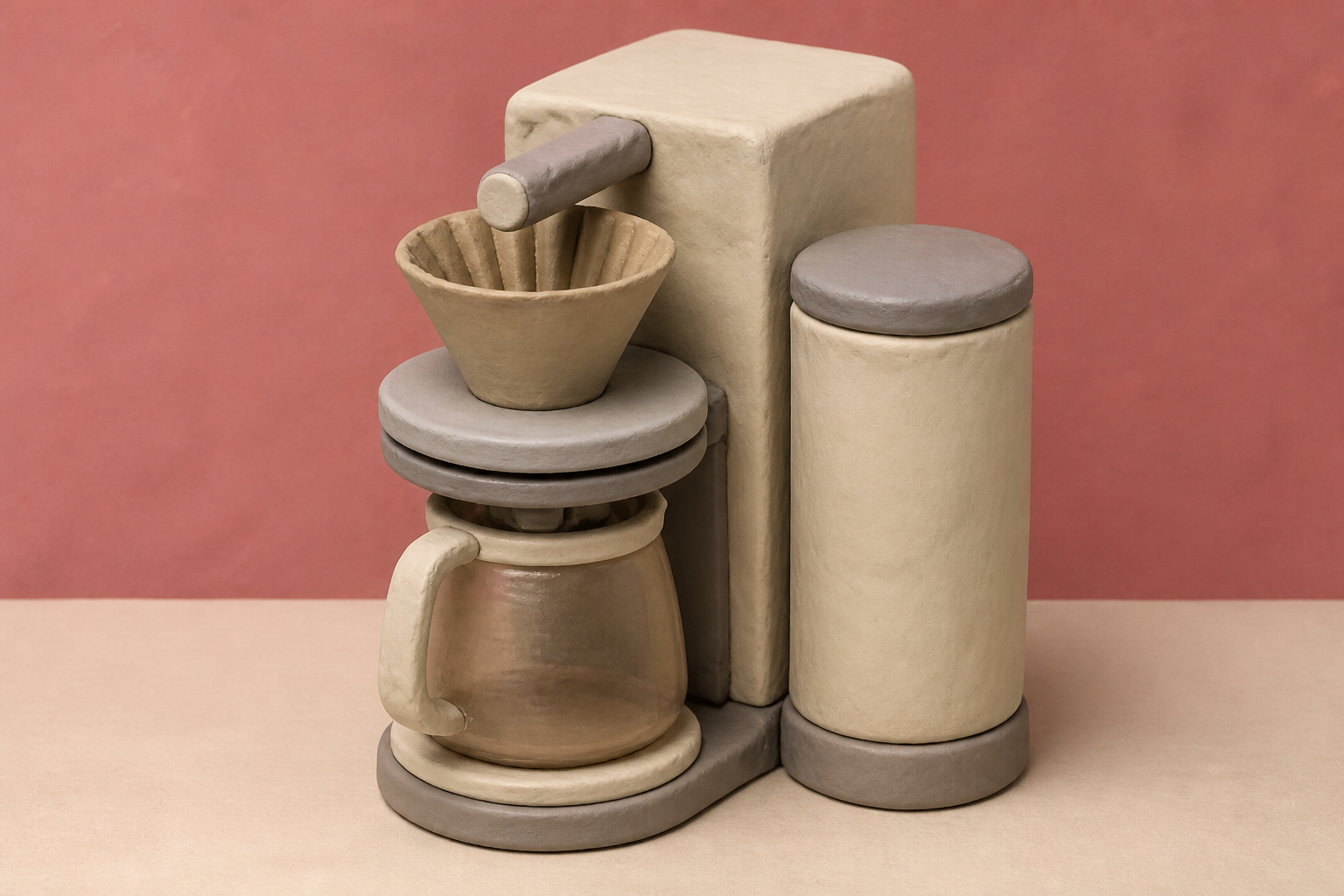
What changes in this design
The record does not establish how other coffee machines perform this job. A casual reader might otherwise picture a basket that stays in one position while brewing.
Here, preset settings drive a rod that moves the spout, a rotating plate that turns the coffee basket, and a vibration plate that shakes the basket.
It helps a reader see the focus of the method: motion of the spout and basket during brewing. The record gives no measurement of the result.
The 950 machines
In April 2025, Voga Coffee, maker of the Ground Control brewer, laid off its 18 full-time staff and ceased operations after its next machine could not be produced on schedule. Sales of the original Cyclops reached 950 units. That small number opens a larger coffee-machine habit: when water and grounds will not behave evenly, designers reach for another mechanism.
Voga's patent approach was not vibration. Repeated, pulsed extractions over a wide, thin filter bed were the proposal, with a pressure difference of at least 60 torr and a claim of roughly 30% less coffee for equivalent dissolved-solids strength. Claimed savings and the shutdown answer different questions. Voga's shutdown is not proof, to my mind, that pulsed extraction was bad coffee science; it is evidence that a clever extraction method must also survive manufacturing, timing, and the burden of being a machine people can buy.
The restless basket
US20260256314A1 arrives in that setting. During brewing, its preset pattern coordinates three motions: a reciprocating rod shifts a spout over a coffee basket, a rotating plate turns the basket, and a vibration plate shakes it. More thorough contact between water and grounds appears to be its point. For me, the interesting fact is how familiar that ambition is.
On July 18, 2014, inventor Spencer Frazer filed an application, later granted as US9867494B2, for an oscillating or reciprocating filter-basket assembly. Wheels, a linkage arm, and optionally an eccentric motor were meant to wash grounds and improve water-coffee contact. Controlled spout, rotation, and vibration give the new filing its own configuration, so I cannot tell from these public descriptions whether its claims stand apart legally. But the lineage matters: moving a basket to even out extraction is a recurring answer to a recurring uncertainty.
Five percentage points
Agitation has a real job to do. A coffee guide says it speeds water-particle contact and can improve extraction uniformity, while too much can push a brew toward over-extraction and bitterness and too little can leave it under-extracted. Finding that narrow window is the fixed vibration pattern's actual task. Movement alone does not earn the machine credit. Getting both amount and timing right is the actual work.
One tougher check is a 2019 modeling and computational-fluid-dynamics study of porous coffee beds. Its models found that vessel and flow geometry substantially drove uneven extraction: in conical beds, velocity peaked at the outlet-wall corner, and fine-grind beds showed about five percentage points of yield variation. Two brews could register the same overall extraction yield and still differ in internal uniformity. That makes me wary of any pitch in which rotation or vibration alone promises evenness. Motion may help, but the study does not let us assume it erases the route water takes through the bed.
Before the machine starts moving, the target is demanding. SCA's Golden Cup standard calls for 18-22% extraction yield, 1.15-1.35% total dissolved solids, about 55 grams of coffee per litre of water with a 10% tolerance, water at 93 degrees C plus or minus 3 degrees C, and four to eight minutes of contact time. More than 1,000 drip machines have been independently lab-tested under its Certified Home Brewer Program, according to a coffee reference guide. Against an impressive list of moving parts, these numbers are the better benchmark, in my view.
The 5,000-rpm machine
Another caution comes from the centrifugal alternative. Spinn took crowdfunding orders in 2016 for a brewer that spins coffee and water through a centrifuge. It missed a mid-2017 delivery date, then a Q1 2018 date; by March 2018, beta testers were only beginning to receive machines, and the original technology inventor had left. Those delays do not tell us whether the extraction idea was sound, but they show how quickly mechanical ambition becomes a product problem.
By 2026, the product sells for $979 and runs at up to 5,000 rpm, yet a 2026 hands-on review reports watery espresso, grounds in the cup at stronger settings, and a bean hopper prone to jamming. What struck me as more revealing than a patent diagram was that contrast: reaching shelves does not settle whether a mechanism delivers reliably. A machine can make a lot happen to coffee and still not make the same good cup each time.
The part worth watching
This application is also arriving in a busier filing climate. China's patent office recorded 1,927,500 invention-patent applications in 2025, up 5.43% year over year; Chinese-origin invention filings rose 6.2% to 1,774,890. Chinese-origin utility-model applications fell 16.81% to 2,643,090. I cannot infer an applicant's strategy from national totals, but the figures place this type of consumer-machine invention within a reported shift toward higher-scrutiny invention filings.
Whether a coffee basket can shake, rotate, and receive water from a moving spout is not the question. It plainly can. What matters is whether preset controls can compensate for geometry-driven unevenness inside a coffee bed without sliding from helpful agitation into bitterness. Our attention should stay on that test, not the number of actuators. Until a brewer of this sort shows repeatable results against a clear extraction benchmark, I see this filing as an addition to an old engineering argument, not evidence that the argument has been won.
Sources
Reporting for this piece drew on the published filing and the references below.
- How Agitation Affects Coffee Extraction
- Analysing extraction uniformity from porous coffee beds using mathematical modelling and computational fluid dynamics approaches
- Golden Cup Standard
- US9867494B2 - Reciprocating coffee filter
- CN114515107A - Coffee machine with rapid and/or multiple extraction process features
- Voga Coffee, Maker of Ground Control Brewers, Ceases Operations
- The Spinn Coffee Maker Is Still MIA For Early Backers
- Spinn Coffee Maker Review 2026
- China 2025 Patent Filing Trends: Invention Applications Rise 5.43% as Utility Model Applications Fall 16.81%
The record, briefly. US20260256314A1, “Control Method For Coffee Machine And Related Device” During a brewing stage, second and third control parameters for a preset brewing pattern drive a reciprocating rod to move a spout on a coffee basket and a rotating plate to rotate the basket; a first control parameter drives a vibration plate to vibrate the basket for sufficient extraction.
More angles on this
- Ruts Have Filed a Formal ComplaintAnother reading from the same G05B classification family, control or regulating systems in general.
- CPC A47J: Kitchen equipment; coffee mills; spice mills; apparatus for making beveragesThe official classification family this record was filed into, published in the USPTO Cooperative Patent Classification scheme.
- CPC G05B: Control or regulating systems in generalThe official classification family this record was filed into, published in the USPTO Cooperative Patent Classification scheme.
- Accessory And Drinkware Assemblies: The Choice After ConnectionAnother reading from the neighbouring A47G classification family, household or table equipment.
- When an Erase Setting Becomes a Timing PromiseAnother reading from the wider G11C classification family, static stores.
Read around this one:Public patent recordUSPTO published figure