Objects
Accessory And Drinkware Assemblies: The Choice After Connection
A cup-topper application arrives as collectible keychains, decorated drinkware, and hard-fought design rights converge on the same habit.

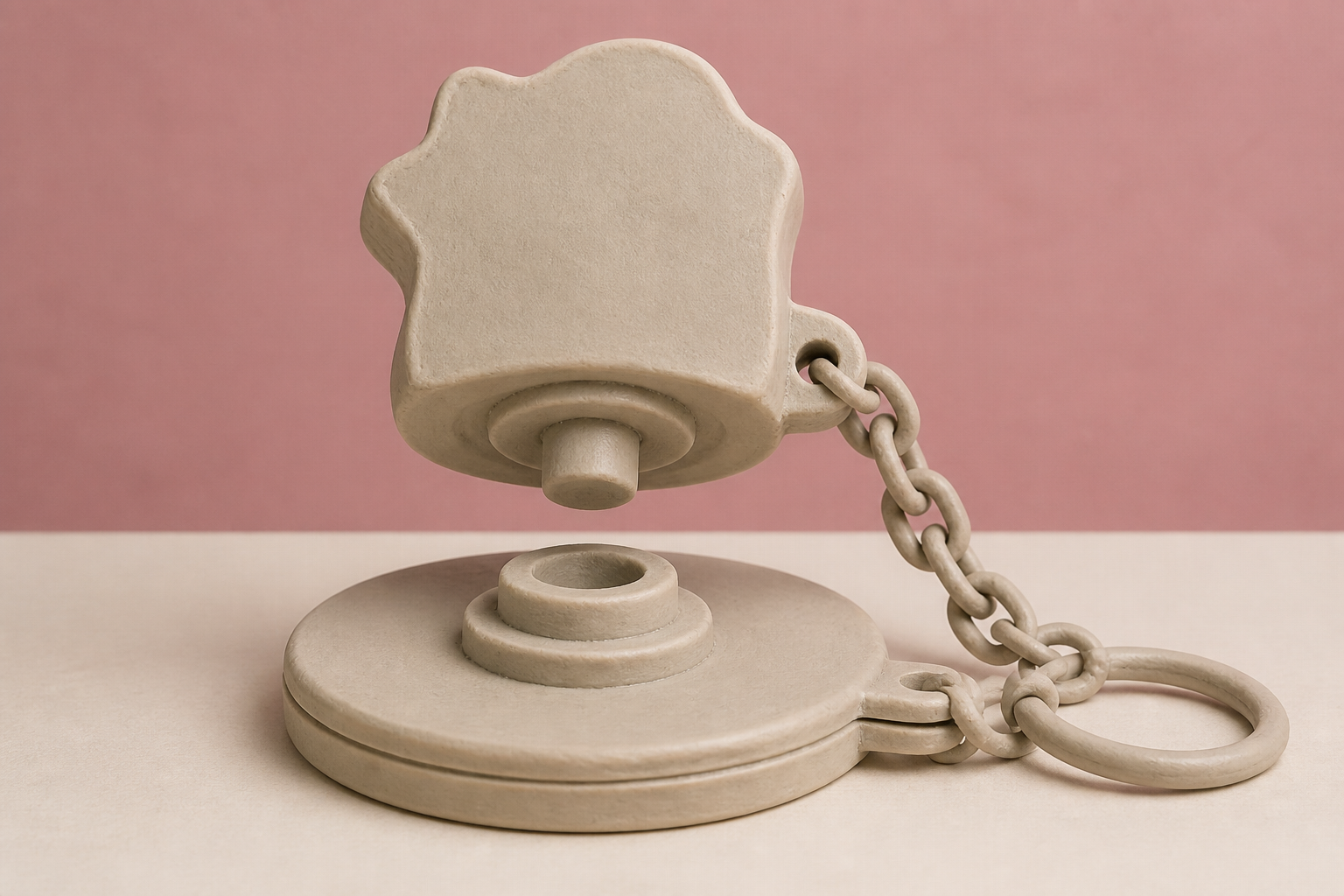
What changes in this design
Many people would expect a figure and its base to be one permanent object, or to be attached in a way not intended to come apart.
Here, the base has one joining feature and the figure has another. The two features allow the pieces to attach to each other and be removed from each other.
That distinction matters because the focus is a removable relationship between two parts, not a permanently fixed figure. The record gives no details about the shape, joining method, or drinkware connection.
A charm worth 45 times retail
Some blind-box keychain figures were reselling at roughly 45 times their retail price in 2025, while searches for Labubu on a resale marketplace climbed 2,600 percent. What stayed with me wasn't the resale multiple, startling as it is, but the object: a small figure meant to clip onto a bag, a phone, a set of keys, or now, increasingly, a drink cup.
Yet that migration has been building. During 2024, the charm boom reached drinkware after the handled insulated-cup craze, turning water-bottle accessories into a recognizable shopping category. An earlier template came from Jibbitz: in 2006, the maker of a perforated foam clog paid $10 million, with up to another $10 million in earn-outs, for a peg-and-hole shoe charm business. Such a small attachment could become the part people choose, trade and license. All of that is the commercial weather surrounding a newly published US application called Accessory And Drinkware Assemblies.
A lid with a round-headed post
Cool Gear International, the applicant, filed on February 25, 2026, and US 2026/0256306 A1 published on September 3. Its core idea is modest and specific: a base and a figure carry matching couplers so the two can be removed and rejoined. The drawings show the base as a cup lid, with a ball-tipped stud rising from it and a hollow decorative figure snapping over the stud. In another illustrated version, that same stud takes a keyring fob or carabiner instead. Also shown is a magnetic-disc alternative.
More important than the decorative silhouette is that last detail. Rather than simply putting a character on a lid, the filing presents a character that can leave the cup and become a portable object. To me, the keyring version is the change that turns a fixed lid ornament into a carry-along charm. The application claims priority to a provisional filed February 28, 2025, placing the idea before the 2025 surge in figure resale data, though well after the broader charm revival.
The old topper on the shelf
Cool Gear is not entering from nowhere. Igloo acquired the company in 2015, so the applicant has spent more than a decade inside a large cooler business. Its shop already lists a $29.99 two-pack of stainless tumblers with interchangeable character toppers. What I could not establish from that listing is whether its commercial attachment is the ball-and-socket arrangement in this application, because the page does not explain the mechanism or the keychain option.
Another listing traces a more revealing engineering history. Priced at $24.99, the 18-ounce Cool Gear model uses a threaded character lid, not a snap coupler. Those new drawings therefore look like an iteration in attachment design, moving from a screw-on lid treatment to a removable figure that can be detached without taking the lid apart. Calling it trivial would be a mistake. But it is much narrower than owning the general urge to personalize a vessel.
The argument lives in the hardware
Removable drinkware decoration was patent territory long before today's cups acquired their own accessory aisles. Back in 2014, an unrelated inventor described a resizable elastic-and-hook-and-loop band with a decorative fabric flap in a published application. It uses different hardware, which is precisely the point. At the category level, removable drinkware decoration is old; the potential distinction here is the particular coupler, the shape and use of the attachment, and whatever claim language survives examination. For my money, that makes this filing a stake in a busy market, not a convincing claim to having invented cup adornment.
Elsewhere, a separate fight offers a warning against loose claims of ownership. In November 2025, the maker of a prominent handled tumbler sued a discount retailer over look-alike vessels, asserting design patents and trade dress; the retailer has countersued, arguing that the disputed features are functional and commonplace. This dispute isn't about a topper. Still, it shows how quickly cup design can become a rights argument once a category catches fire, and why I am wary of treating any one accessory filing as a clean sweep of the trend.
What would have to be true
For this small post-and-figure system to matter beyond a filing, the attachment would need to earn repeated use: secure enough for a drink lid, easy enough to swap, and appealing enough that people want more than one figure. Safety is the less glamorous part of a detachable charm, and the hardware must coexist with it. If a version is intended for children, its intended age and whether the detached component qualifies as a small part would matter. Federal rules bar small parts in products intended for children under three and call for choking-hazard labels on small-part products intended for ages three through eight.
Existing youth-oriented drinkware from the applicant makes that question hard to wave away, though I could not determine the intended age for the configuration shown in the filing. To my mind, the application is strongest as a careful attempt to protect a particular piece of object engineering at a moment when adornment has become part of the purchase. It is weakest if read as a claim over the whole ritual of decorating a cup. Attention should stay on the join: how it holds, how it releases, who uses it, and how narrowly the final rights are drawn.
Sources
Reporting for this piece drew on the published filing and the references below.
- US 2026/0256306 A1 - Accessory And Drinkware Assemblies
- ACON Investments Portfolio Company, Igloo, Completes Acquisition of Cool Gear
- COOL GEAR Pop Topper Tumbler - Interchangeable Character Topper
- Cool Gear Fun Model Threaded Character Lid Tumblers
- US20150053701A1 - Drinkware Accessories and Drinkware Assemblies Including Drinkware Accessories
- The $10 Million Deal That Turned Crocs Into a Fashion Empire: The Untold Story of Jibbitz
- 2024 Was the Year of the Trinket
- Stanley Cup Maker Sues Five Below Over Infringing Dupes
- Small Parts and Choking Hazard Labeling FAQs
- 2025 Collectibles Trends: Labubu Blind Boxes, Pokemon Cards, and Sports Card Repacks Rise
The record, briefly. US20260256306A1, “Accessory And Drinkware Assemblies” An accessory assembly includes a base defining a first coupler and a figure defining a second coupler, with the base and figure removably coupled to one another through the couplers.
More angles on this
- Why a Magnetic Latch Sits Between Your Phone and the AirwavesAnother reading from the same A45C classification family, purses; luggage; hand carried bags.
- The Suspender Belt Is Holding the Plot TogetherAnother reading from the same A47G classification family, household or table equipment.
- CPC A45C: Purses; luggage; hand carried bagsThe official classification family this record was filed into, published in the USPTO Cooperative Patent Classification scheme.
- CPC A47G: Household or table equipmentThe official classification family this record was filed into, published in the USPTO Cooperative Patent Classification scheme.
- A chair with a battery, a column, and a pedal that never touches itAnother reading from the neighbouring A47C classification family, chairs; sofas; beds.
Read around this one:Public patent recordUSPTO published figure