Wearables
The Suspender Belt Is Holding the Plot Together
One garter-belt drawing went through three patent offices in five weeks in 2024, and the offices could not agree on whether it was new.

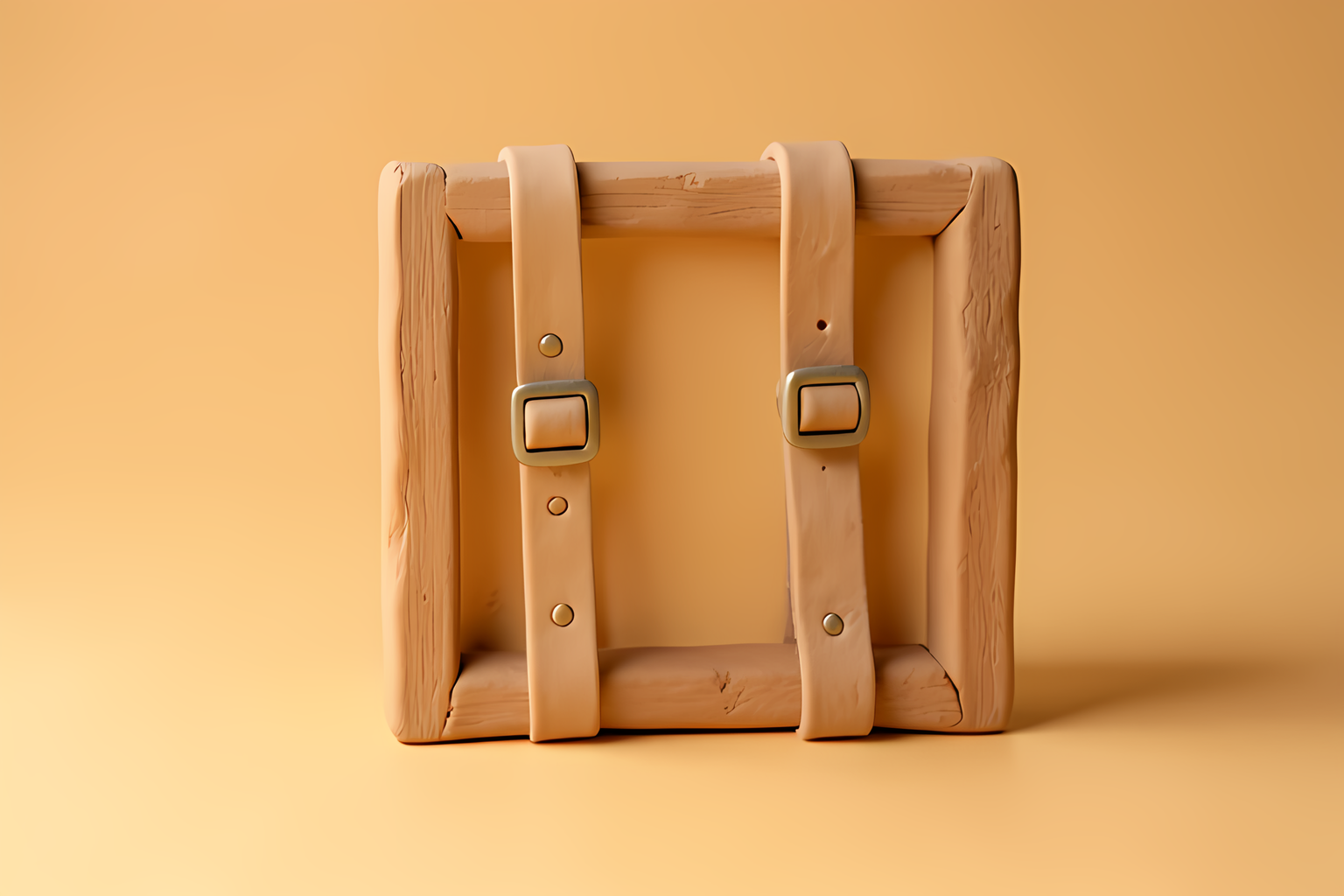
What changes in this design
For an everyday item, people may expect a description to explain its purpose, materials, and the problem it is meant to solve.
This record presents the titled item's visible features, including a broad loop, hanging strips, rectangular layers, rounded tabs, seams, edge lines, and a small right-side projection. It gives no materials, operation, or purpose.
This matters because the image can support a conversation about appearance, but it cannot support claims about use, materials, or performance.
Mary Lucas, Omaha, 1898
I went looking for the oldest document cited on a patent granted this August, and found Mary R. Lucas of Omaha, Nebraska. On May 3, 1898, she was granted US 603,567 for a skirt-lifter: a belt with supporting straps at the sides and rear, ending in folding clasps meant to grip fabric without tearing it. Her stated object is the part I keep rereading. She wanted "to greatly simplify inventions of this class." A class. In 1898 there was already a category here, already busy enough that tidying it up was worth a filing.
Then the problem dissolved on its own. Lastex reached men's hosiery around 1929, socks started holding themselves up, and garters faded out over the following decades, still sold into the 1950s but no longer solving much. A materials change did what the clasps couldn't.
Five weeks, three offices, one drawing
On May 20, 2024, Ruihua An of Wangpiliu Town, China, filed a design at home. Eight days later the same drawing was at the European Union office, and it published on July 1, thirty-four days after filing. On June 26 it reached Washington as application 29/949,225. Same waist belt, same depending straps, same side-release clips, three offices inside five weeks.
I couldn't open the EU office's own explanation of what registration involves, so I won't characterise what those thirty-four days contained. The timing stands on its own. The US took 770 days and issued US D1,137,990 on August 4, 2026, with a single claim: the ornamental design for a suspender belt, as shown and described. The European titles, Strapshalter and sukkanauhaliivit, confirm what the drawings suggest. This is a garter belt.
Ten references, 123 years, granted anyway
Primary Examiner Clare Ann Gannon did real work. She cited ten references reaching back 123 years: Lucas in 1898, Hackman in 1899, McBride in 1912, then 1940, 1945, 1976, three published applications, and D915,027, which is An's own garter patent, filed in 2018 and granted in 2021. The closest thing in the file to the new design was the applicant's earlier design.
The timing sharpens it. In May 2024, the same month as the Chinese priority date, the Federal Circuit sitting en banc threw out the rigid forty-year-old test for design obviousness in LKQ v. GM and replaced it with the flexible four-factor analysis used for utility patents. This application was examined start to finish under the supposedly tougher standard. It was granted anyway.
Sixty-three thousand applications a year
The office's own numbers explain how that happens. Design applications went from about 25,600 in FY2009 to roughly 63,000 in FY2024, with FY2025 estimated near 68,000. The allowance rate has run between 81 and 86 percent for five years, so four of every five disposals end in a grant. Two-thirds of filings come from micro or small entities, and for a micro entity the full statutory set of filing, search, examination and issue fees comes to $520.
Worldwide, 2024 filings covered about 1.56 million designs. China's office alone took 825,330 of them, 52.9 percent of everything. The US received 68,575, up 14.3 percent in a year. Textiles and accessories was one of the two largest sectors.
Where the token gets cashed
A design patent isn't mainly a certificate. It's an entry ticket to Schedule A litigation, where one complaint names hundreds of mostly Chinese online sellers and asks for restraining orders and asset freezes before anyone is served. In the Northern District of Illinois, design patent Schedule A filings went from 38 in 2020 to 63 in 2022, with 59 more in the first nine months of 2023. Southern Florida went from 7 to 18 in a single year.
Judges have started pushing back. In November 2024, a court refused the restraining order in Flotsup v. Partnerships and Unincorporated Associations Identified in Schedule A, finding "no sufficient showing on infringement has been made" given visual differences in raised ridges and curvature. One firm following these cases calls that kind of scrutiny previously rare and now increasingly common.
What would have to be true
For this grant to mean the design is genuinely new, ten documents spanning 1898 to 2019 would have to be visibly distinguishable from a belt with straps and clips, and I can't see it in the drawings. What I can see is a system doing what it is built to do: examine cheaply, grant generously, and hand the result to whoever wants to use it downstream.
I'd want two more things before calling this settled. The firm of record, Hawaii Patent Services, has a website carrying a 2011 copyright and no description of what it does; its filing volume would tell you whether this is a boutique or a pipeline. And I'd want a court to hold D1,137,990 up next to Mary Lucas's skirt-lifter. Someone should ask that question before the belt does any work in a courtroom.
Sources
Reporting for this piece drew on the published filing and the references below.
- US D1,137,990 S - Suspender Belt (USPTO full-text document)
- US 603,567 A - Skirt-lifter, Mary R. Lucas (1898)
- US D915,027 S - Garter, Ruihua An (2021)
- EM150618590001S - Suspender belts, registered Community design
- USPTO Hour: An overview and statistical update on design patents (July 2025)
- World Intellectual Property Indicators 2025: Designs highlights (WIPO)
- LKQ Corporation v. GM Global Technology Operations LLC, 102 F.4th 1280 (Fed. Cir. 2024) (en banc)
- Design Patent Schedule A? More Like Schedule Nay.
- The Slew of Schedule A Cases in the Northern District of Illinois
- Vintage Men's Socks History, 1900 to 1960s
The record, briefly. USD1137990S1, “Suspender Belt” The checked public record identifies a U.S. design patent titled 'Suspender Belt'. The reading treats the published title and figure as a visual starting point and does not infer a material, mechanism, or performance claim not established there.
Identity details. The saved title-page transcription needs review, so names are not repeated here. Check the official published title page.
More angles on this
- A Glove With a PortfolioAnother reading from the same A41D classification family, outerwear; protective garments; accessories.
- The Pants Have a Particular Part To PlayAnother reading from the same A41D classification family, outerwear; protective garments; accessories.
- CPC A41F: Garment fastenings; suspendersThe official classification family this record was filed into, published in the USPTO Cooperative Patent Classification scheme.
- CPC A47G: Household or table equipmentThe official classification family this record was filed into, published in the USPTO Cooperative Patent Classification scheme.
- An Apparel Pattern Wants To Be Noticed Before It Is WornAnother reading from the neighbouring A41C classification family, corsets; brassieres.
Read around this one:Public patent recordUSPTO published figurePatent issue-date index