Field Notes
A chair with a battery, a column, and a pedal that never touches it
A century after the foot-pump chair, a salon supplier is putting power, Bluetooth and a battery in its base, with new costs attached.
What changes in this design
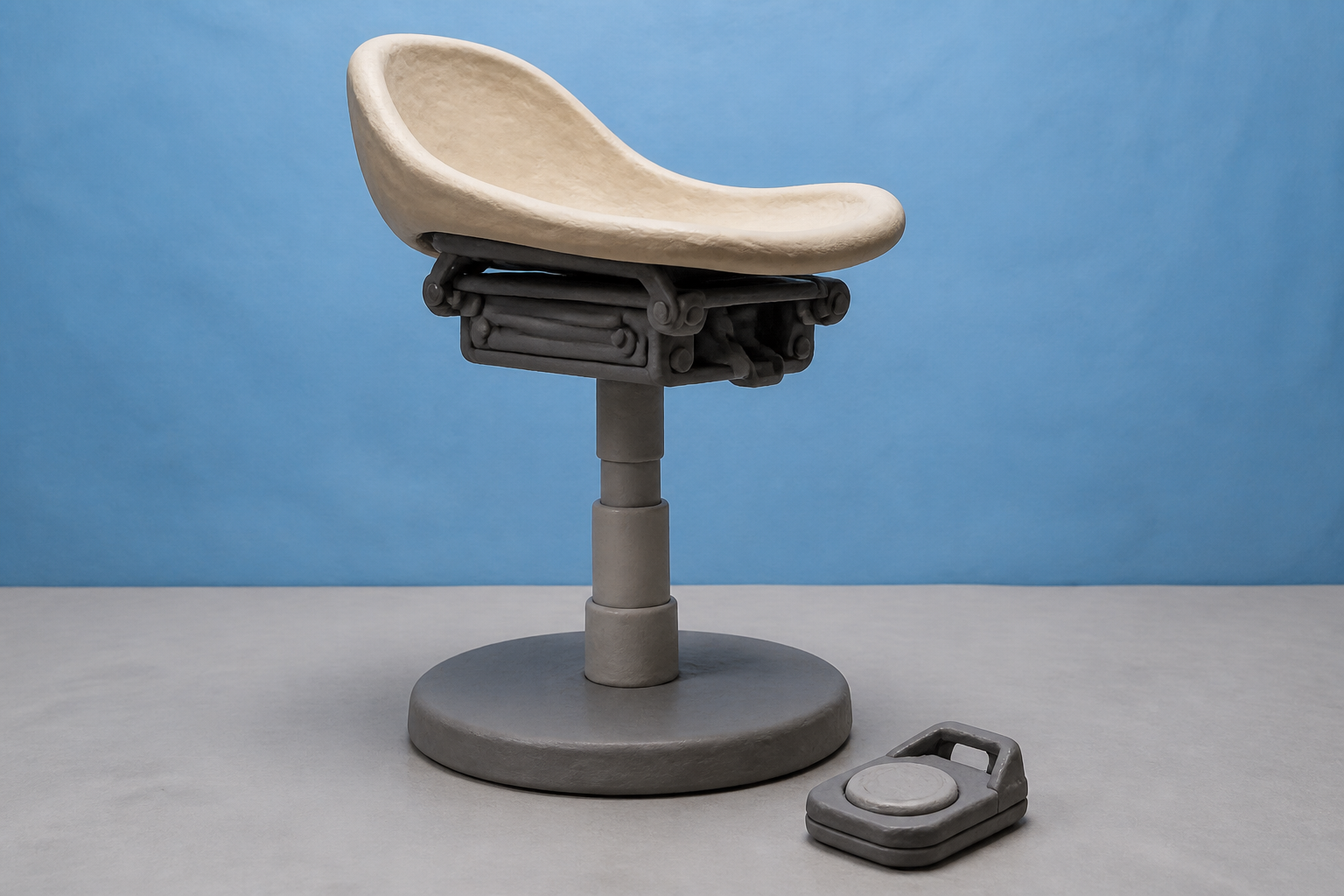
A reader might otherwise picture someone operating the lifting parts directly at the chair, without a separate foot pedal.
Here, a Bluetooth foot pedal operates the actuator, the part that produces movement, for a telescopic lifting column. The chair includes a battery and controller.
It is worth knowing because it gives a clear picture of how the chair's height adjustment is operated: with a Bluetooth foot pedal.
1900: the foot pump
In 1900, Ernest Koken patented a foot-pump hydraulic barber chair that let a barber shift a client's height hands-free, without pausing a cut. That simple work rhythm still explains why the foot pedal matters: the person cutting hair needs both hands, and the chair needs to move without asking the client to get up.
More than a century later, the market still divides salon chairs among manual swivel, foot-pumped hydraulic and electric versions. An account of salon seating places an adjustable-chair patent conflict in the late 1800s, before Koken, and describes electric hydraulic chairs with push-button or pedal controls as a current tier. The new element here is not a chair that rises under power. It is putting the power source and radio control into the chair itself.
A market forecast projects hydraulic chairs alone will reach $12.3 billion of a $17.6 billion global salon-chair market in 2028. Forecasts are not facts, but the number tells us the old pump is not waiting politely to be replaced.
A base already selling
Comfortel Furniture Pty Ltd, an Australian salon-furniture maker, filed its U.S. application on March 22, 2024. Its history traces back to Victoria in 1997, when it introduced the electric reclining Futura washlounge. Its current product line already includes the E-Lift, a rechargeable, battery-operated electric lift for salon chairs. It can be retrofitted to existing Comfortel chairs. The company describes the E-Lift base as launched in 2024-25, placing the product and filing in the same period.
The product page says the lithium battery lasts roughly two to three weeks under normal use lifting an 80 kg client before recharging. It calls the system a first in the salon industry. The part that holds my attention is not that claim. It is the retrofit: a mechanical chair becomes an electrical appliance in the place where it is already working.
The published application
Published on September 3, 2026 as US20260256289A1, Height Adjustable Battery Operated Chair, the application describes a base, seat, battery, controller and telescopic lifting column. A Bluetooth foot pedal tells the actuator to move. Its 13 claims further cover an in-line motor and gearbox, magnetic swivel catches and a storage compartment.
That is a specific package, but it is not a clean-slate idea. A 2006 filing that issued in 2008 described a rechargeable battery, motor and scissor-lift office chair with a smart charger. The mechanisms differ, and the Bluetooth pedal and telescopic column are part of this application's arrangement. I cannot tell from these public materials which claims will ultimately be allowed, if any. A published application is a request for protection, not proof that protection has arrived.
The battery's second life
Every extra function changes what happens when the chair is no longer useful. The German Federal Environment Agency reported that the EU collected 38.6% of e-waste against a 65% target, while electrical-appliance-equipped goods, including furniture with Bluetooth controls, reached 3.26 million tonnes placed on the EU market in 2022. That was 850,000 tonnes more than in 2018.
The figure is not a count of salon chairs, and I would not use it as one. But it puts the E-Lift in a category I think furniture makers should take more seriously: devices whose batteries, controls and motors may be easy to forget when the upholstery wears out. My concern is ordinary rather than speculative. A pedal that saves a barber's posture can also turn a chair's eventual disposal into an electronics problem.
What the filing is really betting on
Comfortel is not betting that salons will suddenly abandon hydraulics. Its own retrofit product suggests a more practical wager: convenience can be bolted onto chairs that are already familiar, without keeping them tethered to a wall outlet during lifting. The Bluetooth pedal matters because it preserves the old hands-free ritual. The battery matters because it makes the upgrade portable.
The historical comparison makes me less interested in the word new than in the trade it proposes. Salon owners can get an electric lift without a cable crossing the floor; the maker gets a defined combination of components to claim; the chair gains a battery that will someday need a plan. I think that is a worthwhile improvement only if the upgrade is matched by clear battery replacement and end-of-life recovery. The filing is therefore less a break with Koken's foot pump than a test of whether convenience can carry its own cleanup.
Sources
Reporting for this piece drew on the published filing and the references below.
- History of the Barber's Chair
- The History & Evolution of Hair Styling Chairs
- Salon Chairs Market Size Worth $17.6 billion by 2028
- About Us - Comfortel
- Comfortel E-Lift (Battery-Operated Electric Lift) for Salon Chairs
- Height Adjustable Battery Operated Chair
- US 2026/0256289 A1 - Height adjustable battery operated chair
- US7341310B1 - Office chair with automated height adjustment
- Invisible e-waste: Furniture, clothing or smart-home products can also be electrical appliances
The record, briefly. US20260256289A1, “Height Adjustable Battery Operated Chair” An electrically operable height-adjustable chair includes a base, seat, lifting mechanism, battery, and controller. A Bluetooth foot pedal operates the lifting-mechanism actuator, and the lifting mechanism is a telescopic lifting column.
More angles on this
- CPC A47C: Chairs; sofas; bedsThe official classification family this record was filed into, published in the USPTO Cooperative Patent Classification scheme.
- Two Rolling Brushes, Mirrored: A Cleaning Module That Says Which Way Its Bristles FaceAnother reading from the neighbouring A47L classification family, domestic washing or cleaning ; suction cleaners in general.
- A crampon that puts the adjustment in the wire, not in the two parts it joinsAnother reading from the wider A43C classification family, fastenings or attachments of footwear; laces in general.
- Non-Volatile Memory With Distributed Write: the erase step that sets the priceAnother reading in the same Field Notes category on this site.
Read around this one:Public patent recordUSPTO published figure