Machines
Two Rolling Brushes, Mirrored: A Cleaning Module That Says Which Way Its Bristles Face
Two mirrored rollers may pick up hair well, but this new filing belongs to a harsher contest over what "no tangles" can honestly mean.

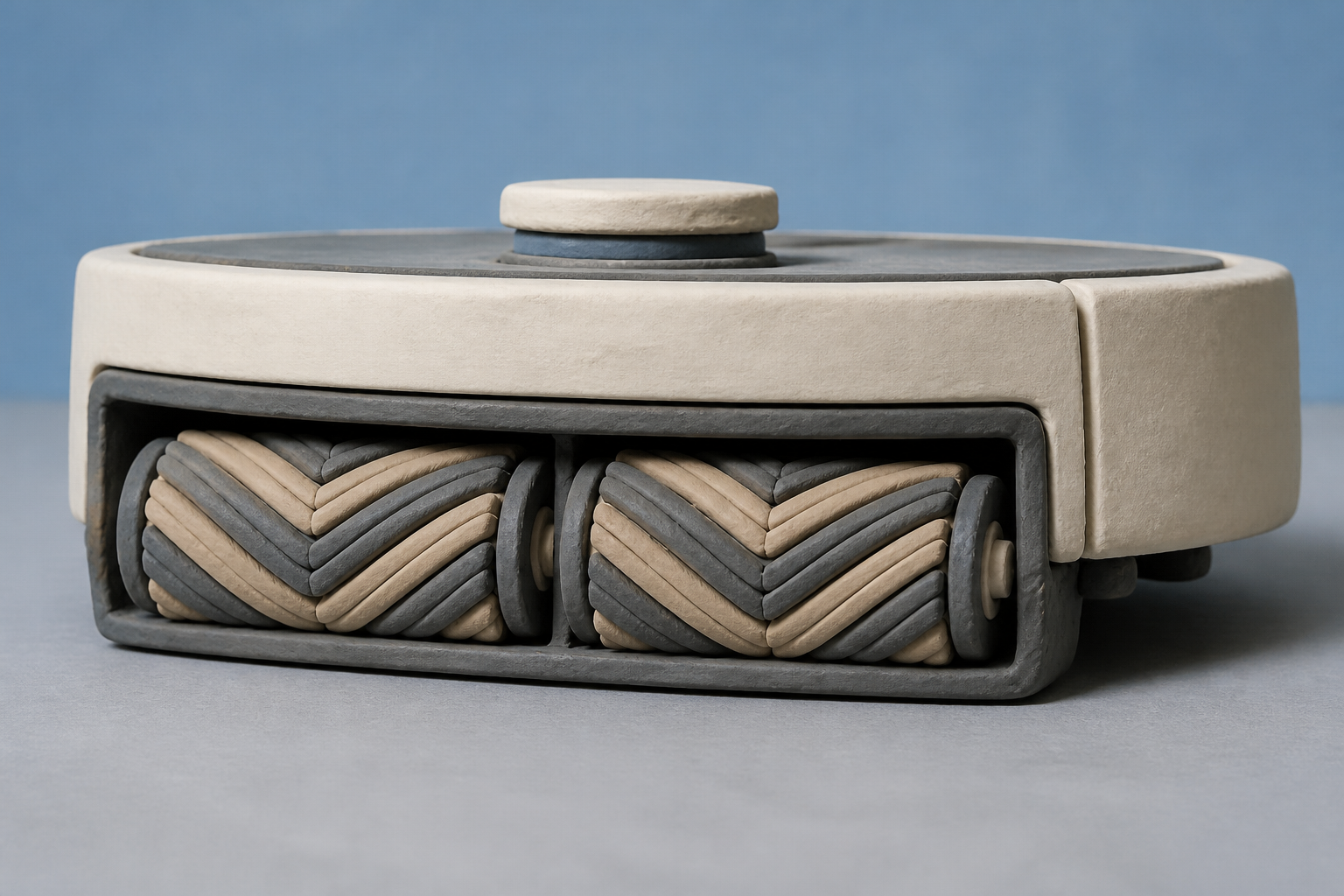
What changes in this design
A reader may otherwise picture a cleaner with one rolling brush, or a pair of brushes simply set beside each other without any stated relationship in how their bristles are positioned.
This module calls for two rolling brushes that are substantially side by side. The two brushes follow a rotational-mirror pattern, meaning their layouts are paired as mirror-like counterparts around rotation.
The mirror relationship is part of the information given about the component, rather than a loose placement of two rollers. Its practical cleaning effect is not stated.
The roller ends
Long hair rarely announces the work it has done. It gathers at the ends of a robot vacuum's rollers, around bearings and caps, along the side-brush shafts, and at the suction inlet. A consumer guide's blunt warning is that two rollers do not mean zero tangles, and homes with pets or long hair still need regular manual cleaning.
That is why the claims around brush systems deserve a closer look. They are not only about what gets lifted from carpet. They also shape the frustrating maintenance bargain: how often someone must turn the machine over, open its underside, and clear the places its clean floor conceals. A machine can lift hair from a rug and still hand part of the job back to its owner. That caveat is where I think the current race becomes more interesting than a better brush.
A September publication
That ordinary maintenance chore puts a new U.S. publication in context. US 2026/0256273 A1, "Cleaning Module And Cleaning Apparatus," names Beijing Roborock Technology Co., Ltd. as applicant and was published on September 3, 2026. Its application was filed September 21, 2023, and it claims priority to a Chinese application filed December 30, 2022.
The design described is restrained: two rolling brushes sit substantially side by side, with their brush distributions arranged in rotational-mirror symmetry. Reading that description, I was struck by its specificity and by what it leaves open. It presents an arrangement, not a measured promise about every loose hair, every bearing, or every home. The underlying idea was nearly four years old when it reached public view. The elapsed time makes a public filing feel less like a sudden household breakthrough and more like one move in a running contest.
The 99 percent line
Roborock already sells a Q5 DuoRoller Plus built around twin rubber rollers. Its store advertises a "99% hair pick-up rate" and says the arrangement reduces hair tangling. The word reduces does serious work here. It admits a residue of the problem rather than declaring it gone.
Across the contest, Dreame markets its competing HyperStream DuoBrush with a harder claim: it cites certification for "100% anti-entanglement" with hair up to 30 centimetres. Roborock's rate is about pickup. Dreame's claim is about prevention. They sound adjacent, but answer different questions. Both messages turn a mechanism into a household reassurance, yet neither phrase on its own tells us what happens after weeks of shedding hair and floor dust. To my eye, the split between reduce and 100 percent is not a minor marketing choice. It is a contest over the expectation a buyer takes home. That guide gives us a reason to resist either slogan, pointing to the same stubborn places: brush ends, bearings, caps, side-brush shafts, and the inlet.
Twenty-one suits
Brush geometry has become a corporate argument. A January 2025 account says Ecovacs had filed 21 patent suits against Dreame since June 2022, seeking about 80 million yuan in damages. That same account reported a 2023 German market split of 37.9 percent for Dreame and 17 percent for Roborock. Those are reported figures, not a complete map of a market, but they make the brush patent feel less isolated.
Allegations have grown personal. Industry executives publicly accused Dreame of recruiting rivals' engineers to obtain trade secrets; the reporting presents accusations, and I cannot treat them as established fact. Separately, a 2024 report said a German court issued a default judgment against Roborock in a robot-mop patent case after the company said it had not received notice. The report also said some Roborock products were pulled from a major online marketplace's German site. The practical consequence was not a new roller configuration but reduced availability in one national storefront. That episode gives the polite-looking roller diagram a much sharper setting.
The open question
The filing's symmetry may be useful. I have no basis to say that it is not, and the product page's pickup figure suggests its maker sees a performance advantage in twin rollers. But a strong pickup rate is not the same thing as a machine that never asks its owner to cut hair free. The distinction is the part I would want a shopper to hold onto.
The material I found supports a narrower conclusion. Roborock is pursuing a mirrored, side-by-side roller arrangement in a market where competitors sell competing answers, litigation is frequent, and public claims range from reduction to complete prevention. I don't read this as proof that the household hair problem has been solved. The twin rollers may be an improvement, but the stubborn strands at the edges leave the central question unresolved: what, precisely, has been made easier for the person who cleans the cleaner?
Sources
Reporting for this piece drew on the published filing and the references below.
- Cleaning Module And Cleaning Apparatus
- Roborock Q5 DuoRoller Plus
- Tangled Hair, Solved: How Dreame Technology Keeps Vacuums Clean
- Dual Roller Brush Robot Vacuum: Is It Better Than a Single Roller?
- The 'Finger Breaking Plan' tore through the unspoken rules of the industry
- Chinese Robot Vacuum Maker Didn't Get Court Notice Before German Patent Ruling
The record, briefly. US20260256273A1, “Cleaning Module And Cleaning Apparatus” A cleaning module includes first and second rolling brushes arranged substantially side by side, each with a brush, with the brushes distributed in rotational-mirror symmetry.
More angles on this
- CPC A46B: BrushesThe official classification family this record was filed into, published in the USPTO Cooperative Patent Classification scheme.
- CPC A47L: Domestic washing or cleaning ; suction cleaners in generalThe official classification family this record was filed into, published in the USPTO Cooperative Patent Classification scheme.
- The Suspender Belt Is Holding the Plot TogetherAnother reading from the neighbouring A47G classification family, household or table equipment.
- Where a Massaging Balm Applicator Makes Its Meeting Points ClearAnother reading from the wider A45D classification family, hairdressing or shaving equipment ; equipment for cosmetics or cosmetic treatments, e.g. for manicuring or pedicuring.
- A Segment That Cools And A Segment That Carries FlavourAnother reading in the same Machines category on this site.
Read around this one:Public patent recordUSPTO published figure