Field Notes
Where a Massaging Balm Applicator Makes Its Meeting Points Clear
A new patent around an Icy Hot balm reveals a familiar tension: packaging can improve while evidence and safe use remain unsettled.
What changes in this design
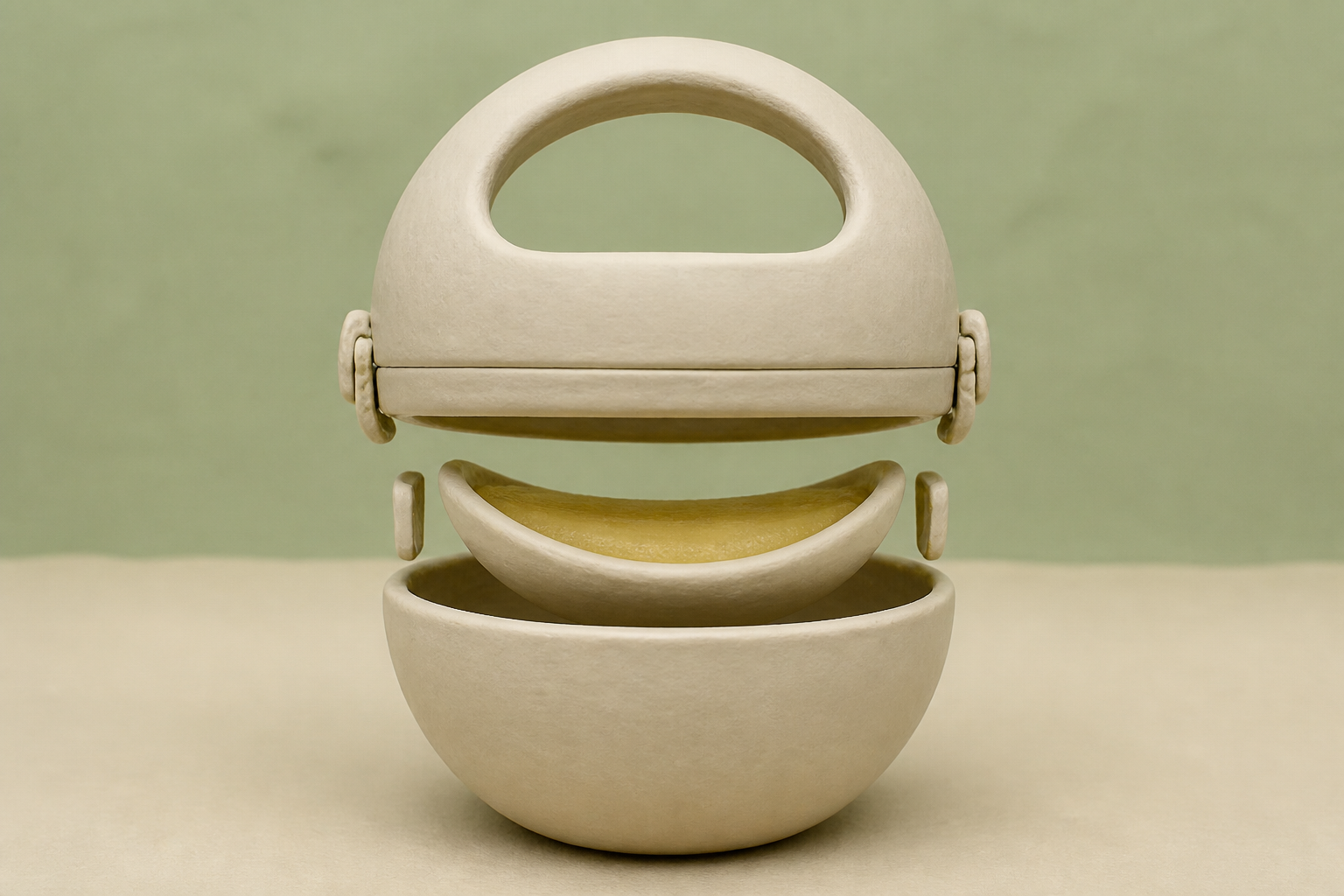
Without these connection details, someone might picture a simple balm applicator as a handle with a balm holder and a cover placed over it, without knowing how the pieces stay joined.
Here, the handle unit includes an adapter. The holder’s first rim is secured to it by a fastener, and the cover’s clasp releasably secures that adapter. Both the holder and cover meet at the same connection point.
That gives a reader a clear way to picture the item. The adapter is the shared place where the holder and cover attach, and the cover can be released from that point.
A sore shoulder and a warning
Someone with a sore shoulder can buy a balm in an easy-grip applicator, hold it firmly, and rub the stick over the place that hurts. The retail directions for Icy Hot PRO Massaging Balm say just that, alongside 16% menthol, 11% camphor, cocoa butter, and avocado oil. The action is almost aggressively ordinary: grip, rub, move on.
But an existing no-mess Icy Hot drug label puts a harder boundary around that little ritual. It warns that rare cases of serious burns have been reported and tells users to avoid heating pads and direct sunlight. The number that caught my attention was not a sales figure or a patent count. It was the word burns, sitting beside directions to rub a product over sore skin.
The grid inside the stick
That is the setting for US20260256264A1, published on September 3, 2026 and assigned to Chattem, whose Chattanooga lineage begins with a medicine business founded in 1879. Its title is Massaging Balm Applicator, and the filing appears to sit behind a balm already on shelves rather than announce a new medicine. The claims concern the ordinary parts that determine how the balm is held: a handle and adapter, a cover with a releasable clasp, and a retainer fastened to the adapter.
Further claims reach into manufacture: a forming cup, a snap-lock fastener, and a reinforcing grid embedded in solidified balm, spanning 5 to 15 percent of its diameter. To my eye, the filing directs its detailed attention to the physical delivery system rather than evidence about the active ingredients. I can't tell from a filing how those features perform in a person's hand, only that they are the parts being claimed.
Two earlier applicators
The basic idea has company. A 2018 application for a dual-balm device put two sticks on perforated mounting structures, each under a removable cover, for lip balm or sunscreen. That was a different product, and it does not decide whether Chattem's later claims clear the legal bar. Still, the retainer-and-cover problem was being addressed long before this publication.
An older 2012 filing took massage while dispensing in another direction: multiple roller balls for topical oils. Its inventor used metal retaining rings because the filing says essential oils can impregnate plastics and relax the elasticity of standard roller-ball housings. The difference matters. The 2026 application uses a different configuration, but the idea of massaging at the point of application was already in the patent record. What I see is a long-running engineering question: how to combine application and massage without treating the container as an afterthought.
The ingredients outside the housing
The patent's silence about clinical effect is not a flaw in patent drafting. Hardware claims do a different job. But it makes the evidence around the balm impossible to ignore. A 2023 review of camphor- and menthol-containing agents found only 15 clinically relevant papers among 103 results in its PubMed search, and only two were randomized, double-blind trials. The authors concluded that no definitive recommendation on efficacy could be made.
That finding does not mean the balm never helps anyone, and I would not turn a small evidence base into a verdict on an individual user's relief. It does mean that a better-shaped applicator should not be confused with stronger evidence for the thing inside it. A market-research estimate puts the global topical-analgesic market at about $11.85 billion in 2025, with over-the-counter products accounting for 86.92% of sales. Packaging is a rational place to compete in a market that large; the evidence gap remains after the cap snaps shut.
Where the risk actually sits
Safety is where this story narrows. In 2019, a customer alleged in a class action that an Icy Hot applicator caused pain and burns rather than relief. Those allegations were not a court finding that the product was defective. In December that year, a federal court sent the case back to state court because the companies had not shown that more than $5 million was at stake, the threshold required for that federal class-action route.
The existing label's warning does not prove what happened in that case, but it does not treat burn risk as imaginary either. In April 2025, Sanofi closed a deal giving CD&R a 50.0% controlling stake in Chattem's parent business; Sanofi retained 48.2%, and a French public investment bank held the remaining 1.8%. Sanofi said the transaction generated approximately €10 billion in net cash. A change of ownership is not proof of instability, and I won't pretend it is. Yet the filing arrived after that reshuffle, making my view fairly simple: the most developed part of this product story is the shell around the balm. The claims may improve a stick's construction. They cannot settle the thinner evidence for menthol and camphor, or make careful use less important.
Sources
Reporting for this piece drew on the published filing and the references below.
- Massaging Balm Applicator patent application
- PRO Massaging Balm
- ICY HOT PRO NO-MESS drug label
- Opella North America
- Dual Balm Applicator and Method of Manufacture - US20190053605A1
- Massaging multiple roller-ball applicator for topical oils application - US9205020B2
- Looking Back to Move Forward: Clinical Applications of Camphor- and Menthol-Containing Agents
- Topical Analgesic Market Report
- Sanofi Must Face Class Claims of Icy Hot Defect in State Court
- Sanofi and CD&R close Opella transaction
The record, briefly. US20260256264A1, “Massaging Balm Applicator” An applicator has a housing and retainer. The housing includes a handle unit with a handle and adapter, and a cover with a clasp that releasably secures the adapter. The retainer secures a substance and has a fastener on its first rim to secure that rim to the adapter.
More angles on this
- The Potato Product Makes Its Entrance in SlicesAnother reading from the same A45D classification family, hairdressing or shaving equipment ; equipment for cosmetics or cosmetic treatments, e.g. for manicuring or pedicuring.
- CPC A45D: Hairdressing or shaving equipment ; equipment for cosmetics or cosmetic treatments, e.g. for manicuring or pedicuringThe official classification family this record was filed into, published in the USPTO Cooperative Patent Classification scheme.
- CPC A61H: Physical therapy apparatus, e.g. devices for locating or stimulating reflex points in the bodyThe official classification family this record was filed into, published in the USPTO Cooperative Patent Classification scheme.
- Seeing the Elastic Pattern Before You Decide What It MeansAnother reading from the neighbouring A61F classification family, filters implantable into blood vessels.
- What a Platform Shoe Edge Can Teach About AlignmentAnother reading from the wider A43C classification family, fastenings or attachments of footwear; laces in general.
Read around this one:Public patent recordUSPTO published figure