Field Notes
Seeing the Elastic Pattern Before You Decide What It Means
Daio Paper's 2026 elastic-layer patent lands as Japan's diaper business shifts from fewer babies toward older adults.

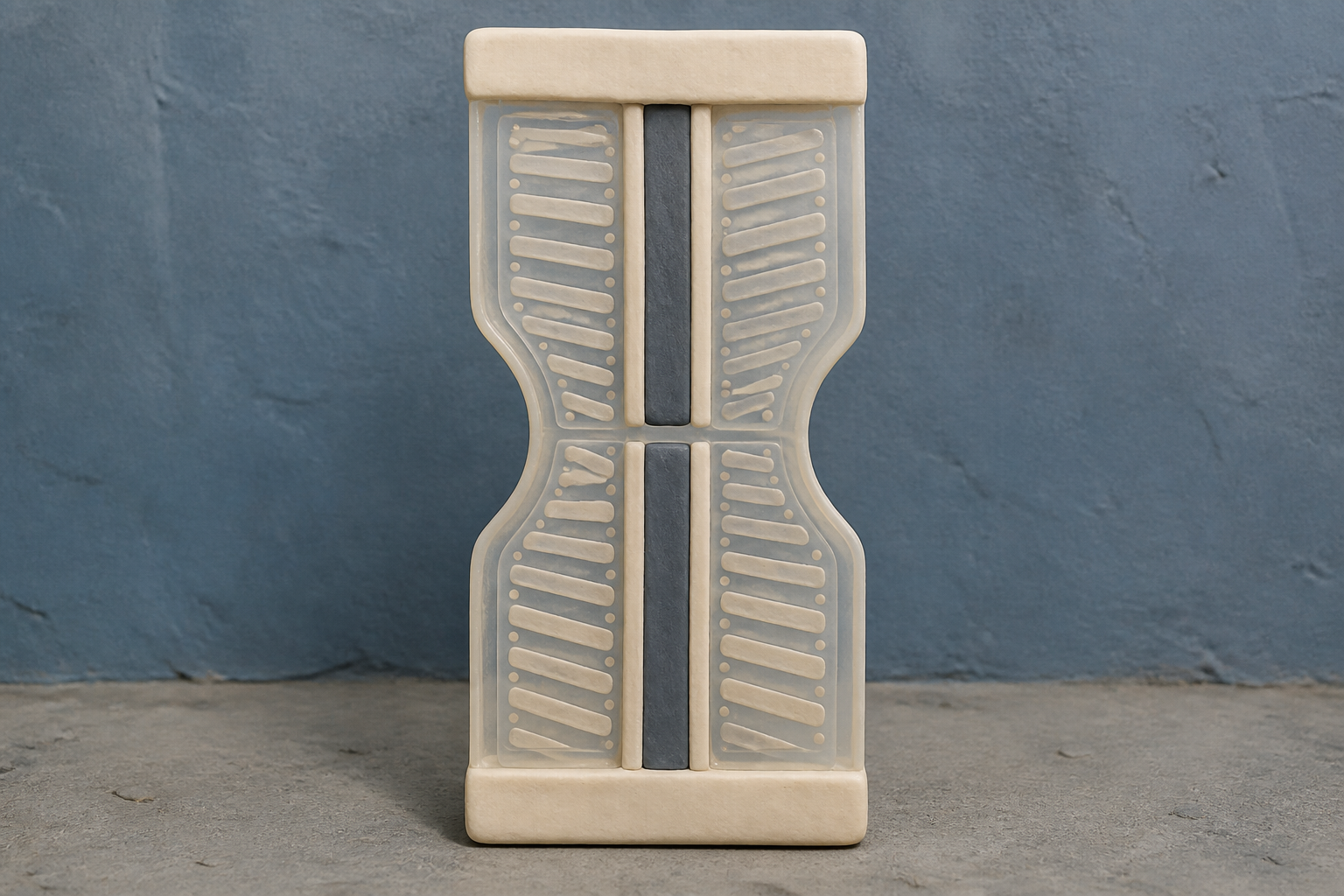
What changes in this design
Without these details, a reader might picture an ordinary stretchy strip with one simple material and repeated features that are all the same size.
Here, the stretchy piece has two translucent sheet layers. Its stretchable area repeats a unit with non-joined bands and joining portions, while the bands vary in width across the direction perpendicular to the first direction.
This gives a reader concrete details to notice: the layers, non-joined bands, joining portions, and changing band widths. What practical result those details are meant to produce is not stated.
80 meters at Fujinomiya
An 80-meter automated line at Daio Paper's Fujinomiya factory makes adult diapers for its Elleair brand. The company says that business already produces twice the revenue of its baby-diaper line. Japan, meanwhile, recorded 727,277 births in 2023, its eighth straight annual record low, and nearly 30 percent of its population was 65 or older. A patent about a stretchy inner layer makes, I think, more sense against that reversal than it does as a detached feat of materials engineering.
One rival, Oji Holdings, stopped producing and shipping baby diapers in Japan in September 2024 to focus on adult incontinence products. The domestic adult-diaper market is projected to grow through 2027 while the baby market contracts. That does not make every baby product obsolete, and it does not turn a patent into a market forecast. It does make the customer behind the engineering harder to ignore.
The filing also lands alongside a reported profit turnaround. In the nine months through December 31, 2025, Daio Paper's consolidated sales fell 1.8 percent to 493.1 billion yen, but operating profit rose 165.4 percent to 18.1 billion yen. This is not a company simply letting a legacy category drift away.
Two translucent sheets
US20260256220A1 is assigned to Daio Paper. Its elastic member has two translucent sheet layers, non-joint bands, and joined portions that run in the stretchable direction. A unit structure repeats through the stretchable region, with the band widths changing across the direction perpendicular to that stretch. Read in isolation, it is deeply local: where sheets meet, where they do not, and how wide the bands are.
A parent patent in the same title family names a particular failure on thin wearers. Holes in the joined laminate can close too much, reducing air permeability. The new publication does not, in my reading, establish that it prevents that outcome in every body type or every finished product. It records another effort to tune the visual and physical behavior of an elastic laminate under use.
Three U.S. records
The trail begins with Japanese priority applications filed in September 2017 and March 2018. A U.S. patent granted in the same family is identified as the parent. Another U.S. patent, a continuation in the Daio Paper family, covers a variation meant to make contraction wrinkles look more complicated rather than monotonous. The new 2026 publication brings the visible record to at least three U.S. entries about nearby choices in the same elastic architecture.
That kind of persistence is not strange in this category. Earlier disputes among large diaper makers have turned waistband, leg-cuff, closure, and training-pant patents into competitive weapons, producing invalidations, settlements, and a $178 million verdict. I don't take this filing as a signal that a lawsuit is coming. It is evidence that a variation which looks fussy on paper can matter when articles are made at vast scale.
Fluorine on the test sheet
Scale makes another omission stand out. This filing addresses the geometry of an elastic laminate, not the chemistry of a finished disposable article. Independent testing reported by a consumer publication found detectable organic fluorine above 10 ppm in 6 of 35 disposable diapers it tested, within a 65-product, 40-brand sample. The testing uses organic fluorine as an indicator for PFAS. Some disposable diapers reached 60 ppm, and the highest reading across all products tested was 323 ppm.
Nothing I found links those results to Daio Paper, the Elleair brand, or the elastic member described here. The figures also do not identify what is in any one component of a diaper. That distinction matters to me: a patent can be precise about a layer without being a full account of a product. Air permeability, gathered texture, and stretch are not the only properties that deserve scrutiny in something designed to sit against a person's skin.
What would have to be true
For this patent to become more than a line in a long family ledger, several things would, I think, have to be true. The variable-width bands would have to produce a benefit someone notices in a real disposable article, across different bodies rather than only a test setup. That benefit would have to matter in a Japanese market moving toward adult incontinence, and it would have to justify years of closely related protection. The improvement in fit, airflow, or appearance would also have to stand beside, not crowd out, harder questions about the materials people wear against their skin.
The number that stays with me is not a band measurement from the filing. It is 727,277. Daio Paper may be protecting a narrow piece of manufacturing knowledge, and there is nothing trivial about that. Yet Japan's diaper business has already begun adjusting to a different customer. Incremental refinements will be judged by that customer, not by the tidiness of a patent drawing.
Sources
Reporting for this piece drew on the published filing and the references below.
- US20260256220A1 - Elastic Member And Disposable Wearing Article Including Elastic Member
- US11,529,266 B2 - Elastic Member And Disposable Wearing Article Including Elastic Member
- US12,465,530 B2 - Elastic Member And Disposable Wearing Article Including Elastic Member
- Diaper change: Japan's aging society is transforming the baby care business
- Oji Holdings to Stop Producing Baby Diapers in Japan
- Japan's diaper makers look to adult market for revenue as births fall
- Daio Paper swings to profit as earnings surge despite slight sales dip
- Part2: Diaper Wars
- Disposable & Cloth Diapers Tested For Indications of PFAS
The record, briefly. US20260256220A1, “Elastic Member And Disposable Wearing Article Including Elastic Member” An elastic member includes first and second sheet layers of translucent material, with non-joint bands and stretchable-direction joint portions. The unit structure repeats in the stretchable region, with band widths varying orthogonally to the first direction.
More angles on this
- The Pants Have a Particular Part To PlayAnother reading from the same A41B classification family, shirts; underwear; baby linen; handkerchiefs.
- Accessible Garment, More Than a Dress CodeAnother reading from the same A41B classification family, shirts; underwear; baby linen; handkerchiefs.
- CPC A41B: Shirts; underwear; baby linen; handkerchiefsThe official classification family this record was filed into, published in the USPTO Cooperative Patent Classification scheme.
- CPC A61F: Filters implantable into blood vesselsThe official classification family this record was filed into, published in the USPTO Cooperative Patent Classification scheme.
- Degassing a bottle: a chamber, a pump, and the judgment left to whoever holds itAnother reading from the neighbouring A61J classification family, containers specially adapted for medical or pharmaceutical purposes.
Read around this one:Public patent recordUSPTO published figure