Wearables
Accessible Garment, More Than a Dress Code
A shirt design granted over roughly 140 references, two of them Amazon listings, and why the drawing was never the hard part.

What changes in this design
Without the drawing, a reader might assume that a title such as Accessible Garment explains a special way the clothing works. The available information does not provide those details; it is visual.
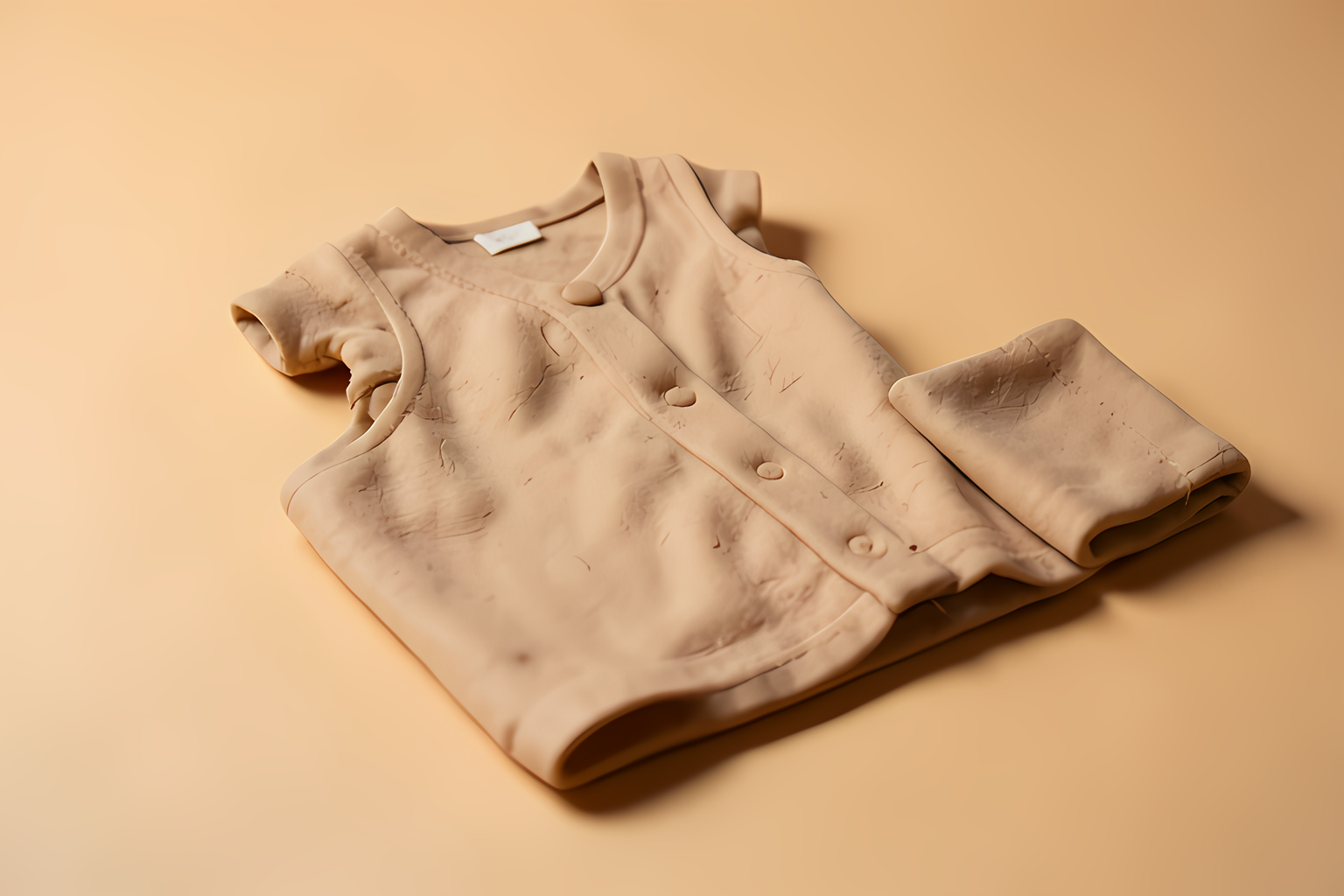
This record presents line drawings of a torso-length, short-sleeved garment. They show a rounded neck with a double-outline band, front rectangular details in one view, and a sweeping curved overlapping panel in the other.
That matters because the drawings are the information a reader can confirm: the garment's visible shape and outlined features. They do not establish what the panels do, what the garment is made from, or how it performs.
An examiner opened Amazon on September 17, 2025
On September 17, 2025, a design patent examiner opened Amazon.com and looked at two listings for post-surgery recovery shirts. One, a full-open snap shirt for shoulder patients, had been available since January 11, 2024. The other, a two-pack of unisex surgery shirts, since September 13, 2022. Both are now printed on the face of a granted US patent, starred as examiner-cited.
That used to be almost unheard of. Among US-origin design patents that eventually issued, the share picking up at least one anticipation rejection ran near 0.1% in 2008. By early 2025 it was above 7%, and it has settled at a sustained 5 to 6%. Call it a fifty-fold change in seventeen years. The law didn't change. Examiners started searching the marketplace instead of only the archive.
Roughly 140 references for a single drawing
The patent is US D1,138,013 S, "Accessible Garment," granted August 4, 2026 to Dorothy J Petrancosta of Glenshaw, Pennsylvania, and assigned to NU-DIGGZ LLC in the same town. Filed July 3, 2024. About 25 months to grant, against a 21.5-month average for design patents in fiscal 2025. One claim, five sheets, eight figures.
The drawings show a cap-sleeve top with fastener points along the tops of the shoulders and sleeves and down both side seams, plus two patch pockets. The last figure shows it opened flat. On the printed face: roughly 100 US patents, the oldest granted to McElroy in July 1923, about 22 published applications, 16 foreign documents, and those two Amazon pages. Around 140 references for one ornamental claim.
The classification is what I keep going back to. It's filed as a patient's upper-body garment and as maternity or nursing wear at once. Two populations, one problem: reaching the chest without pulling anything over a head.
Chest access has been re-solved since 1867
Chest access has a long patent trail. Isaac Stratton patented a pantaloon fastening for "aged and infirm" men in 1867. Lizzie Fifield's Invalid's Robe of 1891 split a garment into sections so a caregiver could reach one part of a body at a time. Hester Larson's One-Piece Garment of 1967 was a full wrap, built so nobody had to raise their arms.
A survey published this spring counted 178 utility patents for disability clothing filed between 1990 and 2024. Socks and underwear dominate; upper-body access is the thin spot. In 2025 alone the office granted about 52,000 design patents, a record, while utility grants stayed flat. So this filing sits in the fastest-growing category and outside the literature meant to map its own field.
$4 gowns and a $192,000 line item
Here's where I think the story turns. A review of 40 studies, published in July, found that patients in hospital gowns report higher perceived dehumanization than patients in their own clothes, and that what they ask for is two-piece sets, real sizing, and snaps rather than ties. The drawings match that list almost exactly.
Snaps were never the obstacle. A traditional tie-back gown costs $4 to $7. Cleveland Clinic's redesigned gowns ran about $15, roughly $10 more than what they replaced. One New Jersey medical center spent $192,000 a year on new apparel against $96,000 for the old kind. Cynthia Rowley redesigned the gown in 1999. Nineteen years later, a laundry trade group official still described tie-backs as "not an overwhelming majority, but still the majority" of gowns in use. Harlan Krumholz has called the gown a symbol of becoming a faceless patient. The barriers that same review lists are cost, laundering specs, standardization, and hierarchy. None of them is a drawing.
What would have to be true
For this design to change a hospital ward, that $10 gap would have to stop mattering, and nearly thirty years of gown redesigns say it doesn't. But wards may not be the point. The same garment is classified for nursing mothers, and there the buyer is a person rather than a purchasing department. Generic snap-front recovery shirts already fill that shelf, which is precisely why the examiner was on Amazon in the first place.
I'd treat the sector's favorite number carefully too. US adaptive apparel gets sized at $47.3 billion; other estimates put actual adaptive-specific global sales nearer $1.7 to $2.3 billion. The larger figure counts what people with health conditions spend on clothing generally.
One more thing. Marketplace searching bites hardest on domestic applicants, since they're the ones with US listings to find. Petrancosta drew the harder examination and cleared it, over 140 references reaching back to 1923. The drawing was never the difficult part.
Sources
Reporting for this piece drew on the published filing and the references below.
- US D1,138,013 S - Accessible Garment (USPTO grant document)
- Amazon as Prior Art: The Rise in Design Patent §102 Rejections - Patently-O
- The Surprising Headline of 2025: USPTO Stability? - Patently-O
- Why do hospitals bare butts when there are better gowns around? - STAT News
- Beyond the hospital gown: a systematic review of patient clothing design - Frontiers in Health Services
- Adaptive Clothing: What is it and Who is it For? - Politics of Patents
- Three decades of utility patent trends in clothing and accessories for people with disabilities
- The US Adaptive Clothing and Footwear Market Represents a $47.3 Billion Largely Untapped Opportunity - Coresight Research
- CPC Scheme A41D (Outerwear; protective garments) - USPTO
The record, briefly. USD1138013S1, “Accessible Garment” The checked public record identifies a U.S. design patent titled 'Accessible Garment'. The reading treats the published title and figure as a visual starting point and does not infer a material, mechanism, or performance claim not established there.
More angles on this
- A Glove With a PortfolioAnother reading from the same A41D classification family, outerwear; protective garments; accessories.
- The Pants Have a Particular Part To PlayAnother reading from the same A41D classification family, outerwear; protective garments; accessories.
- CPC A41D: Outerwear; protective garments; accessoriesThe official classification family this record was filed into, published in the USPTO Cooperative Patent Classification scheme.
- CPC A41B: Shirts; underwear; baby linen; handkerchiefsThe official classification family this record was filed into, published in the USPTO Cooperative Patent Classification scheme.
- The Suspender Belt Is Holding the Plot TogetherAnother reading from the neighbouring A41F classification family, garment fastenings; suspenders.
Read around this one:Public patent recordUSPTO published figurePatent issue-date index