Objects
What a Platform Shoe Edge Can Teach About Alignment
A new shoe-protection filing meets a 144-year history of sole guards as resale turns pristine outsoles into assets.

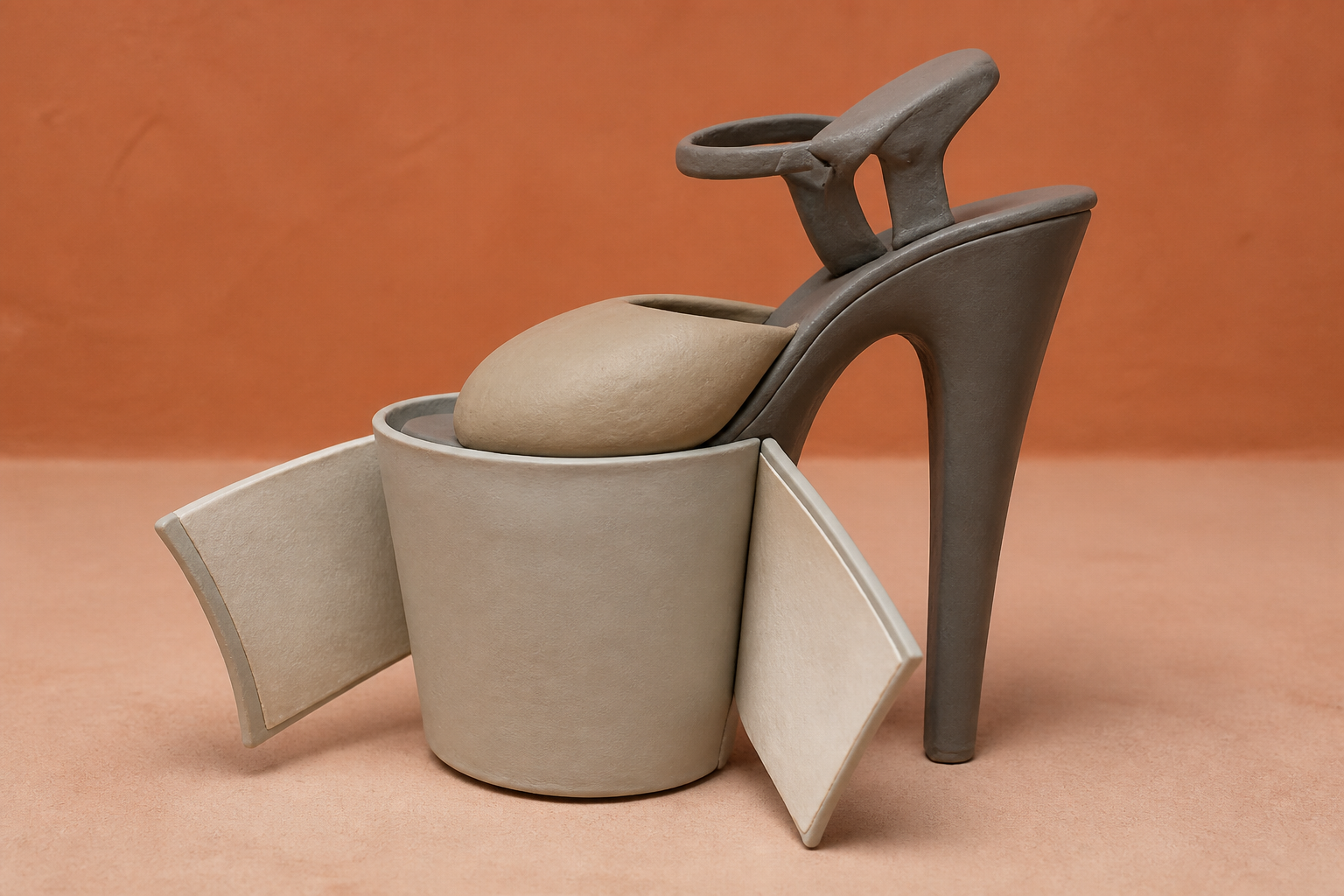
What changes in this design
A general idea of shoe protection leaves open which part is covered and what material touches the shoe.
Here, the covering is a flexible sheet designed to surround the platform shoe's perimeter, conform to it, and attach on the inside with pressure-sensitive adhesive.
It helps a reader see the practical idea: a conforming perimeter covering with a durable outside and an adhesive inside.
The $11.5 billion underside
In 2023, sneaker resale generated $11.5 billion, or 15.3% of the primary sneaker market. That is enough money to turn the underside of a shoe into part of its price. A clean outsole now carries resale value alongside the upper, while scuffs, dirt and yellowing become visible evidence of wear. Forecasts put the market at $51.2 billion by 2032, growing at 16.4% a year, and one major resale marketplace recorded $540.9 million in 2023 revenue. The part that interests me is not the forecast. It is the simple shift beneath it: sole condition is now something people can try to preserve before regular wear begins. That is why a modest accessory has acquired a fresh reason to exist.
A clear film on sale
A thin, transparent layer is already an ordinary answer to that problem. Reshoevn8r sells a $24.88-per-pair clear peel-and-stick film that can be trimmed for a sneaker sole and is intended to stop scuffs, dirt and yellowing. This is why the 2026 publication matters less as a category announcement than as a sign of continued demand. That makes me read US20260256247A1 as a filing inside an existing trade before I read it as a breakthrough. It describes a flexible, adherent sheet that surrounds and conforms to a platform shoe's perimeter, with a durable polymer outer layer and a pressure-sensitive adhesive inner layer. The short published description may leave out distinctions, but the basic product is already on the shelf.
William Gordon's elastic band
In 1882, a U.S. patent by Boston inventor William Gordon described an elastic band long enough to encompass the edge of a boot or shoe sole and protect it from wear. The match is conceptual, not material, but it is direct: a perimeter-hugging protector is not a recent thought. Metal sole and heel plates were already a commercial product. Manufacturing began in Leeds in 1880 and continued for more than 130 years, with production moving to Walsall in 2014. That 1882 document makes me cautious about treating the perimeter of a platform shoe as unexplored territory. The materials have changed. The aim has not.
The 2008 adhesive comparison
The more awkward comparison comes from modern materials. US8024872B2, filed in 2008 and issued in 2011, claims a removable multilayer sole covering with a clear elastomeric ground-facing outer layer and a thin acrylic pressure-sensitive adhesive layer. Those are the same basic jobs assigned to the 2026 filing's polymer exterior and adhesive interior. WO2016133883A1, with a 2015 priority date, describes a peel-away-backed, pressure-sensitive-adhesive sole protector requiring no cure time and removable without residue. I can't resolve legal claim scope from published descriptions alone, and neither earlier document alone determines whether the new application can be patented. But the comparison leaves my confidence in a mechanism-led story very low. Any meaningful distinction would need to lie beyond the basic two-layer construction.
The platform trend's timing
The platform-shoe silhouette has a recent, traceable fashion cycle. Reporting traces the bulky platform or dad-shoe boom to a 2016 luxury sneaker, describes the style as saturated by mid-2023, and records a runway shift toward flatter soles in 2024. The pattern makes the target look like a specific fashion cycle rather than a permanent category. The health context complicates the promise. Podiatrist Dr. Tom Biernacki says elevated soles reduce feedback from the ground and cites peer-reviewed studies linking thick or elevated soles to ankle sprains, plantar fasciitis and peroneal tendon strain. I found that gap hard to ignore: a film may preserve a sole's appearance, while it does nothing to address risks associated with the shoe's height.
What the filing is really betting on
The novelty worth watching is economic, not mechanical. Elastic bands, metal plates, pressure-sensitive adhesive films and clear ground-facing layers each have a documented place in shoe protection. A current retail product already offers the basic proposition. The new filing may still define something legally distinct, but the published material does not establish it. To my eye, US20260256247A1 reads as a bet that the resale economy can make a familiar protection technique newly attractive for a trend-bound shoe shape. It is a commercial story with real logic behind it, not a persuasive account of a newly discovered way to cover a sole.
Sources
Reporting for this piece drew on the published filing and the references below.
- Systems And Methods For Protection Of Shoes And Use Thereof - US20260256247A1
- Sole Shields - Sneaker Sole Protectors
- Shoe Sole Protector - US8024872B2
- Shoe Protector - WO2016133883A1
- Sneaker Resale Statistics
- Will Flat Shoes Kill Chunky Sneakers?
- Platform Sneakers & Foot Health: Podiatrist Perspective
- Blakey's Shoe Protectors
- Sole-Edge Protector for Boots or Shoes - US258228A
The record, briefly. US20260256247A1, “Systems And Methods For Protection Of Shoes And Use Thereof” A protective device includes a flexible, adherent sheet configured to surround and conform to a platform shoe perimeter, with a durable polymer outer layer and pressure-sensitive adhesive inner layer.
More angles on this
- CPC A43C: Fastenings or attachments of footwear; laces in generalThe official classification family this record was filed into, published in the USPTO Cooperative Patent Classification scheme.
- CPC A43B: Characteristic features of footwear; parts of footwearThe official classification family this record was filed into, published in the USPTO Cooperative Patent Classification scheme.
- The Seam Is the Story in a Layered Low-Refraction, High-Hardness Device WindowAnother reading from the neighbouring C09D classification family, coating compositions, e.g. paints, varnishes or lacquers.
- Seeing the Elastic Pattern Before You Decide What It MeansAnother reading from the wider A41B classification family, shirts; underwear; baby linen; handkerchiefs.
- A storage medium with two bosses, and the address that has to survive the handoffAnother reading in the same Objects category on this site.
Read around this one:Public patent recordUSPTO published figure