Machines
A Dishwasher's First Temperature Question
A new Samsung filing turns a dishwasher heater into a timed decision, revealing a five-year effort to answer the wet-dishes complaint.

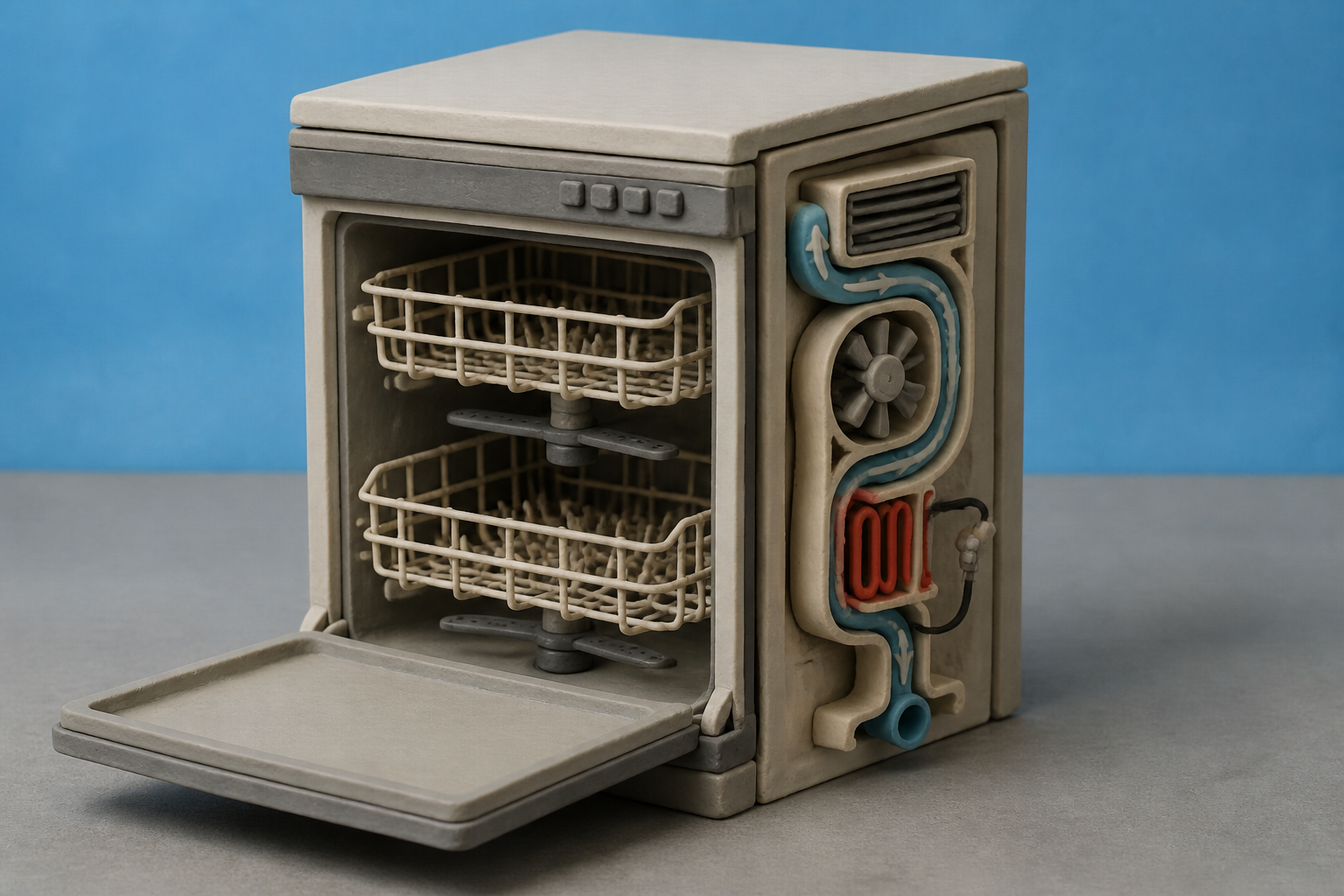
What changes in this design
Many readers might expect the heater to begin with the same set amount of running time each cycle. The record does not say whether that is ordinary practice.
Here, the dishwasher's controller starts the fan with drying and sets the heater's initial running time from a detected temperature.
It tells a reader what guides the first heater setting. The result of using that setting is not stated.
The bowl at the bottom
A plastic bowl comes out of a dishwasher clean, cool, and holding a puddle in its base. The plates beside it may be dry enough to stack. Metal stores heat; plastic has less thermal mass and cools sooner, so water lingers. That stubborn little contrast is why the last minutes of a cycle can matter more than the dramatic wash before them.
Samsung's U.S. support guidance for condensing-dry machines gives this a frank answer: drying is a natural result of physics, rinse aid is required, and a service call will not improve it. I think that can be technically fair and still feel like a poor ending for someone holding a wet food container.
That tension, between the dishwasher as appliance and the dishwasher as a set of physical limits, makes a newly published Samsung filing more interesting than its title sounds.
April 16, 2021
The date that changes how US 2026/0256337 A1 reads is April 16, 2021. Samsung's Korean priority application began that chain; a PCT application followed on March 24, 2022, then a U.S. application on October 13, 2023. That earlier U.S. application became Patent No. 12,648,682. The new publication, filed May 1, 2026, is a continuation of it.
Another related Samsung drying-apparatus patent came from a different Korean application filed on that same April day and was granted in December 2024. The paper trail shows a cluster of drying work being kept alive over five years, rather than a sudden 2026 discovery.
From those records, I cannot tell whether either approach has reached a particular retail model, and the publication does not establish that it has.
A heater gets a clock
The current filing's device sits outside the tub: air enters an inlet, moves through a flow channel past a fan and heater, exits an outlet, and is measured by a temperature sensor. When drying begins, the processor starts the fan and uses that temperature to choose the heater's initial operating time.
The detail sounds fussy. I don't think it is. A fixed heater interval could be too blunt for a changing machine, particularly in the hard case of plastic that does not retain much residual heat.
Manufacturers already pursue at least three drying routes: exposed heating elements, passive condensation, and fan assistance. A rival patent takes another path, pairing heat exchange with a separate condensing module. A premium zeolite sorption system, introduced in 2008, is described by its maker as saving up to 0.2 kWh per cycle, or about 20 percent. None of those approaches makes this filing a proven product advantage.
The water-rule reversal
Drying-control refinements also sit inside a moving regulatory argument. Federal water-use limits have stood at 5.0 gallons per standard dishwasher cycle and 3.5 for compact machines since 2013. In May 2025, the DOE proposed rescinding them, arguing that the standards reduce utility by lengthening wash times. A tighter 2027 rule of 3.3 gallons for standard machines and 3.1 for compact models is being challenged.
That does not prove a federal rule caused this heater timing. The connection is not one I would make from a patent family. But it does weaken the tidy story that efficiency policy will keep pushing every maker toward increasingly elaborate controls.
The missing scorecard
One current Samsung model has been independently rated excellent for heavy-soil cleaning and energy use, very good for noise, and good for cycle time. Those are meaningful results, but they do not let me infer how this sensor-timed device performs: the review's full drying and reliability subscores are paywalled.
A retailer's first-year service data records 33,190 calls across more than 7,000 dishwashers, yet Samsung is absent because that retailer neither sells nor services its machines. The dataset tells us something about a market, but nothing direct about whether this design's added hardware improves reliability.
In the material I reviewed, I found no direct product test tying this continuation's timed heater to drier plastic.
Where this leaves things
The filing is best read as a claim to a control method, not as evidence that the wet-bowl problem has been solved. It turns a familiar compromise into a particular calculation: how long a heater should initially run after a sensor reads the temperature.
Samsung's patent filings have carried that calculation forward from spring 2021. The longevity matters because it makes the issue durable on paper, even if it tells us nothing yet about retail deployment.
The judgment I reach is that the patent's modesty is its point. A dishwasher may be judged by a small puddle after everything else went right, and the paperwork is now concerned with that last frustrated minute. Until measured results connect the temperature-based timing to real loads, we should keep the claims in proportion. The more useful question is whether it dries plastic better without trading away energy, time, or repairability.
Sources
Reporting for this piece drew on the published filing and the references below.
- US 2026/0256337 A1 - Dishwasher And Method For Controlling Same
- US 12,167,822 B2 - Dishwasher Including a Drying Apparatus
- US 11,278,180 B2 - Dishwasher
- Everything to know about how dishwashers dry dishes
- Zeolite drying
- DOE Proposes Rescinding Water Use Standards for Residential Dishwashers
- Samsung DW80CG5451SR Dishwasher Review
- Samsung dishwasher does not dry dishes
- The Most Reliable Dishwashers for 2026
The record, briefly. US20260256337A1, “Dishwasher And Method For Controlling Same” A dishwasher has an external drying device with an inlet, flow channel, fan, heater, outlet, and temperature sensor; a processor starts the fan with drying and determines the heater's initial operating time from detected temperature.
More angles on this
- Two Rolling Brushes, Mirrored: A Cleaning Module That Says Which Way Its Bristles FaceAnother reading from the same A47L classification family, domestic washing or cleaning ; suction cleaners in general.
- CPC A47L: Domestic washing or cleaning ; suction cleaners in generalThe official classification family this record was filed into, published in the USPTO Cooperative Patent Classification scheme.
- A Mixer Gets a Standing AssignmentAnother reading from the neighbouring A47J classification family, kitchen equipment; coffee mills; spice mills; apparatus for making beverages.
- The Small Condition in a Memory Core's GeographyAnother reading of a record filed by the same applicant, SAMSUNG ELECTRONICS CO..
- Accessory And Drinkware Assemblies: The Choice After ConnectionAnother reading from the wider A45C classification family, purses; luggage; hand carried bags.
Read around this one:Public patent recordUSPTO published figure