Field Notes
A Harder Member Between a Scope Cover's Surfaces
An old colonoscopy cuff returns in a new filing just as studies suggest its clearest value may be helping detection software see.

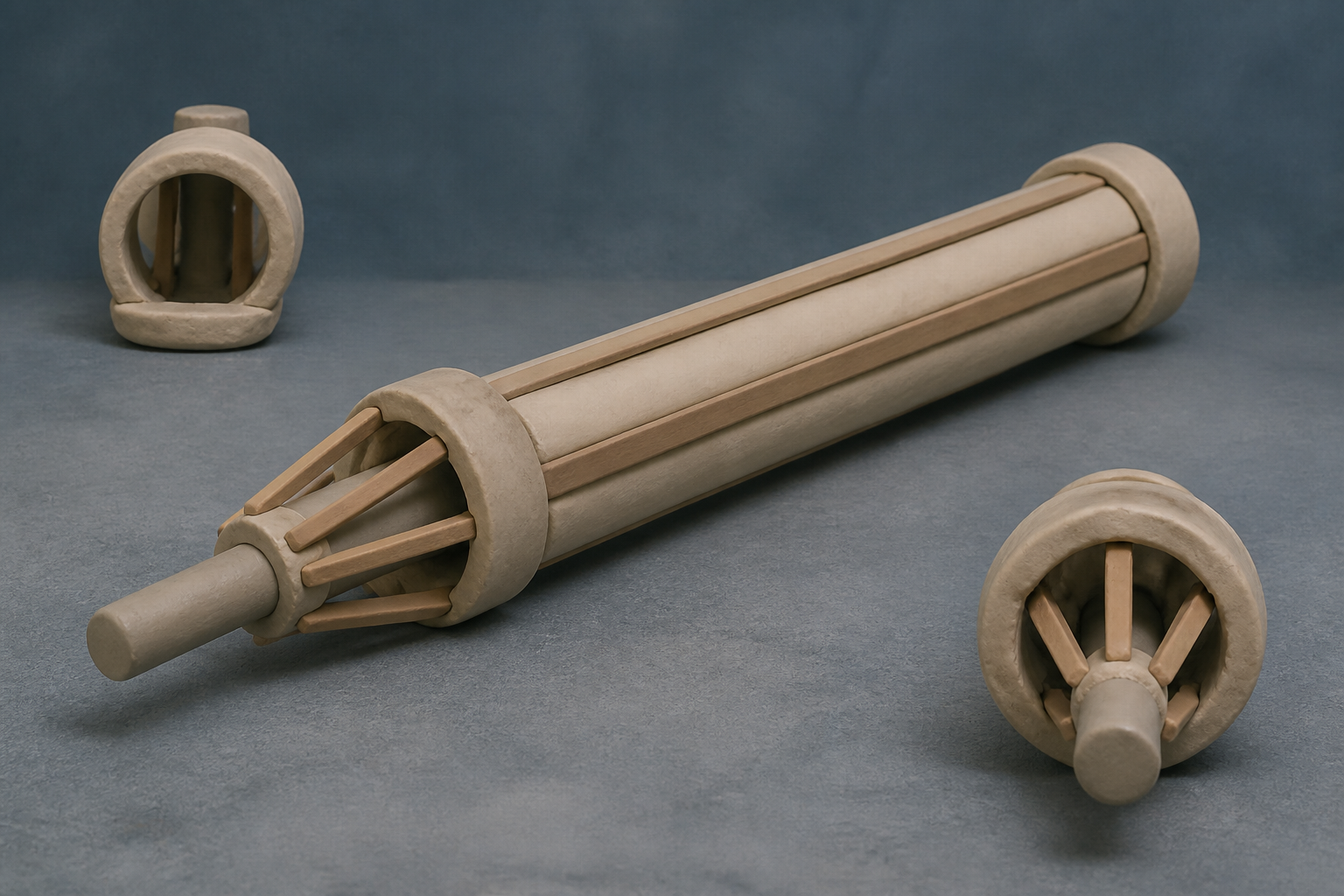
What changes in this design
Without further detail, a reader might picture a simple cover around the end of a medical scope.
This accessory is a tube that can widen outward. Its cover has inward-facing and outward-facing sides, with a piece of material harder than the cover placed between them.
The details show that this is more than a simple surface covering: it combines an expandable tube with a harder internal piece. What practical result those features are meant to achieve is not stated.
The cap that would not come out
A wrongly sized AmplifEYE cap detached inside a patient's sigmoid colon. Biopsy forceps, snares and baskets all failed to bring it back. The successful rescue used an inflated 20 mm esophageal balloon dilator, a procedure detail that makes a simple add-on feel considerably less simple.
That report concerns AmplifEYE, not Endocuff, so I would not turn one complication into a failure rate for every distal accessory. But the episode sets the terms for this story: anything clipped to the end of a colonoscope has to hold on, move through the body, and remain manageable if it does not. The U.S. patent publication that appeared on September 3 sits squarely inside that uncomfortable physical bargain.
Hinged arms at the tip
Figure 1 of US 2026/0256340 A1 shows a tubular collar surrounded by hinged, finger-like arms. It belongs to the Endocuff family, which uses the scope's tip to expose folds where adenomas can hide. This is not a new company's first attempt at the problem. It is another turn in a product line whose foundational U.S. patent trail reaches back to a May 2016 priority filing.
The clinical appeal is real. In 2016, FDA clearance let Endocuff claim improved adenoma detection after a study found a 14.7% increase. In a later 154-patient randomized tandem study, Endocuff Vision recorded a 6% adenoma miss rate, against 19% with plain cap-assisted colonoscopy. Yet the authors also reported that the device had to be removed in a small minority of technically difficult procedures. The result is impressive, but I think that removal note deserves equal billing: a cuff can help in the average case and still be the wrong tool in a hard one.
The March 2023 paperwork
Keymed (Medical & Industrial Equipment) Limited, Olympus's UK subsidiary, is named as applicant and assignee. The family claims March 2023 priority in Britain and the United States, moved through an international PCT filing in February 2024, entered the U.S. national phase in September 2025, and published on September 3, 2026. That is roughly three and a half years between the first priority applications and the document now open to public view.
Ownership matters here. Olympus acquired the Endocuff maker in 2020, completing control of the family, and the foundational patent received a U.S. grant in 2022. Under a 2021 infringement settlement, Medivators agreed to stop selling its competing AmplifEYE cuff after December 31 of that year. The family is not the only physical answer: another major supplier sells a non-arm attachment cap in six sizes for scopes 8.9 to 13.9 mm in diameter. That history makes me wary of calling this a fresh entrant. It looks instead like a well-defended franchise receiving another engineering revision.
A design firm credited with years of work on the original product reported that the Endocuff family had sold 5 million units by May 2024. It also claimed 49,000 colon cancers prevented and more than 9,500 lives saved. I could not independently verify those outcome estimates from the material I read, so they should be treated as company-side claims, not a settled measure of benefit.
Two ways to see a polyp
The case for a better view has grown sharper. A review puts the pooled tandem-colonoscopy adenoma miss rate at 26%, within a broader 20% to 30% range even for experienced endoscopists, and says missed lesions account for roughly half of interval cancers. Computer-aided detection offers another response: the same review reports a 66% relative reduction in adenoma miss rate versus standard colonoscopy.
Yet hardware and software may not be substitutes. Across 798 colonoscopies, GI Genius by itself showed no statistically significant detection improvement, while GI Genius used with EndoCuff was associated with small-adenoma detection rising from 36.3% to 52.1% and right-sided serrated-lesion detection rising from 12.3% to 24.8%. The reported p values were 0.01 and below 0.001. To me, that comparison makes the cuff less interesting as a lone product and more interesting as the part that lets a detection system see into the places it needs to judge.
What the filing is really betting on
US 2026/0256340 A1 is a mechanical refinement, not a report of a clinical result. Its described hardware is a radially expandable tubular body for a scope's distal shaft end, with a cover that has inner and outer surfaces and a stiffening member between them that is harder than the cover material. In plainer terms, it tries to tune the tradeoff exposed by the detached-cap case: something that expands around the scope while using a firmer internal structure to shape it.
Nothing in the published description establishes that this construction prevents detachment, reduces removals, or improves cancer outcomes. I do not read the filing as proof of any of those things. The narrower reading, for me, is that it seeks to preserve the useful parts of a decade-old cuff while addressing handling compromises documented across this kind of accessory.
That is the bet, and it is a modest one. If detection systems work best when a scope has a clean view of folded tissue, the valuable innovation may be neither the cuff nor the software alone, but the way the two give each other a chance to work. The patent is evidence of an established owner tending that connection, not evidence that it has solved it.
Sources
Reporting for this piece drew on the published filing and the references below.
- US 2026/0256340 A1 - Medical Scope Accessory
- Olympus Subsidiary Arc Medical Settles Patent Infringement Case, Medivators to Cease Sale of AmplifEYE
- Retrieval of dislodged AmplifEYE using balloon dilator during colonoscopy
- Reveal Distal Attachment Cap
- Olympus acquires Arc Medical Design, Endocuff devices
- Life saving medical product design
- Colonoscopy in the artificial intelligence era: Spotlight on adenoma miss rate
- Endocuff Vision misses fewer adenomas than cuff-assisted endoscopy
- GI Genius increases small and right-sided adenoma and sessile serrated lesion detection rate when used with EndoCuff
- Olympus ENDOCUFF Now FDA 510(k)-Cleared to Claim Improvement in Adenoma Detection Rate
The record, briefly. US20260256340A1, “Medical Scope Accessory” A medical scope accessory includes a radially expandable tubular body for a distal shaft end, with a cover defining inner and outer surfaces and a stiffening member between them that is harder than the cover material.
More angles on this
- Tracking Wireless Monitoring With Reduced Data Loss Questions the Default ArrangementAnother reading from the same A61B classification family, diagnosis; surgery; identification.
- System And Method For Emergency Dispatch Questions the Default ArrangementAnother reading from the same A61B classification family, diagnosis; surgery; identification.
- CPC A61B: Diagnosis; surgery; identificationThe official classification family this record was filed into, published in the USPTO Cooperative Patent Classification scheme.
- The Light Loop Inside an Oral-Care RoutineAnother reading from the neighbouring A61C classification family, dentistry; apparatus or methods for oral or dental hygiene.
- A Dishwasher's First Temperature QuestionAnother reading from the wider A47L classification family, domestic washing or cleaning ; suction cleaners in general.
Read around this one:Public patent recordUSPTO published figure