Objects
Tracking Wireless Monitoring With Reduced Data Loss Questions the Default Arrangement
As Masimo fights over wearable-monitoring patents, a new filing exposes a harder question: does more continuity make care safer?

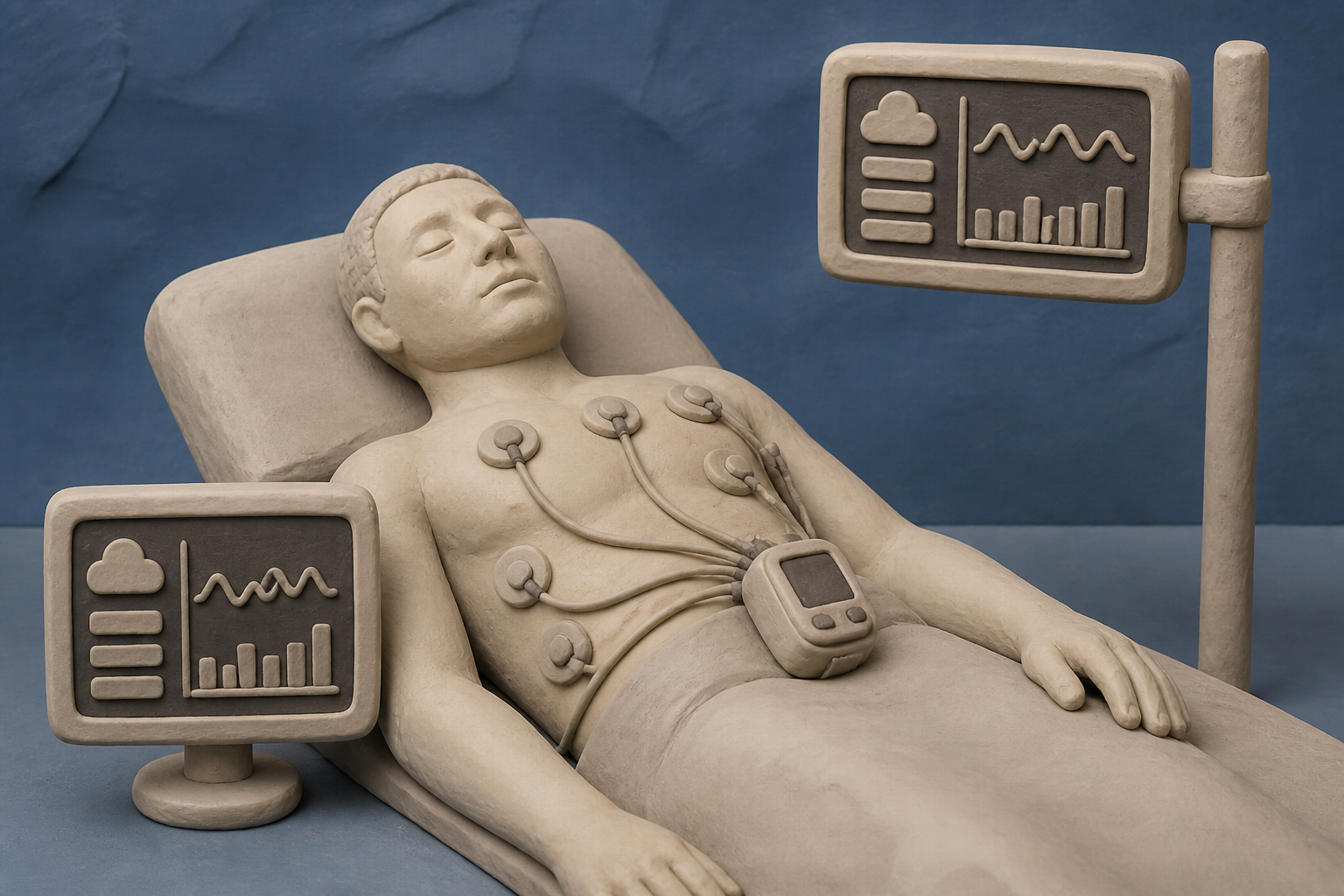
What changes in this design
The record does not spell out a usual alternative. A reader may picture current readings and earlier readings being viewed separately.
Instead, it accesses wireless setup information, establishes communication with a wearable device for live body-related readings, receives earlier readings, and generates one interface that combines the two. Its stated goal is to reduce a monitoring gap.
It is worth knowing because the focus is not solely on live information: earlier information is brought into the same interface. What the readings measure, how long a gap lasts, and how much it is reduced are not stated.
September 19, 2024
On September 19, 2024, Joe Kiani lost his seat on Masimo's board after a two-year proxy fight. That was not a quiet executive departure, which is why I began there: the vote redrew the company's leadership in public. That fight isn't, in my view, an explanation for an invention. But the fight sits oddly, I think, beside a problem of continuity: keeping a patient's record intact when a wireless connection changes.
The application is US20260255412A1, titled Tracking Wireless Monitoring With Reduced Data Loss. A listing names Masimo as assignee. The narrow technical proposition I read is this: access wireless configuration data, communicate with a wearable for real-time physiological readings, receive historical readings, and combine both in one interface. The intended result is a smaller monitoring gap during a transfer. A person can be moved while their record becomes discontinuous.
One missing transport record
The gap matters, as I see it. In a 2015 study of 184 trips moving patients within a hospital, 85 trips, or 46.2 percent, involved a mishap. The count included 30 oxygen-desaturation events and one cardiac arrest. A patient-transport review says monitoring gathered on the move routinely fails to return to the electronic health record. Those numbers don't prove this method would prevent harm. They do show that a missing stretch of data can sit inside an already risky moment.
Hospital transport is one setting where the design makes sense, though the filing is not framed as a transport-only system. Its proposed move is straightforward, as I see it: preserve the live signal, bring in the earlier record, and put the two in one interface. Its described goal is narrower than diagnosis: leave less of a patient's monitored history stranded between wireless systems.
Nearby wireless devices
Wireless handoffs are not just a software issue. The FDA's 2013 guidance tells medical-device makers to demonstrate that their wireless systems can coexist with others nearby, because neighboring devices can cause data loss or disruption. That gives this filing weight. A wearable may be collecting a physiological signal, yet the route to the display can be the weak point. The application is, in my reading, an attempt to make that weak point visible and recoverable.
But continuity and usefulness are different things. An unbroken connection can, I imagine, coexist with readings that are wrong, late, or too noisy to help a clinician. That distinction is my concern, not a claim made by the filing. A merged interface may make the history easier to inspect. It cannot, by itself, decide which alert deserves attention or whether another alert should have been generated at all.
Two Apple cases
Masimo is not merely a name on an assignment line. Its patents are part of a public fight over what a wrist-worn monitor can measure and who gets to sell it. On March 19, 2026, a federal appeals court affirmed a trade commission finding that certain Apple Watch models infringed two Masimo blood-oxygen patents, upholding a limited exclusion order. The reason I mention it is not to inflate this filing, but to place it in a company story where monitoring technology is disputed in court while new systems are being described.
Another dispute produced a $634 million jury verdict over Apple Watch heart-rate monitoring in November 2025. On July 21, 2026, the judge denied a new-trial request; Apple has said it will appeal. Neither result is, to me, evidence that this handoff method works or changes care. The results show, to me, how much can turn on the sensor, signal, and gap between records.
What the filing is really betting on
The filing is making, I think, two bets, but only one is in its technical reach. The first is that real-time readings and historical readings can be joined into a clearer view of a patient's monitored course. That is the practical value it seeks: fewer blank spaces during a transfer. The second bet is larger. It assumes that a more continuous record will help someone make a safer decision.
This is where I want to keep my confidence low. A review on alarm fatigue describes one medical center that logged more than 59,000 alarms in 12 days, published false-alarm rates from 72 to 99 percent, and limited evidence that reducing monitoring gaps or adding monitoring data improves outcomes. That isn't, to me, an argument for accepting data loss. It reads, to me, as a warning against treating continuity as clinical proof. This filing bets that a tidier handoff can become meaningful care. Until outcome evidence closes that loop, I see a sensible engineering response, not a settled safety claim.
Sources
Reporting for this piece drew on the published filing and the references below.
- US20260255412A1 - Tracking Wireless Monitoring With Reduced Data Loss
- US 2026/0255412 patent listing
- How Masimo's 20-year CEO was ousted by activist investors
- Adverse Events Can Happen Anywhere, Anytime, Including Patient Transport
- Wireless Medical Devices
- Federal Circuit Affirms ITC Finding That Apple Watch Infringes Masimo Blood Oxygen Patents
- Apple loses bid to overturn $634 million Masimo patent verdict
- Alarm Fatigue - Making Healthcare Safer III
The record, briefly. US20260255412A1, “Tracking Wireless Monitoring With Reduced Data Loss” A method accesses wireless configuration data, establishes wearable-device communication for real-time physiological data, receives historical physiological data, and generates an interface combining both data types to reduce a monitoring gap.
Identity details. The saved title-page transcription needs review, so names are not repeated here. Check the official published title page.
More angles on this
- Inside the haptic deviceAnother reading from the same G06F classification family, electric digital data processing.
- Medical Devices And Related Systems And Methods For Reducing Signal Treats the Relationship as the PointAnother reading from the same A61B classification family, diagnosis; surgery; identification.
- CPC H04W: Wireless communication networksThe official classification family this record was filed into, published in the USPTO Cooperative Patent Classification scheme.
- CPC A61B: Diagnosis; surgery; identificationThe official classification family this record was filed into, published in the USPTO Cooperative Patent Classification scheme.
- Apparatus And Method For Reorder Buffer With Sliding Window In A Treats the Relationship as the PointAnother reading from the neighbouring H04L classification family, transmission of digital information, e.g. telegraphic communication.
Read around this one:Public patent recordUSPTO published figure