Machines
The Light Loop Inside an Oral-Care Routine
A new Colgate-Palmolive filing can see more of a brushing session. The harder question is whether seeing more helps people clean better.

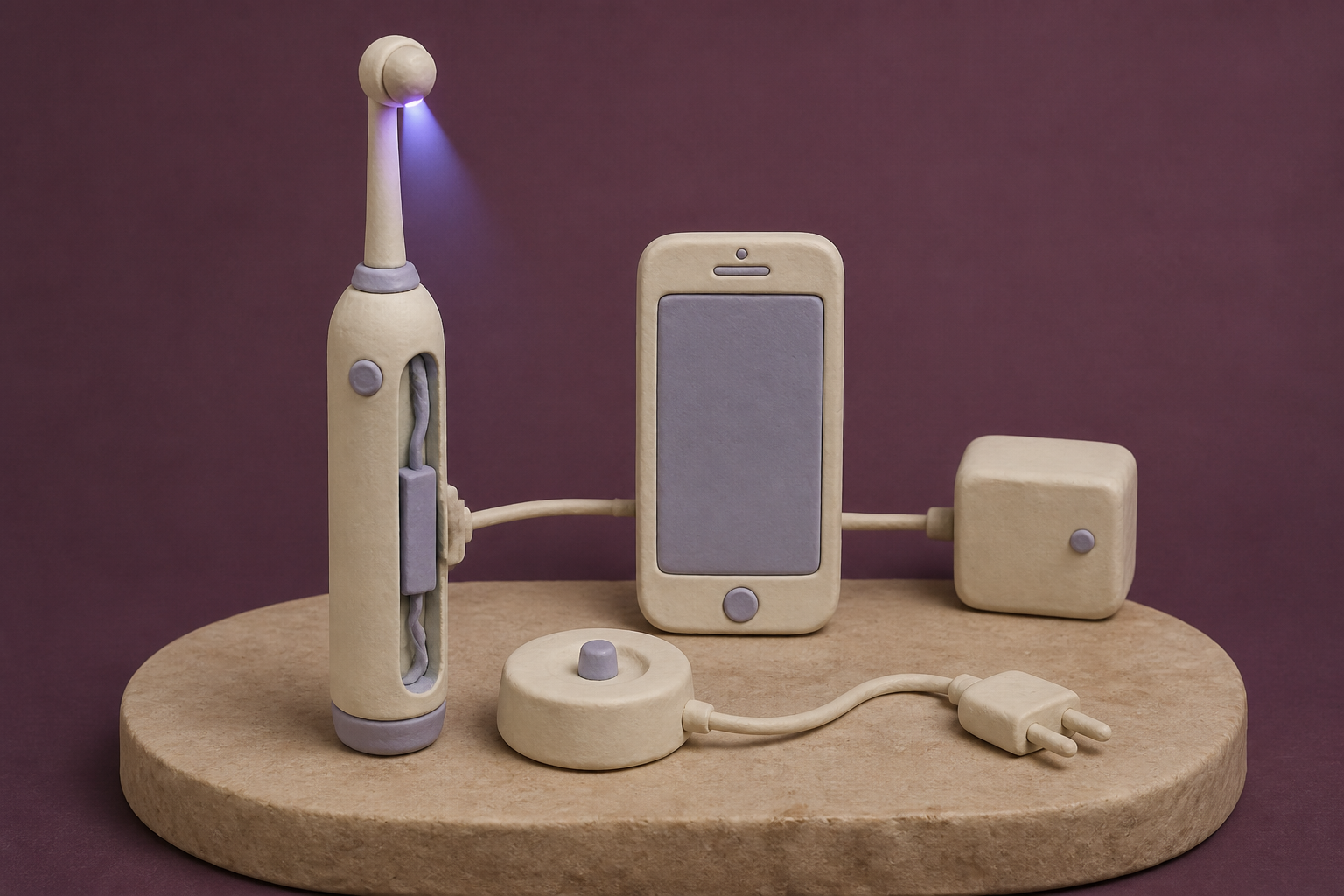
What changes in this design
What people ordinarily use to assess oral care is not stated, so a usual method cannot be established from this record.
This record says the item has a light source and an optical sensor, a part that reads light. It produces information from light reflected or fluoresced by organic matter. A processor can use it to characterize oral care and control a score or motor stroke frequency.
It is worth noticing that light supplies information used to characterize oral care. What the score represents, what exactly is measured, and how any result is used are not stated.
The 47.2% problem
Nearly half of U.S. adults aged 30 and older have some form of periodontal disease. At 47.2%, the figure makes the promise of a toothbrush that notices what a person misses feel less like accessory technology and more like an answer to a common problem. Among adults 65 and older, the share is almost 60%. Current smokers and men are affected at still higher reported rates.
At the sink, however, a careful-feeling two minutes cannot itself tell someone whether the technique was effective. That uncertainty is where a new patent filing earns attention. It does not just prompt a brushing session. It proposes to judge one as it unfolds.
Light on a brush
Filed April 21, 2026, and published September 3 as US 2026/0256275 A1, Colgate-Palmolive's application describes an oral-care device with a light source and optical sensor. The sensor collects light reflected or fluoresced by organic matter, while a processor characterizes oral care from that data. Its 20 claims link the sensing to tissue differentiation, a location-based oral-care score, and real-time adjustment of a motor's stroke frequency.
That last step changes the frame. The proposed system connects a sensed condition, a score, and a physical response from the device itself. The claim I found most revealing is not that light might flag organic material, but that measurement and motor control sit in the same loop. The brush is meant to become both observer and coach.
A 2017 starting point
This is not a sudden wager on a new trick. An earlier Colgate-Palmolive patent, filed in 2019 with a July 2017 priority date and granted in 2021, used 350-450 nm light to excite porphyrin compounds in oral bacteria and detected fluorescence in the 625-750 nm range to generate objective hygiene grades. Hrebesh Molly Subhash appears on both that earlier patent and the newer family.
An identically titled European family member, filed in 2021 with a 2020 priority date and published in 2023, adds deep neural-network processing of sensor data for powered-brushing control and feedback. My reading is that the new U.S. publication is a continuation-style filing in a long, multi-country technical effort, not a fresh breakthrough. A separate U.S. patent granted in 2025 to an unrelated small optics company describes violet-light fluorescence, an intraoral camera, and motion sensing to look for plaque and caries at home. That overlap shows competing work on detection, not a settled answer about outcomes.
The mirror test
The evidence for what feedback changes is less certain. Published research on the existing hum by Colgate connected brush included an 80-person randomized trial and a 159-person single-arm study. Users' perceived improvement rose sharply, but its correlation with objective brushing measures was described as close to zero. That divide makes me pause. Feeling improvement may matter to a user, but it is not the same metric as objective brushing performance.
A 20-person randomized study of a rival app-equipped electric brush found plaque-index improvement of 8.5% in the app group and 4.7% in controls. The difference was not statistically significant, with p=0.39, and the researchers concluded that the app added only marginally despite user satisfaction. I would not turn a small trial and perception findings into a verdict against connected brushes. But neither gives us a sound basis for saying that richer feedback, by itself, makes average brushers objectively better.
The FDA's 2024 line
In September 2024, the FDA classified a radiofrequency toothbrush as a Class II dental device, rather than the Class I status generally applied to ordinary powered toothbrushes. The decision required special controls including non-clinical performance testing, biocompatibility work, software validation, and label-comprehension studies.
Optical sensing is not radiofrequency treatment, and this filing does not establish how any eventual product would be regulated. Still, I take that decision as a useful boundary for my purposes. When a toothbrush claims to measure and alter care through complex hardware and software, its effects should be assessed rather than assumed.
What the filing is really betting on
US 2026/0256275 A1 is betting that the right signal, captured in the right place in the mouth, can turn a routine into a better decision. Its optical sensor, score, and adjustable motor put that proposition into technical form. The larger hypothesis is behavioral: that detection can produce guidance a person will understand, follow, and sustain.
The problem is large enough to deserve serious attempts. Global severe periodontal disease ranked 11th among conditions worldwide in the Global Burden of Disease Study 2016, while one review found WHO-tracked adolescent periodontal data in only 20 of 193 U.N. countries. What I cannot find in this patent family is proof that more sophisticated sensing closes the distance between what users feel and what their mouths need. Until outcome evidence catches up, my position is simple: treat this filing as an ambitious sensing program, not evidence that the average brusher will get a better result.
Sources
Reporting for this piece drew on the published filing and the references below.
- Oral Care System And Method For Promoting Oral Hygiene
- Oral care system and method for promoting oral hygiene - US 2026/0256275 A1
- US10980424B2 - Oral care evaluation system and process
- EP4167797A1 - Oral care system and method for promoting oral hygiene
- US12418710B2 - Smart toothbrush utilizing fluorescence and intraoral camera
- Impact of connected toothbrushes on patient perceptions of brushing skills and oral health
- Treatment Success and User-Friendliness of An Electric Toothbrush App: A Pilot Study
- Gum disease: By the numbers
- Global Prevalence of Periodontal Disease and Lack of Its Surveillance
- Medical Devices; Dental Devices; Classification of the Radiofrequency Toothbrush
The record, briefly. US20260256275A1, “Oral Care System And Method For Promoting Oral Hygiene” An oral care system includes a device with a light source and optical sensor that generates sensor data from light reflected or fluoresced by organic matter, allowing a processor to characterize oral care and control a score and/or motor stroke frequency.
Identity details. The saved title-page transcription needs review, so names are not repeated here. Check the official published title page.
More angles on this
- Inside brush, methodAnother reading from the same A46B classification family, brushes.
- Apparatus And Method For Vehicle External Communication Questions the Default ArrangementAnother reading from the same G06T classification family, image data processing or generation, in general.
- CPC A46B: BrushesThe official classification family this record was filed into, published in the USPTO Cooperative Patent Classification scheme.
- CPC G06T: Image data processing or generation, in generalThe official classification family this record was filed into, published in the USPTO Cooperative Patent Classification scheme.
- Where a Massaging Balm Applicator Makes Its Meeting Points ClearAnother reading from the neighbouring A61H classification family, physical therapy apparatus, e.g. devices for locating or stimulating reflex points in the body.
Read around this one:Public patent recordUSPTO published figure