Objects
Inside brush, method
One brush filing joins a long effort to remove toothbrush staples, while showing why cleaner fastening cannot solve plastic waste alone.

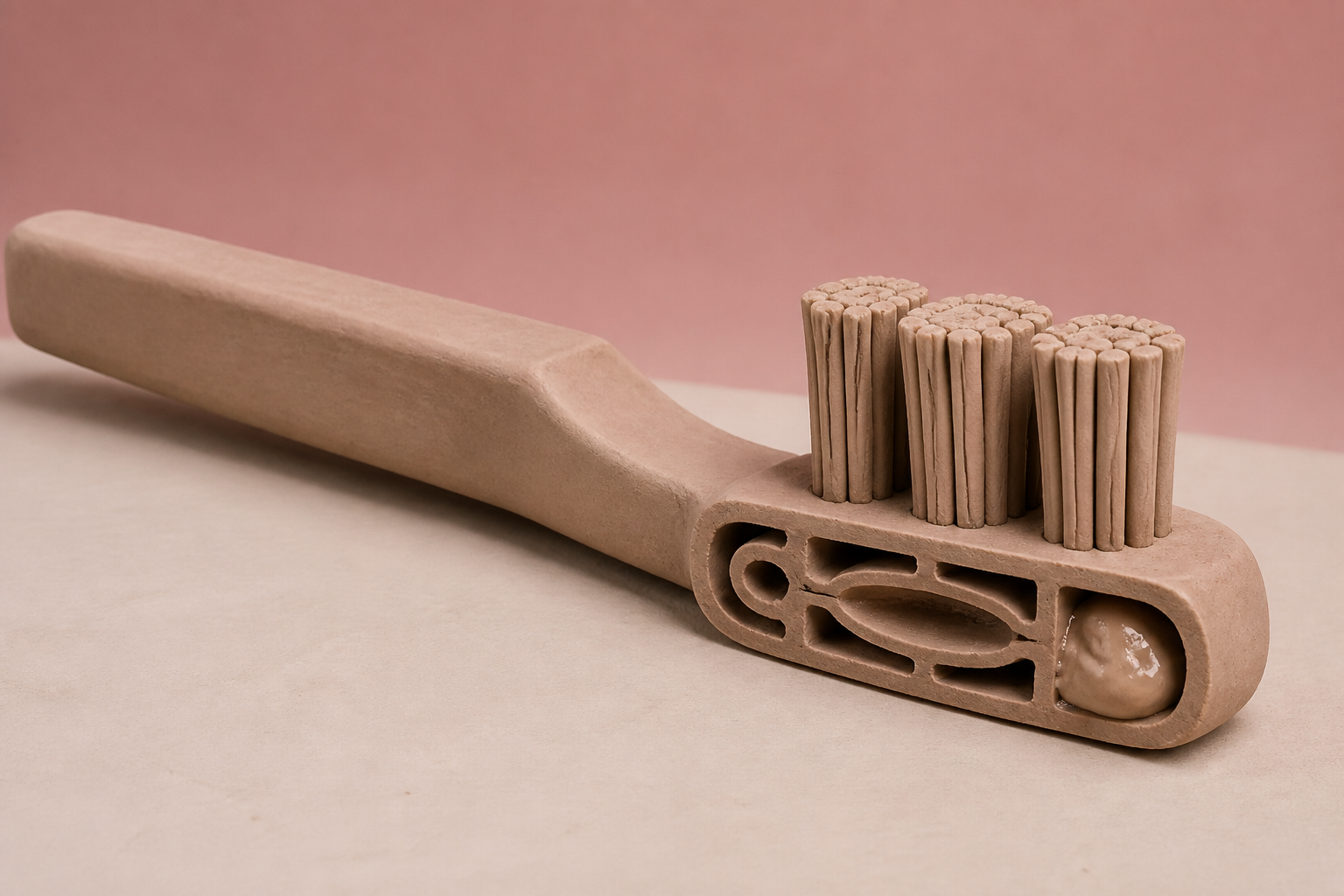
What changes in this design
A reader might picture bristles attached to a holder without knowing what happens inside the holder during the fastening step.
Here, the holder includes a recess. As the bristles are fastened, material from the ends used to attach them fills that recess, either partly or completely.
It makes clear that attention is paid to the holder's recess and to the material that fills it while the bristles are secured.
Fifteen newtons
Fifteen newtons is not a number many people carry into the bathroom. Under ISO 20126, a manual toothbrush's tuft-retention force must be no less than 15 N. Pull a bundle of bristles with that force and it should stay put. That modest threshold explains why the apparently simple toothbrush head contains a manufacturing problem that has kept machine builders busy for years.
The number gave me a useful way into US20260256274A1, a newly published U.S. application titled Brush, Method For Manufacturing Brushes And Brush-Manufacturing Device. It does not concern the bristles we see in the mirror so much as the joint underneath them. Its carrier has a receiving depression that is filled, completely or partly, with melted material from the fastening-side ends of the filaments as they are secured. The bristle material, in other words, becomes part of its own attachment.
The anchor beneath the tuft
A metal anchor has long been a practical answer, but it also makes a toothbrush more difficult to dismantle. That tension helps explain why a Boucherie application filed in 2012 described rear carrier openings that were funnel-shaped through more than 60 percent of the carrier thickness. Melted filament material could fill the shape and lock the tuft without a separate anchor. A later U.S. patent, US10362858B2, took another anchor-free route, widening carrier holes by deforming bristle-end portions and wall elements built into the carrier.
A later Boucherie family, rooted in a March 2019 priority filing, used sleeve-shaped receiving grooves deformed by heat and pressure into a mushroom-like mechanical lock, again without an added anchor. Zahoransky was pursuing the machine side at much the same time. Its 2012 filing described quartz-glass or ceramic receptacle sleeves for melt-fastening bundles, intended to avoid plastic bulges associated with older fusion approaches. To my reading, these are not isolated refinements. They are a sustained attempt to make the bristles and carrier do the fastening work once assigned to a separate piece of metal.
A receiving depression
US20260256274A1 belongs in that line, but it should not be awarded more than its public description supports. The depression is the detail to watch: a place in the carrier deliberately available to receive melted material from the bristle ends. That geometry will eventually have to be judged on retention, appearance, cycle time, and material use. From the public material, I cannot tell whether this particular joint is stronger, cheaper, easier to automate, or aimed at a common retail toothbrush.
The filing is about brushes broadly, and it does not promise curbside recyclability or make a claim about plastic shedding. That restraint matters to me. Recent machine-maker materials frame metal-free attachment as part of a much larger environmental promise, but a better hidden joint is only one part of the product people eventually throw away.
1,200 bundles a minute
That promise is still being worked out in factories. In April 2025, Zahoransky said its Z.ORCA and CUBE lines could be retrofitted to use plastic rather than metal anchors at the same tufting speed, up to 1,200 bundles per minute. It also said its EDGE machine, introduced in 2024, can make anchor-free mono-material toothbrushes. Those are company statements rather than an independent environmental verdict, but they show that the fastening question remains very much a live one.
A Zahoransky and Evonik prototype gives the uncertainty a sharper edge. The toothbrush was presented around PA12 as a route to single-stream recycling, yet its developers said it still used conventional metal anchors because of time constraints, with metal-free versions planned next. That detail stayed with me: even a purpose-built mono-material concept had not finished solving the join.
One market estimate put the global toothbrush category at USD 8.4 billion in 2025, with manual brushes accounting for USD 3.864 billion, or 46 percent. I would not use a forecast as evidence of environmental benefit, but it does explain why a hidden fastening method attracts so much patient engineering.
The harder half of the problem
Removing a metal anchor would fix only one mismatch inside a toothbrush. Recycling centers report that toothbrushes can stick and jam sorting machinery; even after staples are out, nylon-6 bristles and plastic handles are different materials that facilities generally cannot separate. A large account of the category estimates that a billion toothbrushes are discarded in the United States each year. If the world followed typical replacement guidance, it puts the global total at about 23 billion annually. Neither number proves what any one design will do, but the waste problem is much larger than the hidden anchor.
Then comes the problem this filing does not touch. A study described in reporting on simulated twice-daily brushing found microplastic release from every toothbrush tested, about 39 particles a day in that experiment. The concern there is the nylon or PBT bristle material itself, not the anchor beneath it. My conclusion is deliberately narrow: US20260256274A1 may help make a metal-free brush easier to manufacture, but the public filing does not show a recyclable toothbrush or a lower-shedding one. It is a move in the fastening race, not the finish line.
Sources
Reporting for this piece drew on the published filing and the references below.
- Brush, Method For Manufacturing Brushes And Brush-Manufacturing Device
- ISO 20126 - Manual toothbrushes
- Method of manufacturing a brush and brush (US10362858B2)
- Verfahren und Vorrichtung zum Herstellen von Bürsten sowie Bürste (WO2013050181A1)
- Method for producing a brush, bristle carrier and magazine (CN113453582A)
- Vorrichtung zum Herstellen von Bürsten oder Borstenwaren (DE102012005311A1)
- Machine portfolio easy to retrofit for toothbrushes with plastic anchor
- A Mono-Material Toothbrush by ZAHORANSKY and Evonik
- Toothbrush Market Size & Share, Statistics Report
- Your plastic toothbrush is a bigger problem than you realize
- How to Recycle Your Toothbrush
- You Swallow 39 Microplastics Every Time You Brush Your Teeth
The record, briefly. US20260256274A1, “Brush, Method For Manufacturing Brushes And Brush-Manufacturing Device” A brush and brush-production method use a bristle carrier with a receiving depression that, while bristle filaments are fastened, is filled completely or partially by melted material from the fastening-side filament ends.
More angles on this
- CPC A46B: BrushesThe official classification family this record was filed into, published in the USPTO Cooperative Patent Classification scheme.
- CPC A46D: Manufacture of brushesThe official classification family this record was filed into, published in the USPTO Cooperative Patent Classification scheme.
- Where a Massaging Balm Applicator Makes Its Meeting Points ClearAnother reading from the wider A45D classification family, hairdressing or shaving equipment ; equipment for cosmetics or cosmetic treatments, e.g. for manicuring or pedicuring.
- What a Platform Shoe Edge Can Teach About AlignmentAnother reading in the same Objects category on this site.
Read around this one:Public patent recordUSPTO published figure