Groundwork
A Cart Container at the Moment of Handoff
Device and Method are the useful handles: A storage container for a golf cart includes a bottom wall. It keeps the central design choice visible.

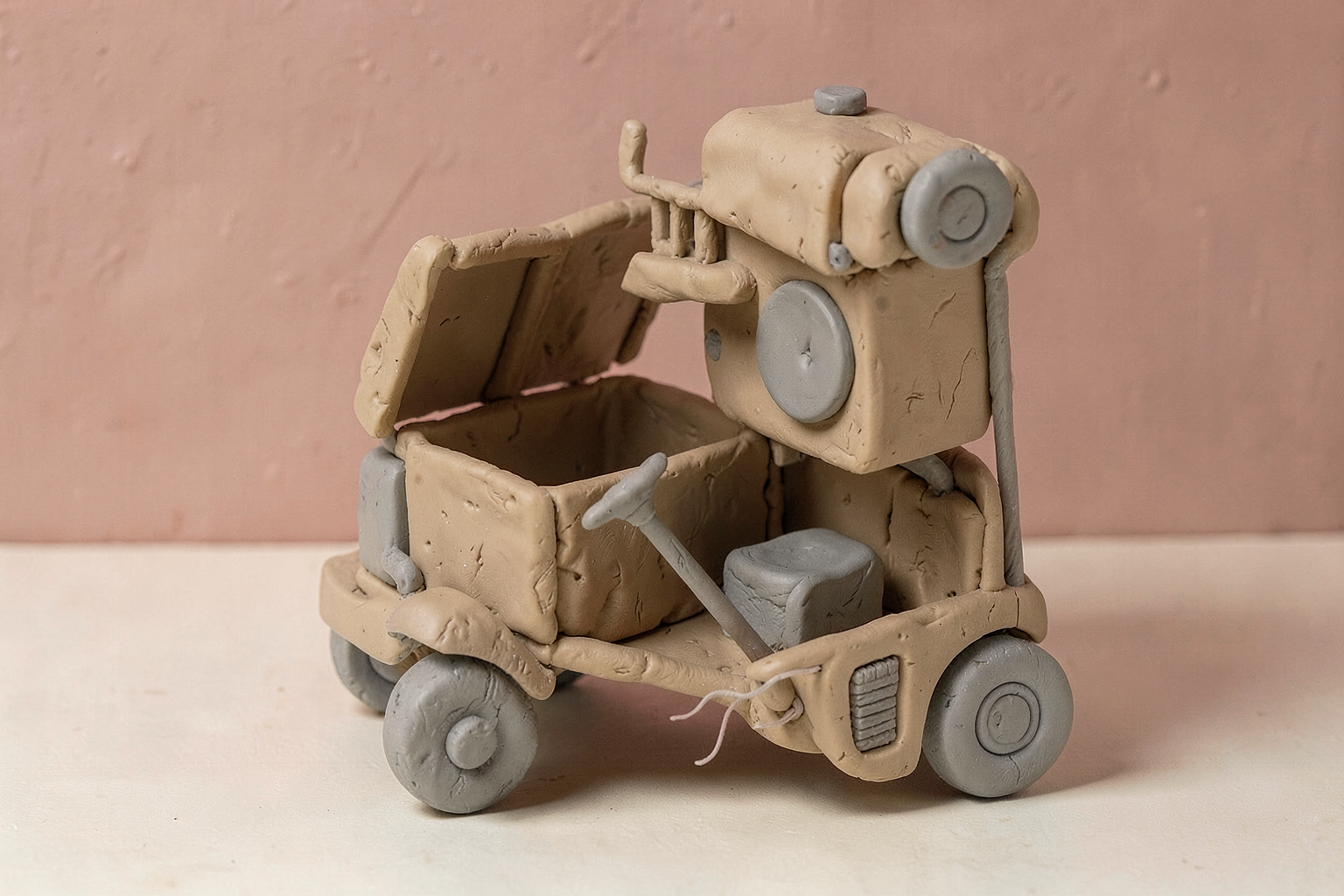
First, the setting
On a golf course, people spend long stretches outdoors moving from place to place in a small cart. They bring personal belongings and playing gear that need somewhere to rest instead of rolling around, getting lost, or sitting exposed to sun and weather.
A golfer or companion climbs into a cart with a phone, gloves, and small personal items. Near the seats, a lidded organizer is attached to the cart, with separated spaces for belongings. During the ride along the path, someone can reach for an item while the cart moves between shots.
What changes in this design
A reader might expect personal items and golf accessories in a cart to be carried loose or kept in whatever separate storage is available.
Here, a single container has a bottom and surrounding wall, a pivoting lid, dividers that form compartments, a wireless charger, and a magnetic mount for a metallic part of the cart.
That helps explain the mix of box-like storage features and electronics: it combines item storage, device charging, and coupling to the cart in one container.
The Lid Begins the Handoff
A pivotable lid above a bottom wall and perimeter wall is the physical detail that catches the eye first. Ordinary objects become interesting when a human routine changes hands: you set something down, close a cover, and expect the next moment to be easier. In US20260263882A1, published September 10, 2026, that modest sequence is framed around a storage container for a golf cart. The first picture is not a grand machine but a bounded place, with a lid that can swing open or shut and walls that set an edge around what it holds. That restraint made me look twice, because the handoff begins before any accessory earns its separate role.
That early handoff brings the terms into focus. The published record is titled Storage Container For Storing Personal Items And Golf Accessories In A Golf Cart And Method Therefor; its words for personal items and golf accessories matter because they leave the contents human-sized rather than turning them into a generic cargo category. A bottom wall is the base; a perimeter wall is the boundary that runs around it; a pivotable lid is a cover that can move on a pivot. The filing describes dividers, which are internal separators that create compartments. In that language, the container does not merely receive things; it gives them an order before the cart becomes their temporary address. A container with named walls has the air of a tiny front desk, quietly deciding where the day is allowed to wait.
Parts With Separate Jobs
Once the terms have set the scene, the mechanism matters because each described part performs a distinct handoff. The dividers create compartments, so the broad interior is turned into smaller spaces. A wireless charger, meaning a component that charges a device without a cable connecting the device to it, is included to wirelessly charge a device. A magnetic mount, meaning a holder that couples magnetically, couples to a metallic portion of the cart. These functions do not need to be made more mysterious than they are: separation, charging, and coupling are named one after another. The dividers have the air of a librarian quietly insisting that unrelated things stop leaning on one another. What I noticed is the timing: a personal item can be placed, a device can be charged, and the mount can make its coupling to the cart, all within one described container arrangement.
One Container, Several Relationships
Because those roles arrive in sequence, the stated purpose comes into view without a detour. The filing describes a storage container for storing personal items and golf accessories in a golf cart, not simply a box with a lid attached after the fact. Its bottom wall and perimeter wall establish the place; its pivotable lid provides a moving boundary; its dividers form the compartments; its charger and mount take up the device and cart-side relationships. The consequence appears first: an item, a device, and the cart do not have to be treated as the same kind of problem. The broader design question follows: when an ordinary object collects several routines, should one large space absorb them all, or should the arrangement show where each handoff belongs? The filing is worth your attention for making that question visible in physical parts.
That question also clarifies the comparison that belongs here. A generic container gives you capacity, but the described arrangement makes relationships visible: dividers relate contents to compartments, the charger relates a device to charging, and the magnetic mount relates the container to a metallic cart portion. The charger behaves less like a decorative feature and more like a patient dock waiting for a device. The magnetic mount is a small stage manager, keeping its coupling to a metallic cart portion in the visible cast. Neither comparison promises a result beyond the filing; each simply marks a relationship that the parts are described as carrying. The contrast is therefore not between a clever object and an inferior one. It is between a single undifferentiated holding space and a container that assigns several handoffs to identifiable components.
From that contrast, two transferable observations settle into place. First, a design can make a routine easier to understand by turning a vague inside into visible compartments, rather than asking every object to negotiate one shared space. Second, an added function earns its place when its handoff is clear: the charger is for a device, and the mount is for coupling to the cart's metallic portion. I think that is the modest lesson behind the arrangement, not a claim that every container must become a control room. The described parts behave more like a polite committee than a pile of belongings, each taking one agenda item and leaving the others alone. You may find the container's interest lies precisely there, in the refusal to make storage, charging, and mounting pretend they are one task. Return, then, to the pivotable lid above the bottom wall and perimeter wall: the small physical detail opens onto a routine that has already been given somewhere to go.
The record, briefly. US20260263882A1, “Storage Container For Storing Personal Items And Golf Accessories In A Golf Cart And Method Therefor” A storage container for a golf cart includes a bottom wall, perimeter wall, pivotable lid, dividers, wireless charger, and magnetic mount. The dividers create compartments, the charger wirelessly charges a device, and the mount couples to a metallic cart portion.
More angles on this
- The Restless Padding Problem and the Ring of TensionAnother reading from the same A63B classification family, apparatus for physical training, gymnastics, swimming, climbing, or fencing; ball games; training equipment.
- When a Smoking Substitute Device Takes the First LookAnother reading from the same H02J classification family, electric power networks.
- CPC A63B: Apparatus for physical training, gymnastics, swimming, climbing, or fencing; ball games; training equipmentThe official classification family this record was filed into, published in the USPTO Cooperative Patent Classification scheme.
- CPC A45C: Purses; luggage; hand carried bagsThe official classification family this record was filed into, published in the USPTO Cooperative Patent Classification scheme.
- The Fuse That Gets Told When to Blow: A Fire Prevention Filing for Electronic Control UnitsAnother reading from the neighbouring H02H classification family, emergency protective circuit arrangements.
Read around this one:Public patent recordUSPTO published figure