Machines
Concentric Clearances and the Thermal Absorption of Wave Energy
System and Key detail form one stated connection: A wave energy apparatus has a source with a cylindrical hole and cylindrical susceptor.

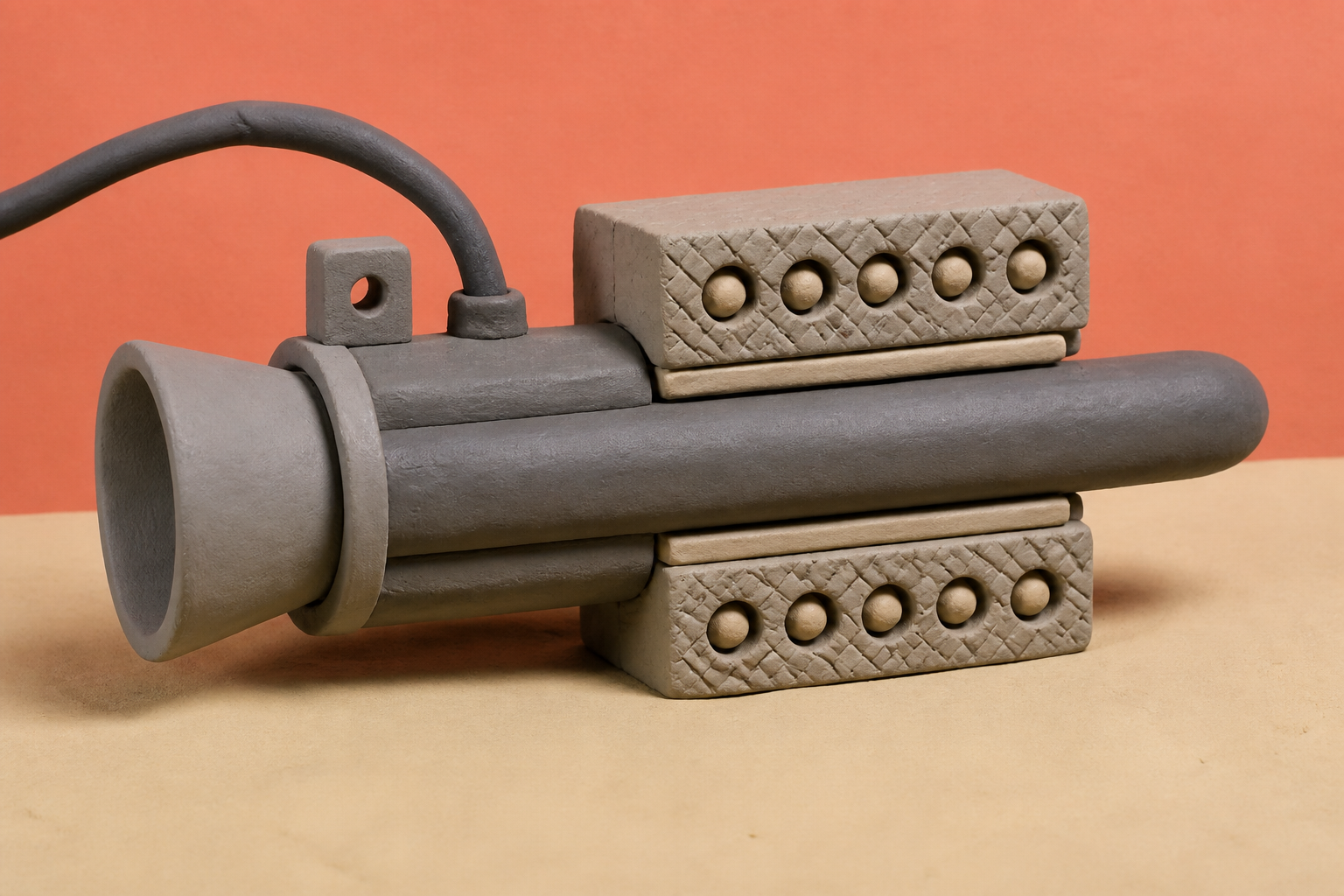
First, the setting
Many everyday tools use invisible energy to warm, dry, cure, or prepare materials without placing a flame directly against them. In kitchens, workshops, and manufacturing spaces, people care about controlled heating because materials can be sensitive, surfaces can be hard to reach, and workers need a practical way to manage heat.
In use, equipment of this kind may sit inside a shielded work area, with a technician placing a part or material near an enclosed energy source. The material warms as the system runs, while nearby workers watch controls, handle protective fixtures, and wait for the piece to cool before moving it to the next step.
What changes in this design
Without more detail, a reader might simply expect wave energy to be captured by some collector and put to a use. The location and shape of the absorbing part would be unclear.
Here, the absorbing part is cylindrical and works beside a cylindrical opening. Their opposing walls are separated by a gap, and the absorbing part converts the generated wave energy into heat.
It gives readers a concrete way to recognize the setup: a cylindrical absorbing part and cylindrical opening separated by a gap. The gap’s size and its effect on heat are not stated.
Concentric Walls and the Space Between Them
Picture a smooth cylindrical tunnel bored straight through an energy source, with a second cylindrical body suspended inside that cavity. If you have spent time around heavy machinery, your instinct is probably to expect interlocking teeth or sliding gaskets designed to force parts together. This wave energy apparatus, published as US20260262141A1 on September 3, 2026 under the title Wave Energy Systems, takes a contrary route by refusing physical contact. Instead of pressing its components into mutual friction, the application describes a deliberate separation where an outside wall and an inside wall face each other across an open gap. The inner cylinder sits within that bore less like a driven piston and more like a calm librarian guarding an exact perimeter of silence. That visual contrast immediately caught my attention in the published record. By stepping back from direct contact, the geometry establishes a quiet boundary where waves travel freely without grinding moving joints to pieces.
Understanding why this separation exists requires looking closely at the vocabulary the filing relies on to explain its core arrangement. The application centers on what it designates as a source with a cylindrical hole and a cylindrical susceptor nestled inside it. In plain language, a susceptor is an absorbing material engineered to intercept wave energy and convert that intercepted energy directly into heat. Rather than attempting to harvest energy by forcing a shaft to turn, the apparatus treats incoming waves as something to be caught and thermalized. The source generates wave energy, and the cylindrical susceptor waits inside the bore to take up that load. The deliberate air space between the outside wall and the inside wall has the air of a meticulous clipboard inspector who refuses to let two neighboring surfaces touch under any circumstances. I find myself lingering on the strict circular clearance that keeps those two boundaries apart. The filing positions the absorber inside the hole and lets conversion happen across the dividing margin.
Making Spatial Clearance an Inspectable Boundary
Because the inner cylinder never brushes the surrounding bore, mechanical friction ceases to be the governing crisis of the apparatus, allowing you to evaluate the whole system as a problem of deliberate spatial clearance. When you picture the cross-section of this assembly, the entire interaction resolves into two concentric circles separated by a quiet annular void. What becomes visible is not a battle of opposing surfaces, but a disciplined relationship between an emission boundary and an absorption target. That void provides inspectable room where an observer can evaluate tolerances without dismantling a tight press-fit. In many conventional machines, the moment two functional bodies interact, their interface disappears into a dark seam where stress accumulates unnoticed. Here, the gap between the outside wall of the inner core and the inside wall of the outer source remains distinct and visible. This configuration leaves significant space for design judgment, because you can adjust how energy radiates simply by altering that ring of clear air.
Converting Wave Disturbance into Steady Thermal Heat
That structural visibility clarifies the precise mechanism by which the published record handles incoming energy. As the source produces wave energy within its cylindrical cavity, those waves traverse the open buffer zone and strike the outer face of the cylindrical susceptor. The susceptor does not reflect the energy back into the chamber or convert it into electrical potential through wiring; it absorbs the generated wave energy and translates it straight into heat. Because the outside wall of the susceptor never touches the inside wall of the source, thermal transfer back into the generating structure is governed by that spacing rather than through direct conduction. Converting incoming wave motion into plain warmth inside a suspended cylinder operates as if a patient stage-manager decided the loudest performance in the theater should conclude in an empty dressing room. The wave energy does its work within the material itself, raising its temperature while the surrounding gap prevents the receiver from binding against the source.
The broader purpose of turning wave energy into heat rather than immediate mechanical motion reveals an intentional strategy for handling erratic dynamics. Wave inputs in real-world systems are notoriously uneven, prone to sudden surges and lulls that batter rigid transmissions into premature failure. By electing to convert that energetic surge into stored heat within a cylindrical susceptor, the apparatus creates an intermediate thermal reservoir that buffers the incoming flux. Heat does not demand instantaneous synchronization the way a rotating axle does; it simply accumulates and dissipates under steady physical laws. I cannot easily dismiss how much discretion this simple boundary affords the surrounding architecture. Because the thermal sink is isolated inside the cylindrical bore by a clear gap, an engineer retains the latitude to decide how and when to extract that accumulated heat without threatening the physical integrity of the wave generator. The design separates wave capture from thermal management, establishing a forgiving operational margin.
Looking at this apparatus from a wider design perspective leaves you with two concrete lessons that apply far beyond wave conversion. First, isolating an energetic exchange inside a physical gap demonstrates the value of decoupling source and receiver; when you separate the generator from the collector across open air, you prevent localized thermal buildup from destabilizing the primary source. Second, converting volatile, high-frequency energy directly into heat shows that dampening an erratic input into a slower thermodynamic medium is often much sturdier than attempting to match every oscillation with moving hardware. Systems gain resilience when designers resist the urge to lock components together in rigid physical contact. You can see the quiet strength of that philosophy by returning your attention to that simple bored cylinder, where a suspended core and a clean ribbon of open air do the patient work of turning wave energy into warmth.
The record, briefly. US20260262141A1, “Wave Energy Systems” A wave energy apparatus has a source with a cylindrical hole and cylindrical susceptor, with a gap between an outside wall and inside wall; the susceptor absorbs generated wave energy and converts it to heat.
More angles on this
- The Moment a Remediation System Hands OffAnother reading from the same C02F classification family, treatment of water, waste water, sewage, or sludge.
- A Segment That Cools And A Segment That Carries FlavourAnother reading from the same H05B classification family, electric heating.
- CPC H05B: Electric heating; electric light sources not otherwise provided for; circuit arrangements for electric light sources, in generalThe official classification family this record was filed into, published in the USPTO Cooperative Patent Classification scheme.
- CPC C02F: Treatment of water, waste water, sewage, or sludgeThe official classification family this record was filed into, published in the USPTO Cooperative Patent Classification scheme.
- Dual-Chamber Electronic Device Makes a Small Case for Better TimingAnother reading from the neighbouring H05K classification family.
Read around this one:Public patent recordUSPTO published figure