Objects
Dual-Chamber Electronic Device Makes a Small Case for Better Timing
A Taiwanese inventor splits a curbside control box in two, but the faults that sank earlier sensor networks live well beyond its seal.

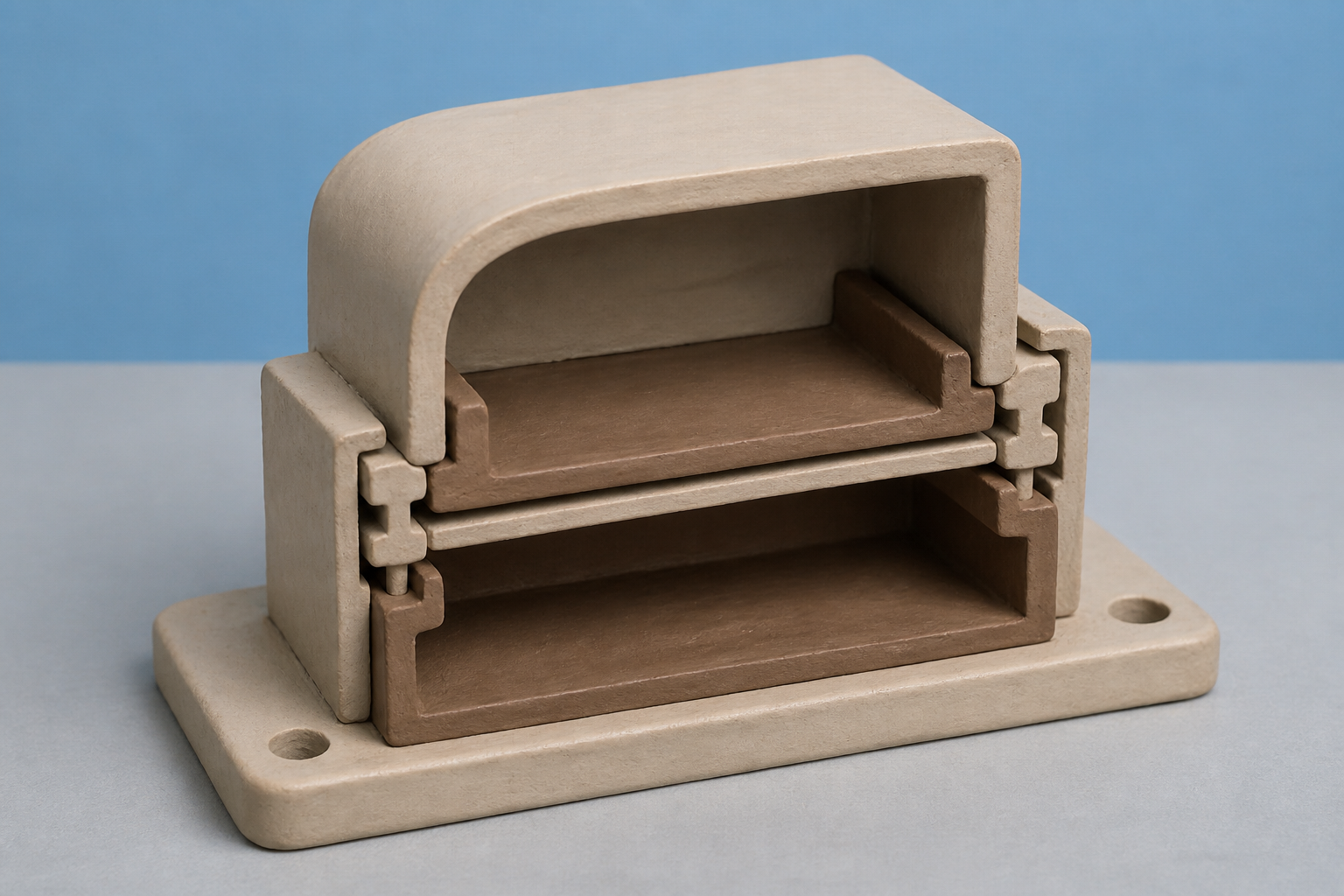
What changes in this design
Without more detail, a reader might picture an electronic item as a single, closed case whose pieces do not change position.
Here, the case is divided into a lower base and an upper mount section. The upper section has an upper cap and detachable connectors, and it can either touch the base at its bottom wall or be separated from it.
The moving gap is the central visible idea: the same two-part item has a contact state and a separated state. That gives a reader a clear way to recognize what this patent focuses on, even though its intended use is not stated.
Three dark districts
On August 1, 2013, data went dark in San Francisco's Richmond, Union, and West Portal districts. The city's parking-sensor report covered 11,917 sensors across 8,228 spaces, and it found that failures had begun arriving roughly a year ahead of schedule. By November 2012, a few hundred sensors a month were failing. Designed battery life had fallen from five years to about three after noise-filtering software was added; electrical interference from trolley and light-rail DC current also impaired detection.
The number that stays with me is not the sensor count but the failure rate: hundreds per month in a network meant to make parking legible. A curbside device has to endure weather, road grime, power noise, replacement work, and the small indignities of being installed where nobody wants to spend much time fixing it. That failure catalogue is why I think a new enclosure patent deserves attention, even if it is only trying to solve one part of the problem.
A box built in Taichung
US 2026/0259481 A1, filed January 20 by Taichung inventor Che-An Liu, proposes a dual-chamber electronic device for mounting to a curbstone. Liu claims priority from a Taiwan application filed March 3, 2025. No company is listed as applicant or assignee. The filing describes the sort of curbside control box that has to be opened for maintenance, with each opening creating another chance for water to enter.
The design divides that box in two. A base holds a lower chamber and two fixed connecting members; a detachable mount seat carries an upper chamber, cap, and two matching connectors. Its bottom wall can meet the base or separate from it. The practical pitch is independent service: components with different maintenance schedules can be reached without opening the whole enclosure. Yet I can see this as an effort to reduce maintenance exposure, not an attempt to reinvent the sensor network itself.
New Taipei's roadside bet
That distinction matters in Taiwan, where smart-curb hardware is still being built out at scale. New Taipei launched a 2024 pilot using 3,471 geomagnetic road sensors across 122 roadway stretches in four districts, alongside street-side cameras tied to parking-payment enforcement. The program was presented as a pilot intended for expansion, rather than a finished public utility.
The spending behind the category is substantial. Over eight years, the city reported NT$20.64 billion, approximately US$640 million, spent on 314 smart-parking sites and 14,459 spaces, with a plan to integrate 30,000 roadside spaces by 2027 using AI and data analytics. That scale makes me less willing to dismiss a modest mechanical improvement. Thousands of boxes create thousands of occasions for a repair crew to open one.
Water between service calls
The patent's concern is concrete. A single chamber can force a technician to expose every component when only one needs attention, and every opening can compromise the enclosure's defense against water. Splitting the work into upper and lower chambers could mean fewer full-box openings. The water risk I want to keep in view, though, is not solved merely by adding a second compartment and a pair of detachable connections.
Outdoor enclosures are judged against demanding ingress tests. IP66 involves a 100-liter-per-minute water jet at 100 kPa from three meters away for at least three minutes. IP67 calls for surviving one meter of submersion for 30 minutes. The filing presents a maintenance arrangement, not a demonstrated rating against either test. Its value would depend on whether the new joints, caps, and routine service preserve the protection the device needs in the street.
The harder half of the problem
The enclosure has a sensible target, but past smart-parking systems point elsewhere too. Batteries wear down. Electrical noise muddles readings. Crews must dig into pavement or revisit equipment. A trade guide on curb management reports that Bosch and Nedap, once leading makers of ground and curb sensors, stopped producing them because the format had become cumbersome to install and maintain. It puts ground-sensor accuracy at about 85 percent and contrasts one-space coverage with camera or LIDAR systems that can cover 10 to 100 spaces per unit.
Those figures should be treated as an industry argument, not a universal measurement. Still, the direction fits the old San Francisco field evidence: a better seal does not lengthen batteries, silence rail interference, or change the cost of touching one device per parking space. The gap, I think, is the real story around Liu's filing. The patent may make a curbside box easier to service and less often opened, which is a worthwhile improvement. I come away unconvinced that it reaches the harder half of smart-curb reliability: whether the underlying roadside hardware remains economical and dependable enough to keep deploying at all.
Sources
Reporting for this piece drew on the published filing and the references below.
- US 2026/0259481 A1 - Dual-Chamber Electronic Device
- New Taipei to launch smart roadside parking inquiry system
- New Taipei celebrates parking space expansion milestone
- SFpark Parking Sensor Data Guide
- Complete Guide to Parking Sensors for Smart Parking and Curb Management
- The Mysteries of IP65, IP66, and IP67 Rated Enclosures Explained
The record, briefly. US20260259481A1, “Dual-Chamber Electronic Device” A dual-chamber electronic device has a base unit and a mount seat unit. The base has a lower chamber member and two fixed first connecting members; the mount seat has an upper chamber member, upper cap, and two detachable second connecting members, and moves between states where its bottom wall abuts or does not abut the base.
More angles on this
- Thermal Imaging Camera Device Makes the Next Move Easier to SeeAnother reading from the same G03B classification family, apparatus or arrangements for taking photographs or for projecting or viewing them.
- A storage medium with two bosses, and the address that has to survive the handoffAnother reading from the same H05K classification family, printed circuits.
- CPC G03B: Apparatus or arrangements for taking photographs or for projecting or viewing themThe official classification family this record was filed into, published in the USPTO Cooperative Patent Classification scheme.
- CPC H05K: Printed circuits; casings or constructional details of electric apparatus; manufacture of assemblages of electrical componentsThe official classification family this record was filed into, published in the USPTO Cooperative Patent Classification scheme.
- A Segment That Cools And A Segment That Carries FlavourAnother reading from the neighbouring H05B classification family, electric heating.
Read around this one:Public patent recordUSPTO published figure