Machines
Thermal Imaging Camera Device Makes the Next Move Easier to See
A patent application mounts a thermal sensor on a spinning turntable, but physics and mechanical wear make a full circle harder than it looks.

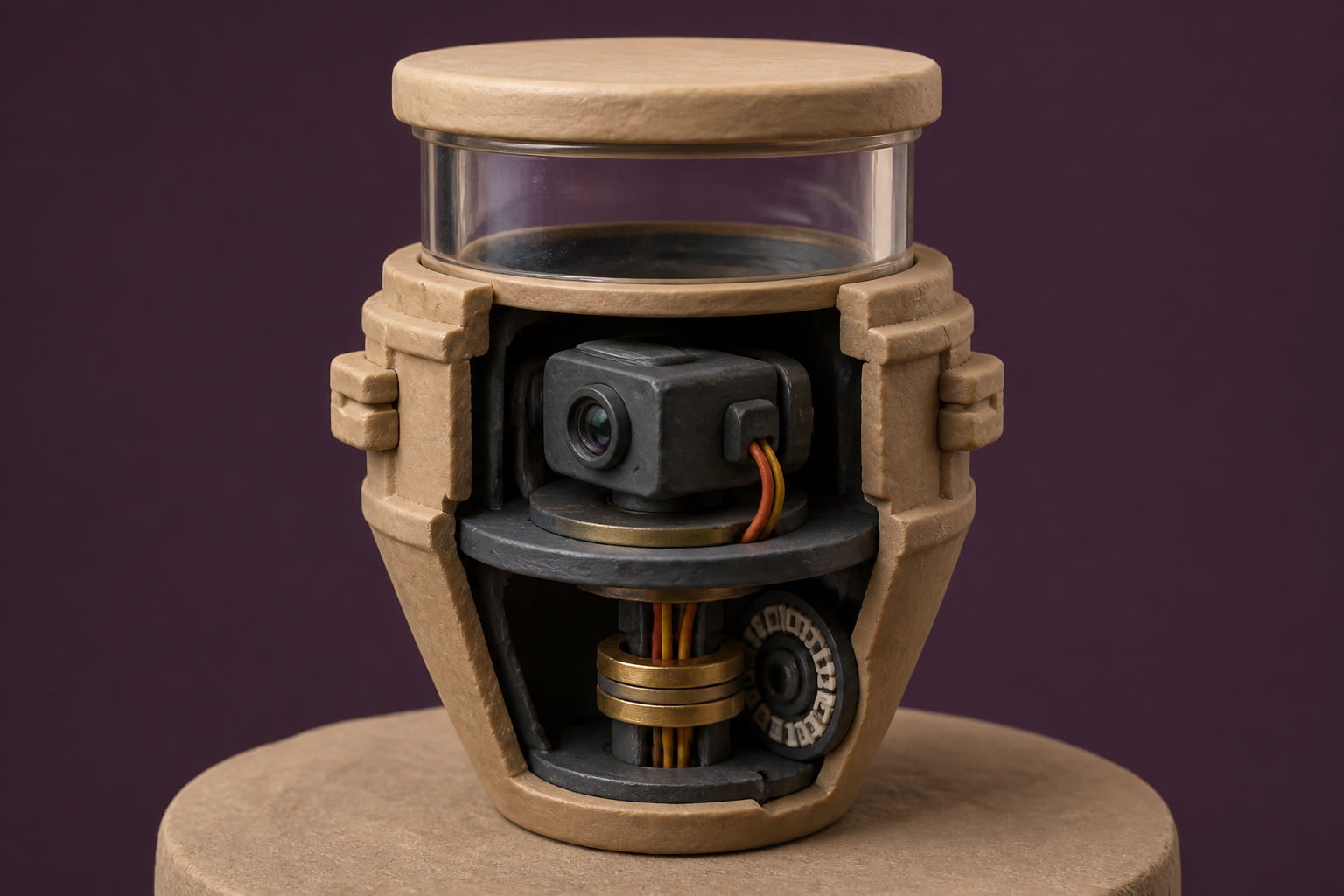
What changes in this design
Most rotating cameras have limited turning ranges or must stop and reverse direction because standard wiring would wrap tightly around the moving frame and snap.
The camera feeds its wires straight through the middle of the turning motor to a slip ring, enabling unbroken 360-degree rotation while an encoder tracks its angle.
Continuous full-circle rotation allows an uncooled thermal camera to scan surroundings seamlessly in any direction without catching or tangling its electrical connections.
The memory of heat
In 1992, the United States declassified a thermal sensor developed two decades earlier under a classified Honeywell defense contract. The core innovation was the uncooled microbolometer, a microscopic bridge suspended above silicon that warms when long-wave infrared radiation strikes it. Today, vanadium oxide accounts for roughly 70 percent of that market, with pixel dimensions that shrank from 45 microns down to 12 and 6. But microbolometers share an inescapable physical quirk: they do not reset instantly. They take between 8 and 15 milliseconds to cool down after absorbing heat.
When I look at the physical limits of thermal imaging, the problem usually isn't optics; it is time. If you move the sensor too quickly across a dark field, a hot vehicle leaves a smear behind it. The camera's pixels retain thermal memory, creating motion blur that ordinary sharpening routines can't easily undo without running complex pixel-wise inverse solvers.
Putting a cold eye on a turntable
Standard perimeter security setups rely on pan-tilt-zoom cameras that swivel back and forth, but they suffer from blind spots while turning. To watch an entire perimeter at once, commercial systems like HGH Infrared Systems' Spynel-U spin an uncooled sensor continuously at half a revolution per second, spotting human movement up to two kilometers away.
A recent patent application, published under number US20260259083A1 with the title Thermal Imaging Camera Device, tries to simplify this spinning geometry. The design pairs an uncooled thermal sensor with a rotary actuator, a rotary encoder to track angular position, and a slip ring. All the sensor wiring passes straight down through a central through-hole in the actuator, letting the sensor turn a full 360 degrees relative to a stationary base without winding its cables into knots.
What caught my eye in the patent filing is how straightforward the mechanical drawing looks. Instead of building an elaborate gantry, it stacks the motor, encoder, and slip ring along one central axis.
The noise inside the brass ring
The catch sits in the slip ring. Passing power and video signals across a rotating interface requires physical brushes sliding over metal rings. Over months of continuous rotation, those brushes wear down, shedding conductive carbon debris and introducing fluctuating contact resistance.
That wear is hazardous for thermal imagers. Microbolometers produce tiny micro-volt shifts in electrical resistance, and their readout integrated circuits are tuned to detect temperature differences below 100 millikelvins. Looking through the readout circuit literature, we find sensors measuring voltage shifts so slight that a minor spike in brush resistance can corrupt the signal.
I doubt a sliding mechanical contact can keep micro-volt signals clean over years of uninterrupted 360-degree rotation without regular cleaning or costly gold-alloy brushes.
The export boundary at nine hertz
Speed brings its own regulatory ceiling. Under the dual-use Export Administration Regulations, thermal cameras running faster than 9 frames per second face strict licensing under export classification ECCN 6A003. Commercial security hardware often stays at or below that 9 hertz limit to avoid burdensome compliance hurdles.
Yet at nine frames a second, rotational panning becomes treacherous. If the camera rotates once every two seconds, each frame spans 80 degrees of panoramic arc. The sensor's 15-millisecond thermal lag blurs every hot object across adjacent pixels. I could not find an easy way around the thermal time constant without heavy software corrections, which adds processing cost to what was intended as a simple hardware assembly.
What would have to be true
For this electromechanical turntable approach to win over solid-state multi-camera arrays, several commercial conditions must hold.
First, uncooled focal plane arrays must remain expensive enough to justify the mechanical complexity. Long-wave infrared sensors scaling up to 1280 by 1024 pixels are still far costlier than visible light chips. As long as buying three or four fixed thermal cameras costs significantly more than buying one camera and a motorized turntable, the single rotating sensor has a cost advantage.
Second, the slip ring assembly must either adopt contactless optical data transmission or achieve wear lifetimes long enough to match the mean time between failures of the sensor itself.
My sense is that this turntable design is a pragmatic compromise for facilities that want wide perimeter coverage on a tight budget. But unless slip rings eliminate electrical noise and digital deblurring solves thermal lag, high-reliability sites will continue migrating toward fixed staring arrays that have no moving parts to wear out.
Sources
Reporting for this piece drew on the published filing and the references below.
- US20260259083A1 - Thermal Imaging Camera Device
- SPYNEL-U - Uncooled 360° Thermal Panoramic Camera - HGH Infrared Systems
- Pixel-Wise Motion Deblurring of Thermal Videos
- Microbolometer - Wikipedia
- Slip ring - Wikipedia
- Readout IC Architectures and Strategies for Uncooled Micro-Bolometers Infrared Focal Plane Arrays: A Review - PMC
- Thermography - Wikipedia
- Export Administration Regulations - Wikipedia
- Pan–tilt–zoom camera - Wikipedia
The record, briefly. US20260259083A1, “Thermal Imaging Camera Device” A camera system includes an uncooled thermal imaging sensor, a rotary actuator, a rotary encoder, and a slip ring. The rotary actuator enables the sensor to rotate 360 degrees relative to a horizontal base. Sensor wiring extends through a central through-hole in the rotary actuator to rotate freely with the slip ring, while the encoder monitors angular position.
More angles on this
- When Service Selection Becomes a Matter of OrderAnother reading from the same H04N classification family, pictorial communication, e.g. television.
- Medical Devices And Related Systems And Methods For Reducing Signal Treats the Relationship as the PointAnother reading from the same H04N classification family, pictorial communication, e.g. television.
- CPC G01J: Measurement of intensityThe official classification family this record was filed into, published in the USPTO Cooperative Patent Classification scheme.
- CPC G03B: Apparatus or arrangements for taking photographs or for projecting or viewing themThe official classification family this record was filed into, published in the USPTO Cooperative Patent Classification scheme.
- Measurement Method, Observation Device, And Program Makes the Next Move Easier to SeeAnother reading from the neighbouring G01B classification family, measuring length, thickness or similar linear dimensions.
Read around this one:Public patent recordUSPTO published figure